
Elegant "Grandmaster"


Wong Kar-wai delivers a stunning blow with his martial-arts epic
In the world of martial arts, what does it take to be a grandmaster? Champion kung fu skills, unyielding perseverance to pass on the torch, or relentless efforts to protect the family discipline? The beginning of “The Grandmaster” says it all, in a philosophical fashion: “Kung fu. Two characters: one horizontal; one vertical. Only the one left standing in the end is right.”
Kind of profound, isn’t it? Just when you are intrigued by the line, you are taken on a journey back to the early 1900s, and see how Hong Kong director Wong Kar-wai portrays martial-arts masters of different schools.
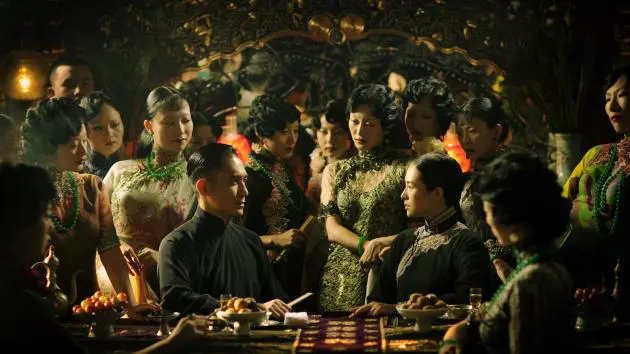
The film auteur’s distinctive aesthetic, along with cinematographer Philippe Le Sourd, make the martial arts epic elegant – something that sets it apart from its action-rich counterparts. Not to say fight scenes are less fierce in “The Grandmaster”, but the way they are delivered clearly carries a style, ambience and taste of the era.
The main characters in the film are legendary Wing Chun master Yip Man (Tony Leung Chiu-wai), who was also mentor to Bruce Lee, and Gong Er (Zhang Ziyi), daughter of the Gong family that is known for combining two schools of martial arts, Xingyi and Bagua.
Yip Man and Gong Er first see each other after Yip defeated Gong’s father at a martial arts contest. Gong sees this as an unacceptable failure and sets out determined to save her family’s face. She invites Yip to a dinner banquet, except it is essentially another martial-arts challenge, which ends up giving both of them a sense of mutual appreciation, just like the Chinese proverb “From an exchange of blows friendship grows.”
Here comes what Wong excels at the most – the delicate illustration of repressed sentiments. Yip is a happily married man and Gong is an engaged woman. But they are also two martial-arts practitioners who see each other as confidants, a base by which their appreciation for each other grows. However, the era they live in prevents them from developing their sentiments into something more. What they can do is exchange letters and tokens of fondness such as a coat button or a box of burned hair. This is an alternative and smart way to say: We are all products of our time.
Wong succeeds in representing the martial-arts community, as well as how and what people live by and their philosophy of life, which is the ultimate goal of “The Grandmaster”. Nonetheless, his talent is less apparent in handling the peripheral roles, which perhaps were not supposed to be peripheral in the first place.
In addition to Wing Chun, Xingyi and Baqua, there’s another school of martial arts which forms a storyline in the film: Bajiquan. This style is subtly represented by master Razor, played by Chang Chen. Yet this storyline goes on somewhat quietly, showing little relation with the other two. What seems more bizarre is the fight scene between Chang Chen and Xiao Shenyang, who plays a young mobster engaging in a protection racket at Razor’s barber shop. The fight feels comical, making you wonder why it is in the final cut of the movie.
After the movie’s world premiere earlier this month, Wong told the press that he planned to tell more about Razor, but unfortunately he couldn’t fit more in the final version due to the limited running time. Other characters that don’t earn much screen time, but whose appearances are still impressive, are Chinese actor Zhao Benshen, who plays a wise consultant to Gong Er’s father; and Korean actress Song Hye-kyo, who plays Yip Man’s silent but affectionate wife.
In the end, we’re left with a Wong Kar-wai martial-arts epic, showcasing everything it takes to be a grandmaster and more.
