
Three men and a toilet


Hong Kong play tackles the issue of urbanisation so rapid that it goes beyond the humane
Travelling on the Airport Express train from Hong Kong’s Chek Lap Kok airport to the city centre, I was once again amazed at the number of new residential buildings going up in the New Territories. Here too, just as in Kowloon and Hong Kong, there have been protests against the demolition of historic buildings but the bulldozers march on, the dissent unheeded. If China is currently the land of opportunities, then its Special Administrative Region, currently the world’s most expensive city, is on the tip of it.
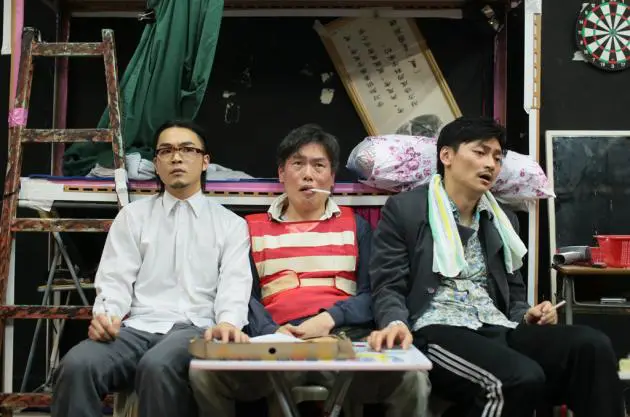
Presented as part of the 41st Hong Kong Arts Festival, young playwright Wang Haoran’s “Blast” depicts what life is like in those residential buildings through three single men who share a small room with a triple-tier bunk bed. The word “roommate” is almost synonymous with “bedmate” as personal space is virtually non-existent, notwithstanding the curtain on each tier that’s drawn when its occupant is sleeping.
On the top tier is Wang Weibo, a new university graduate who’s about to lose his job. The middle bunk is occupied by Wang Xiaobo, a middle-aged con-artist who recently immigrated from the Mainland while the bottom is home to a senior pizza delivery man named Wang Dabo, who’s in trouble with his wife following the disappearance of their daughter.
I enjoyed the playwright’s humour in having all his characters, each of whom has almost equal dramatic weight, share his family name – none are related – as much as the performance by the three actors who made them credible.
While the main dramatic action takes place in this small residential unit, the door on the right allows the character to exit to the outside world and that on the left reveals the toilet with the bowl in full view. A theatrically stylistic touch is the presence of a mysterious woman, who roams around the space yet neither utters a word nor enters their room. The play reaches it climax when Dabo reveals dozens of pizza boxes underneath the bed he has just decided not to deliver.
“Blast” is an example of a contemporary play with specific local issues that have universal relevance and hence can be understood by an international audience. I really wish a Thai playwright would reflect opinions about Bangkok having many more cars than can actually be driven, and the amount of time we spend in them.
“Blast” is the young Hunan-born, Shenzhen-raised playwright’s graduation work for his Master of Fine Arts degree, which he finished with distinction at the Hong Kong Academy of Performing Arts last year. Wang writes in the programme that the festival “does not fear they may not recoup a penny by staging my play”. In fact, the play, performed in Cantonese and Putonghua with Chinese and English surtitles, struck the right chord with the local audience and an extra performance was added to the previously scheduled six at the Hong Kong Cultural Centre’s Studio Theatre.
This not only shows HKAF’s continuing effort in promoting local works on its international stage, but also how the 41-year-old festival is building the bridge between the academic and professional worlds. The festival also publishes these new scripts. And this, of course, is another example festivals in Thailand can follow.
NEXT YEAR
The 42nd Hong Kong Arts Festival is scheduled for February 20 to March 23, 2014. Highlights will be announced in August and booking can be made as early as October.
So far, the festival has the Savonlinna Opera Festival production of “Lohengrin” by Richard Wagner, the Budapest Festival Orchestra led by music director Ivan Fischer and Maria Joao Pires with the Scottish Chamber Orchestra.
For more details, visit www.HK.ArtsFestival.org.
