
Clooney's heroes


Play
The smooth star works on both sides of the camera for a movie about the men who rescued stolen artworks from the Nazis
It was an art-pillaging rampage such as the world had never before seen. With the advance of German forces in World War II, the Nazis began stealing paintings and sculptures on a gigantic scale.
More than five million works of art were rounded up from museums, churches and private collections – names like Vermeer, Michelangelo and da Vinci among them.
On orders from Adolf Hitler, Marshall Hermann Goering was to build a “Fuehrer Museum” in Linz, Austria. Only after war’s end in 1945 were most of the works returned – largely thanks to a group of art historians and curators who helped find and secure the stolen art.
The history of these “monuments men”, as the roughly 350 men and women from 13 countries were dubbed by the military, is told in a book by American author Robert M Edsel.
“The Monuments Men: Allied Heroes, Nazi Thieves and the Greatest Treasure Hunt in History” reads like something between an educational book and a mystery novel.
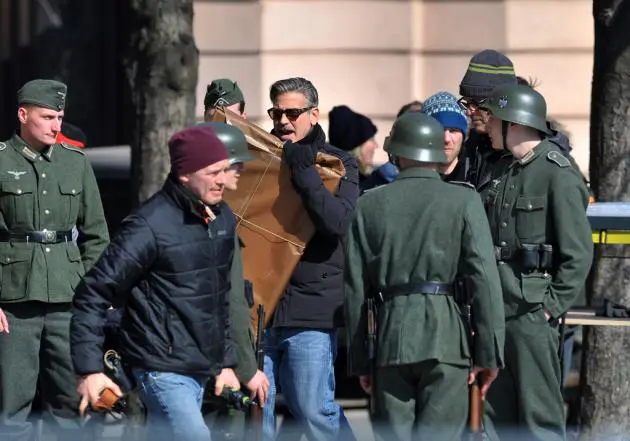
Actor-director George Clooney was quick to see the potential for a feature film and is now in Germany, shooting the movie in Berlin and nearby Potsdam.
He is also playing the lead role, that of art historian George Stout.
With a thin moustache and a revolver at his hip, the man on the cover of Edsel’s book looks like a mixture of Indiana Jones and Ernest Hemingway. Stout was an expert in preserving and restoring art.
Before the war he was involved in working with threatened works at Harvard University’s Fogg Museum and had contacts with museum experts the world over.
In January 1943 he reported for military duty in hopes of helping to rescue the art casualties of the war. But first the military put him in a unit doing experimental work with camouflage for aeroplanes.
It was only thanks to pressure by US museum directors that a special unit was created. US President Dwight D eisenhower said it conducted a “battle that serves to protect our civilisation”.
Stout was named mission coordinator and it would become his life’s work. “What happens if we win the war but lose the last 500 years of our cultural history?” he asked.
Among his helpers was James Rorimer, the curator at the Metropolitan Museum of Art in New York who would become its boss after the war. Another was German Harry Ettlinger, a Jew who fled to the US to escape the Nazis. He returned to his home country as a US Army soldier, using his German fluency to serve as an investigator.
What’s unclear is what powers the unit actually had. US generals were not keen about being given advice by art historians. Starting after the Allies’ conquest of Sicily, Stout’s men travelled with US forces advancing northwards.
Members of Stout’s unit were also there at the D-Day invasion of Normandy in June 1944. In German-occupied France, the artwork rescuers relied on a network of informers that reached all the way to the head of the Louvre museum.
Whether by sheer courage or finesse, or both, they succeeded in finding the trail to stolen works of art. The trails would lead to a salt mine in Altaussee in Austria, where Jan van Eyck’s Ghent altarpiece and Michelangelo’s sculpture, the Madonna of Bruges, were among the items hidden.
