
Building Branches in the Brain
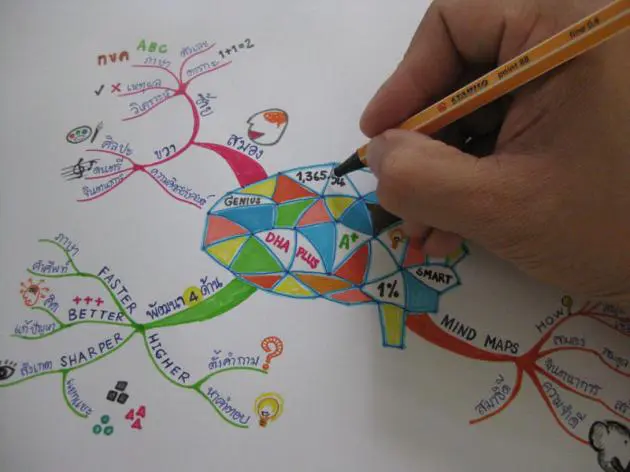


Mind mapping expert Tony Buzan drops into Bangkok to offer advice on developing |young minds
When noted thinker Porphyry of Tyros graphically visualised the concept categories of Aristotle back in the third century, he unwittingly gave birth to a notion that would become a trend some 1,700 years later.
The Mind Map, as it’s known today, was further developed in the 1950s and ’60s and the new form of the graphic technique that uses a combination of logic and creativity to unlock the potential of the brain was popularised by British psychologist Professor Tony Buzan in the 1970s.
This weekend, Buzan will be in Thailand to explain the mind map theory as part of the “Enfa Brain Expo Mind Maps” exhibition being held at Central World Live on the eighth floor of Central World.
Blair Sailes, general manager of Mead Johnson Nutrition (Thailand), the organisers of the event, says Buzan will be demonstrating how mind mapping unlocks and enhances the potential of children’s minds through intensive, interactive learning sessions.
Dr Pongsak Noipayak, a developmental and behavioural paediatrician at the Faculty of Medicine Vajira Hospital, Navamindradhiraj University, explains that the human brain consists of one hundred billion brain cells, linked by cranial nerves that transmit at lightning-fast speeds. Yet kids use just one per cent of their neural pathways to learn a new concept or idea.”
“Regularity and nutrition are key factors that impact a child’s potential. The current learning environment focuses on rote learning and does not encourage children to have strong critical and integrated thinking skills. Consequently, the child’s left brain tends to dominate the right brain, influencing talents like artistry, imagination and creativity. If children do not practice using the left and right brain together, brain cells will not be fully engaged,” he says.
With mind mapping, a child can translate an idea into words, pictures, and colours, thus stimulating the brain into employing logical and creative thinking equally, a very useful skill for advanced creative thinking. The brain processes images quicker than words and data, making pictures an extremely useful tool in improving memory skills.
The Mind Maps principle can be adapted for use with all ages. The first 1,365 days of a child’s life, from pregnancy to three years of age, is the crucial period for mental development, as 80 per cent of the brain develops during this time. Parents should create multi-faceted learning environments for children during this crucial period, and using a mind map is one of the most effective ways to ensure their child develops a highly functioning and well-rounded brain.
Dr Patana Chutpong, a lecturer at the Preschool Education Association of Thailand describes mind maps as a technique that lets children generate and analyse the ideas, starting from the central idea, and splitting into sub-branch categories.
“When children see their ideas through pictures, they can link that information in the mind map, thus helping them solve problems or come up with new creative ideas. This mind map harnesses the balanced connection of the left and the right brain – words, images, numbers, logic, rhythms, colours and spatial awareness – in a powerful way,” she says.
Parents can apply mind maps to everyday activities to improve their child’s concentration, memorisation, planning and creative thinking skills. Using pictures is especially helpful for parents with babies and toddlers who have not yet learned to read. For example, by pasting your child’s favourite fruit in the middle of a sheet of paper and linking it to colour or taste, you are able to create associations in the brain that help your child learn about food.
Changnoi and Witsata Kunjara have used mind maps with their two daughters, Ara and Irin, and are pleased with the results.
“We wanted a suitable technique to enhance our children’s development, and we chose to use mind maps. We started with simple routine activities like the things they needed to put in their school bags. We drew pictures using colours to distinguish items, then we tried to connect them with a drinking bottle and books. We also do mind mapping with basic life skills, such as bathing, brushing teeth and drinking milk so that the kids develop a better understanding.”
