
A glimpse into the abyss


Play
Japan's Shugendo practitioners seek the experiential truth of Buddhist teachings in Wakayama's sacred mountains
For centuries, the ancient spiritual fortress of Tomogashima was off-limits to ordinary folk. The Buddhist monks who came here in search of enlightenment took an oath of secrecy, vowing not to reveal details of their Shugendo practice.
Their path here in these mountains was steep and ascetic. Shugendo aims to gradually build spiritual power, culminating in a sudden “awakening” to the true relationship between humanity and nature.
The founder of Shugendo, Buddhist monk En no Gyoja, is said to have arrived here in the 7th century. Tekking through the forested valleys and climbing rocky peaks, he laid a “path of training and testing” that is followed to this day.
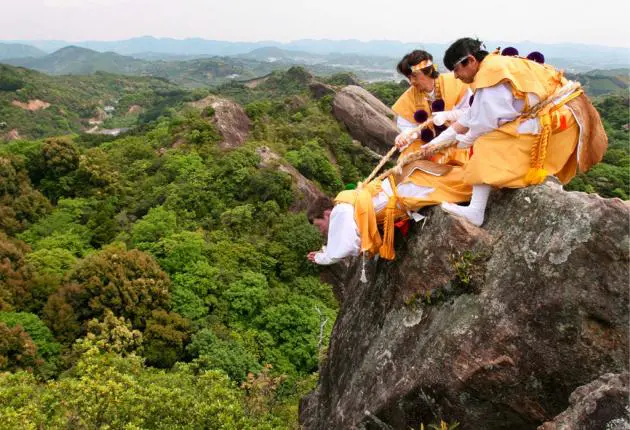
Shugenja, as the practitioners are known, still arrive here every year to undergo pilgrimages involving challenging tests of courage and devotion known as shugyo.
These take place on mountain treks, with each Shugenja gradually rising in “rank” within the sect with every passing year.
The rituals are kept secret from neophytes and the outside world. This helps to inspire a fear of the unknown that tests the faith of newcomers as they embark on their austere journey. The same fear also serves to keep spiritual dilletantes away.
As with other non-conformist sects, secrecy was also a necessary protection in the past, borne out of persecution and oppression of followers by ruling powers. Many modern shugenja maintain a reluctance to speak out about their involvement in the practice.
These days, the once-forbidden islands are growing in popularity as a tourist destination. But most visitors are lured by their military history.
Tomogashima stands at the entrance of Osaka Bay and was used as a fortress during the Edo period (1603-1867). The military also set up batteries on the island in the Meiji era (1868-1912) to prepare for attacks by foreign warships.
In the end, no battles were fought here, but the islands are still dotted with remnants left by the Imperial Japanese Army.
On Okinoshima, the path cut by the military through the laurel forests has become a good hiking trail. The cool shade of the dense, dark trees gives me just a taste of the elemental bliss said to be experienced by shugenja.
As it is a weekday, once the last ferry of daytrippers departs, the island sinks into silence.
A herd of deer appears from somewhere and begins to graze.
There are no year-round residents on Okinoshima, but three Japanese-style inns are open during the tourist season as the island has good fishing spots and a lighthouse.
About 20,000 people visit each year.
As Tomogashima has no public water supply, visitors are required to conserve water.
Using conservation as an excuse, I opt for saké at one of the island inns, and drink a copious amount to wash down a side of fresh sea cucumber and octopus. My mood is further enhanced by the star-studded night sky and the sound of the surf lapping in the distance.
Next day, I take the boat from Okinoshima to Torajima, where traces of Shugendo rites abound.
I scramble across a steep rock face to visit my first pilgrimage site, a cave. Panting, I edge out of the entrance and along the cliff, in search of the sutras said to be inscribed on a rocky shrine here. I find them, but am sweating hard – partly from the exertion but also from the fear of falling. Shugendo is living up to its reputation as a challenging and sometimes scary practice.
The basic training course includes climbing rock faces, descending precipices by rope, and other challenging activities. I highly recommend that visitors study the content carefully before attempting it.
After my brush with Shugendo, I take a ferry back to Kada Port on the mainland and head to Mukai House, which once provided accommodation to ascetics en route to Tomogashima for training.
Yoshiko Mukai, 74, welcomes me, and I follow as she trots nimbly up the hill to show me the shrine where the remains of En no Gyoja lie.
Compared with the treks deep into the mountains undertaken by experienced shugenja, the Tomogashima course is a picnic, Mukai tells me.
I instantly awake to the truth that enlightenment is still a long way off for me.
