
Essence of the women
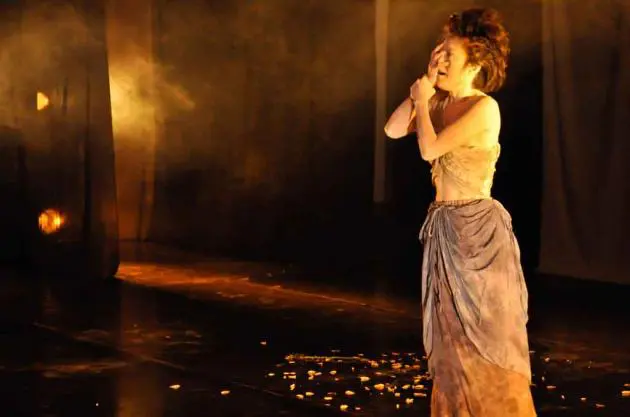


An International roster of female performers demonstrate different styles of Japan's butoh
The eight edition of the International Butoh Festival Thailand organised by Butoh Co-Op Thailand, B-Floor Theatre and the Bangkok Art and Culture Centre wrapped on Sunday with performances by women from Hong Kong, Japan, South Korea, Malaysia and Thailand.
Programme A, the more conventional of the two, started with “Womanities”, a solo performance by B-Floor Theatre’s Sasapin Siriwanij who transformed herself, physically and spiritually, into a professional butoh performer. Almost entirely in silence and on the ground, her movements spoke loud and clear and proved that even though “being a woman is an amenity”, as she wrote in the programme leaflet, women are still suffering in many male-dominated societies.
The second show, “Jump Jump Jump”, billed as “a collaboration by four artists from four different countries”, was nothing of the sort.
Japan’s Yuko Kawamoto, Korea’s Natalie K Kim, Malaysia’s Yeow Lai Chee and Hong Kong’s Vinci Mok shared the stage for just the first and last scenes and the remainder of the performance was devoted to their solos plus one duet. The duet wasn’t exactly collaborative either, with both Kim and Mok staying in their individual spheres. Perhaps they need to spend more time together in one place and also hire a director to help unify this work.
In the more contemporary and more fulfilling Programme B, for which the performers didn’t put on white powder and wore normal dresses, Bo Kittiphon restaged her solo “Whispers of the Shadow of a Quivering Leaf”, which premiered in March at B-Floor Room. On this larger stage, she was able to play more efficiently with rays of light and patches of shadow, created by swathes of cloth hung from the ceiling, and the switch of mood and tone towards the end was effective and uplifting.
Berlin-based Yuko Kaseki delivered the highlight of the festival with her solo “Unspelled.” She didn’t restrict herself to butoh but blended different styles in order to convey her emotions and messages clearly to the audience. Like Bo’s strips of cloth, Kaseki’s plastic bags in various colours, were a form of installation art. These lifeless objects, to which the audience could instantly relate, were given life by the performances and evolved from decorations or accessories into different characters and powerful images that provoked thoughts about the women of today.
Both of these works, unlike those in Programme A, clearly demonstrated the extent to which butoh has developed into a universal art and is already an integral part of contemporary dance.
Notwithstanding the studio’s low ceiling and limited equipment, lighting designer Pavinee Samakkabutr and her team managed to create a visual space that further enhanced the meanings of each work.
Looking around last weekend, it seemed evident that the only audiences for Butoh in Thailand are foreign expats and Thai artists working in related fields.
If butoh performances were scheduled as part of larger contemporary dance and theatre festivals, the way they are now in most countries, the audience would cross over, the way this dance art is doing, and expand as well.
With “Butoh Women”, BACC’s second Performative Art Festival also came to a close. Since early November, the reconfigured fourth-floor studio has been hosting various styles and genres of dance and theatre – evidence that BACC is now another major venue for performing arts and offering an opportunity to experience visual arts and performing arts under the same roof.
DANCING IN THE DARK
Find out more on Facebook by searching for “The International Butoh Festival Thailand”.
