
A little fish with a few big surprises


Play
How the humble zebrafish is helping scientists develop treatments for certain cancers
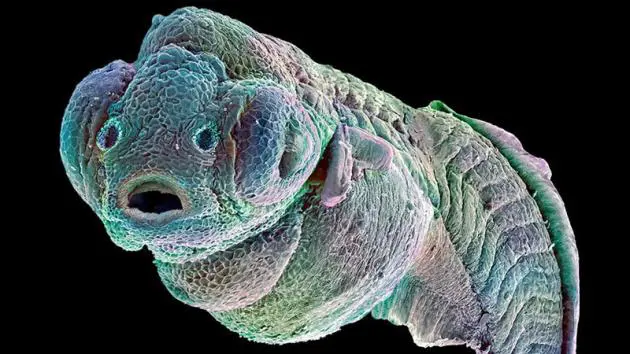
WHEN I first see the photo on the BBC website, I guess it’s a close-up of a parasite of some kind. “Anything so ugly has to be evil,” I think.
How wrong I am! The photo, a winner of the 2014 Wellcome Image Awards, shows a close-up of a zebrafish embryo, scanned with an electron microscope by Annie Cavanagh and David McCarthy.
Anyone who keeps fish should know zebrafish. You can find these pretty, striped fish in any aquarium shop in Bangkok. Easy to keep, small and friendly (well, friendly for a fish), zebrafish are perfect as “starter fish” for the first-time fishkeeper. They live very well on ordinary fish food flakes and tubifex worms.
Sometimes called “Danio rerio” or “zebra danio”, zebrafish are found in the wild in the southeastern Himalayan region, in parts of India, Pakistan, Bangladesh, Nepal and Burma. I’ll bet you can even find it in streams, canals and rice fields in Thailand too.
It’s such a tiny fish – only around four cms in length – and it doesn’t live very long in captivity, only around two years.
Yet it’s become a favourite of scientists in all sorts of fields. Who wouldn’t love a fish that has the ability to regenerate fins, skin, heart and in the larval stages, before it’s even become an embryo, the brain. It can even regenerate certain cells in its eyes.
“That’s wonderful for the fish,” I hear you say. “I wish humans could do that too.”
Well, humans don’t have those regenerative abilities yet, but slowly, they’re on their way.
Here’s the problem: scientists have already “mapped” the 20,000 or so genes in the human body. They just don’t know what all these genes do.
The zebrafish, though, is helping us figure our genes out. According to Derek Stemple, head of mouse and zebrafish genetics at the Sanger Institute in the UK, about 70 per cent of human genes have a zebrafish counterpart. The number rises even higher, to 84 per cent, in genes that cause disease in humans and that have zebrafish counterparts.
It doesn’t mean that the zebrafish is a close relative of ours (although 300 million years ago, we perhaps shared a common ancestor), but that scientists can manipulate the genes in a zebrafish and find out what might happen in a human.
They can even start with the zebrafish’s embryo and with young zebrafish. Since both are transparent, they can easily see what’s happening inside, without having to kill the embryo or the fish.
Zebrafish mamas breed every three months or so, and they can produce hundreds of babies at one time, which researchers appreciate. Fishkeepers (and researchers) have learned that the closer the living conditions are to those in the wild, the more babies are produced.
Since the mamas prefer very shallow water, you simply tilt one side of the tank so that the water is only a few centimetres above the sand. The mamas love that.
At first, researchers seem to have “played” around with the zebrafish’s genes, producing various colours of fish for the fish trade. They even developed a strain of zebrafish that glows in the dark.
As they’ve continued to map the zebrafish’s genes, though, results have had more serious outcomes.
So far, scientists comparing human and zebrafish genes have discovered human genes involved in causing forms of muscular dystrophy, and in human embryo development, and in heart physiology. They’ve even developed drugs that may in the future successfully treat skin cancer.
Lots more discoveries are waiting to be uncovered, all to the benefit of humans and thanks to the tiny zebrafish.
We’ve known these simple little fish for years – but we haven’t known them at all, have we?
