
The mind at rest


Play
Buddhist book translated into Vietnamese
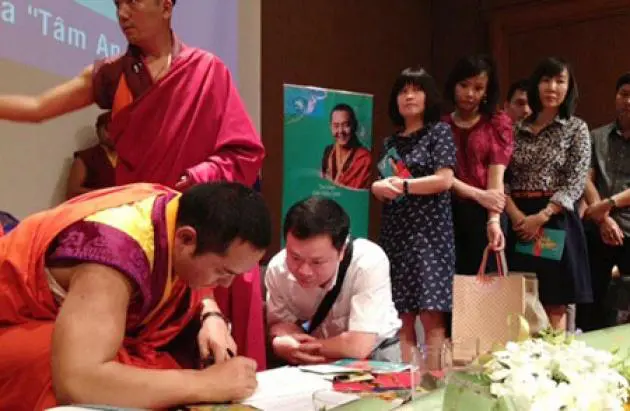
The Vietnamese version of “Tam An Lac” (“The Restful Mind”) by His Eminence Gyalwa Dokhampa, one of the most revered contemporary spiritual masters of Buddhism’s Drukpa school, officially hit bookstores last Tuesday.
Dokhampa was invited by Vietnam’s National Buddhist Sangha to launch the book as part of the celebrations marking the UN Day of Vesak 2014 and met Vietnamese Buddhists in Hanoi late last Tuesday.
The two-hour event, which ended up running for double the expected time, was attended by historian Duong Trung Quoc, secretary general of the Vietnam Association of Historians, and writer Nguyen Quang Thieu, vice chairman of the Viet N\\\\nam Writers Association.
Dokhampa is renowned for his understanding of the pressures of modern life and their impact on individuals. In “The Restful Mind”, he shows new ways to calm both the body and the mind, become more aware, deal with problems and appreciate moments in day-to-day life.
He also works to make Buddhist ideals relevant to modern life and emphasises that Buddhist principles can and should be integrated into everyday life, through service to others.
“Buddhism is not a religion, but rather a way of life to finding happiness,” he told the more than 300 participants at the event.
Dokhampa was born into the family of His Holiness the present Gyalwang Drukpa, spiritual head of the Drukpa school, whose main centres are in India and Bhutan. He holds a Masters degree in Buddhist philosophy, was twice appointed as the Chairman of the Annual Drukpa Council and is currently in charge of spiritual guidance for Drukpa centres across Asia, including in Vietnam.
“I’ve been coming to Vietnam for many years. I love Vietnam’s culture and heritage, and recently I [have come to] love one more thing: the Vietnamese saying that ‘when you eat [an] apple, think of the person who grows it’,” Dokhampa said, paying tribute to his own teachers who had made the book possible.
“Due to the teachings of my great teachers, I have the confidence to understand that every experience of happiness and suffering does not come from the outside.”
“Whatever Buddhist teaching is, it is undeniably about the development of the mind. It’s logical that all experiences we go through, happiness, suffering, sadness, and so forth all come alive in our mind and our own actions.
“If you do not understand that we have no freedom,” he said.
Invited to share the stage with His Eminence Dokhampa, historian Quoc said, “Having read “The Restful Mind”, I can better understand the essence of Buddhism: tame the mind so that you can open up and receive the world.”
It is not far away from what our forefathers had taught, Quoc said, adding that Buddhism had accompanied Vietnamese people through many challenges throughout history, of which the Buddha King Tran Nhan Tong and the establishment of the Truc Lam school of meditation Buddhism are prime examples.
“Thus, what was taught in the books can be seen as part of the process of embracing modern values. They never depart from traditions, they adapt to changes in society and are still in line with the ultimate goals of Buddhism. All practices start and end with the mind. Keeping the mind restful means keeping the values of both your spiritual path and life.”
