
Five glorious decades with Inson


Play
Adventurous National Artist Inson Wongsam gets a well-deserved retrospective
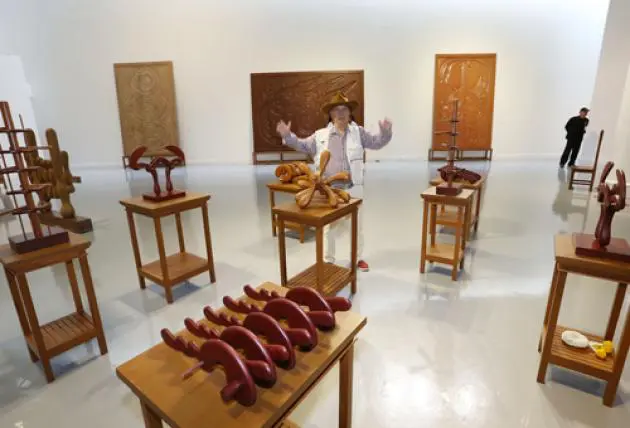
At age 80, National Artist Inson Wongsam is still in close contact with his muse. More than 100 sculptures, woodprints – and paintings, a more recent interest – are on display in the retrospective “Inson Wongsam: The Autonomous Spirit” at the Bangkok Art and Culture Centre, a record of supreme talent and high temperament since the early 1960s.
Transported from his own private museum in Lamphun, the works are among the thousands he’s made, new ones appearing almost daily. “It’s part of my life,” Inson told The Nation with considerable understatement and a hearty laugh.
Curator Tuksina Pipitkul has assembled a showcase of Inson’s adventurous life and art that can’t fail in its mission to further inspire the younger generation. Unfortunately some of his strongest works are absent, and the presentation is rather cluttered with so many pieces crowded in. The show is a jumble of chronological presentation and varying techniques.
But Tuksina is quite correct in pointing out that “the discovery in himself and his art has marked the history of Thai visual art”, and a graciously offered guided tour taught me a great deal more about his inspirations and philosophy.
“Like meditation, creating art makes my mind deeply peaceful and keeps me alive,” Inson explained as we walked among the exhibits. “Journeys also influence my work,” he said, pointing to large abstract images carved in wood in the early 1960s.
After graduating in 1961 from Silpakorn University, where he learned at the feet of Silpa Bhirasri, “the father of Thai modern art”, Inson set out to be a sculptor. He selected wood from his native Lamphun and rendered skilful abstracts, chiselling the lines on huge flat panels, almost like bas-relief.
“These are inspired by nature, Buddhist teachings and the freedom of my mind,” he said, standing before an enormous piece as impressive for its scale as it is for the wondrous surface and the meandering engraving etched into it. The explanatory note on the wall alongside says, “He realised that abstract art aimed to reflect the state of mind and reveal truth that is beyond senses.”
Inson earned fame of a different sort at age 28 by riding a scooter all around Europe. He spent 40 days, taking special delight in visiting Florence, Professor Silpa’s home city, and conducted art “happenings” everywhere he went.
The adventurous journey broadened his horizons and showed him his own path. It also provided inspiration for Navin Rawanchaikul, who’s become internationally known and has collaborated with Inson.
That scooter might have been part of the current exhibition, but instead the curator has opted to place photos from the journey alongside the Navin-Inson collaborations on the fifth floor.
Inson’s travels opened his eyes to Western art as well, but he’s always stuck to his Asian roots.
“While he was living in the US in the 1960s, Inson witnessed pop art, op art and performance art, but he insisted on abstract art,” Tuksina says. “He was incessantly drawing with black ink as a means of physically training [his hand] in harmony with his mind.
“Inson’s abstract art, such as the black-ink drawings and woodcut prints, are rooted in Eastern way of thought, especially the
concepts of purity, balance and human nature, and the constant flux of changes that are universal.”
Inson has always explored new materials. While living in New York he collected junk metal from the street and turned it into art. At the Culture Centre you can see his small “Sculptures under the Sea” created between 1986 and 1974.
“Every night I’d make a miniature sculpture depicting underwater scenery,” says Inson, who the Culture Ministry named a National Artist in 1999.
After 28 trips to Europe and the US, he was back home at age 40 and ready to assume his own path. His experience had opened a door that led within him. To this day he incorporates folk wisdom, with its profound connections to the natural world.
Along one curved wall is “Huay Fai”, made of the wooden posts that adorn Lanna-style houses. This one he made in 1974-77. Folk-art pieces nearly provide a contrast with the semi-abstract bronze sculpture “The Retractable Ones” from 1997.
The main room has a mix of old and new pieces. In one corner is a series of huge sculptures made from dried teak stumps hauled out of a forest. They stand as testament to Inson’s yearning for nature’s abundant purity and his wish for people to take better care preserving woodlands.
“I used various technique to shape the trunks and show the beauty,” he told me. “Each piece has its own unique pattern. Sometimes I burned them first and then crafted them. Sometimes I just lightly crafted them.”
There is less “crafting” now in his advanced age. He’s turned more to painting to express his feelings. “I’m older now, so I enjoy painting and drawings more.” Vivid abstract paintings share wall space with prints, both alive with patterns drawn from nature that are even, in some cases, transferred to batik and jewellery.
Wachara Kanha is another younger contemporary artist inspired by Inson. He’s made videos that are shown amid the master’s paintings and sculptures, a biographical tribute to him and his quest for self-discovery.
ON YOUR SCOOTER
“Inson Wongsam: The Autonomous Spirit” runs until November 23 at the Bangkok Art and Culture Centre.
Inson’s prints, batik and jewellery are on sale in the centre’s shop on the fifth floor.
Find out more at www.BACC.or.th.
