
A glimpse into an unseen world


Play
The first zoo for microbes sets up house in Amsterdam
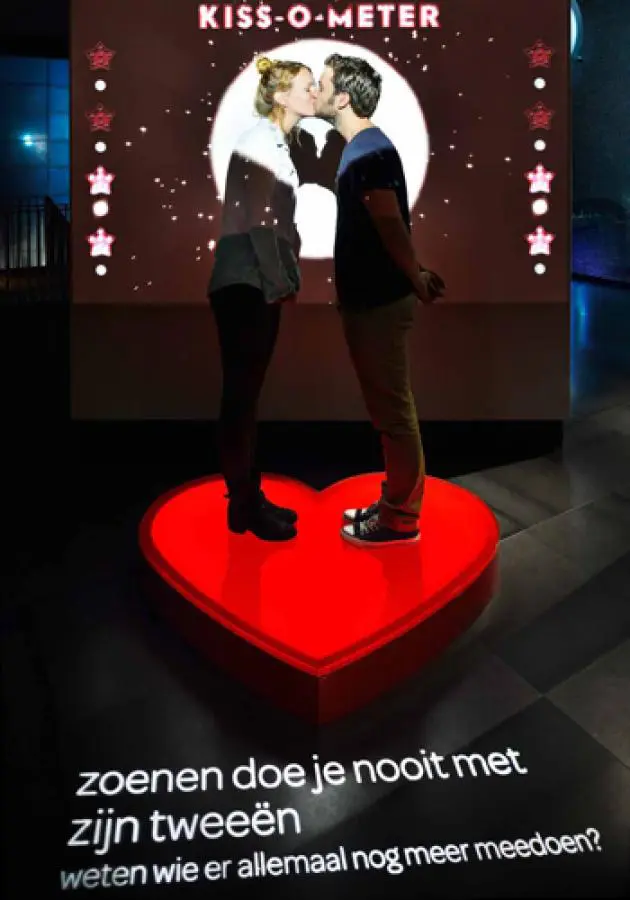
A red heart made out of plexiglass is lit up temptingly on the floor. A couple stands on it and hug each other tenderly. Their lips meet.
As the kiss goes on, a number on the Kiss-O-Meter, a screen behind them, rises until it proclaims: “You have just exchanged 1 million microbes.”
Admittedly the message is not particularly romantic but the kiss-o-meter is not part of a dating game, it is one of the eye-catching exhibits at Micropia, the world’s first zoo for microbes, which has opened in Amsterdam.
The city’s animal park Artis, founded 176 years ago and now one of the oldest in the world, is widening its remit to include the planet’s smallest and oldest life forms.
“We don’t want to be a reservation for dying species,” says Artis director Haig Balian. “We want to show that everything in nature is connected.”
An elegant grey box in a 140-year-old building at the zoo is now home to bacteria, fungi, algae and other one-celled organisms and animals invisible to the naked eye. Beings that made life on Earth possible.
Scientists believe that only around 1 per cent of these life forms are even known.
For many people, the mere though of microbes arouses disgust, fear or even the constant need to scratch.
“It’s fear of the unknown,” says Balian. Micropia aims to make this invisible world visible.
Of this Balian is convinced: “If we really want to understand nature, then we have to get to know microbes.”
That begins with one’s own body. “You are not alone,” whispers the cheery “Microman” in the video. Every person has billions of microbes on their bodies, something which every visitor to the museum can confirm themselves with a body scan.
“There are 80 different types on a person’s heel alone,” says Balian.
Micropia is an experience, a museum, a laboratory but also a zoo.
“We show how microbes live, feed themselves, and reproduce,” says Balian. But how is that possible? Bacteria are so small that a million will fit on the tip of a needle.
Microbiologists from Dutch universities have been puzzling over the concept for more than 12 years.
They chose organisms that could also survive in artificial atmospheres. Dangerous types such as the AIDS virus HIV are only shown as models.
Others are depicted in photos or films – their fantastic shapes and colours make them like works of art.
But some of the microbes can be seen alive, but of course a microscope is needed.
German design studio Art+Com has developed a 3D telescope that is connected to the lens of a microscope and allows the subject to be magnified a thousand-fold.
Now you can see crystal-like green stars in a water basin – green algae. With a sort of joystick you can move around the miniature landscape.
In one glass box a sort of worm made of green slime lies, apparently motionless. Physarum polycephalim – slime mould.
Through the 3D-lens the mass can be seen moving, looking for nourishment.
Virtual landscapes also show the extreme living conditions of some microbes – perpetual ice or inside the wrecked Chernobyl nuclear reactor, for example, places where no human could survive.
Much of this fascinating world is a puzzle, but one thing is clear, these organisms are extremely powerful.
The museum presents some unusual microbes as glass sculptures on pedestals, almost like rock stars. They include one spiked “worm” which twists around itself elegantly: It is the Ebola virus.
