
There’s an app for that
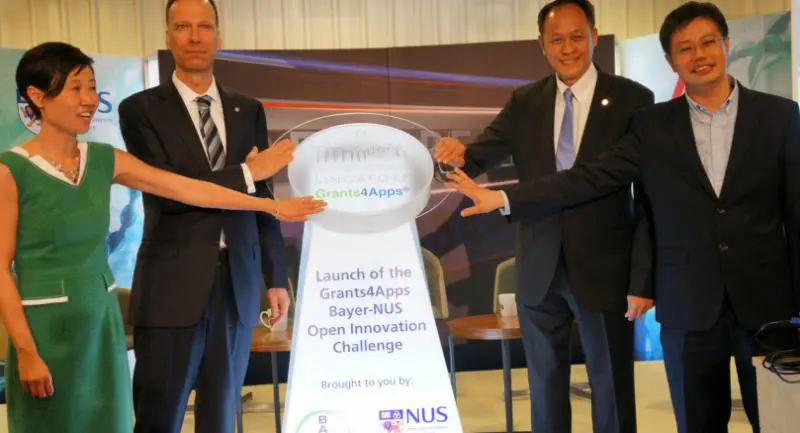


Bayer Pharmaceuticals addresses the problem of drug adherence in the elderly by launching the "Grants4sApps" challenge in Singapore
The latest report of the United Nations World Population Prospects estimates Thailand’s current ageing population at 16.4 per cent and predicts that it will reach 37.1 per cent in 2050. This rapid increase is also taking place all over South and Southeast Asian resulting in countless forums being organised to discuss the best ways of taking care of elderly residents. The latest of these, “Transforming Ageing with Health Innovation”, was held recently at the National University of Singapore and focused on the value of health innovations, including medications, in addressing these challenges.
The forum was organised by the NUS Enterprise, National University of Singapore (NUS) and Bayer and saw the launch of the inaugural Grants4Apps challenge in Singapore.
Dr Chuan Kit Foo, head of medical affairs for Bayer Pharmaceuticals’ Asia Pacific division, told participants that the region is facing a tsunami of elderly, with new reports suggesting that by 2050, a quarter of the population will be over 60. New medicines have been developed to help treat the most common disease found in older people including diabetes, high blood pressure and high cholesterol, but all this advanced medication will be useless if the elderly don’t take the medicines as prescribed.
Clause Zieler, senior vice president and head of commercial operations for Bayer Pharmaceuticals, added that 50 per cent of patients with chronic diseases don’t take their medication as prescribed.
“It’s become a major problem. So we want to do now is to reach out to you as a community as never before in a crowdsourcing type of way and get your very best ideas on how we can improve adherence to medication,” he told the crowd.
The Grants4Apps Bayer-NUS Open Innovation Challenge calls for innovative health tech solutions across countries in Asia-Pacific to improve medication adherence in the elderly with chronic diseases. It’s open to everyone in the region from healthcare professionals and caregivers to scientists, engineers, students, programmers, developers, start-ups and entrepreneurs. The challenge will select three winners who will each receive S$10,000 (Bt248,000) in financial support and access to mentorships from Bayer, NUS Enterprise and other industry partners, which will support them in advancing their project ideas and digital strategies for innovative technologies for doctors, patients, and consumers in the health sector.
The winners will also be eligible for incubator support from NUS Enterprise and be given access to the Modern Ageing Singapore business accelerator programme, organised by Access Health international and NUS Enterprise.
“We are looking for carefully thought- through or already started projects rather than ideas and not simply a reminder app,” Zieler said.
There is no restriction on platforms, operation systems or technologies and the applicants or their team should be able to develop and implement the proposed solution. Another criterion is that the solution can be developed into a minimum viable product in a short to mid-term timeframe of six months.”
Proposals should be submitted to the Grants4apps website. The submissions will be reviewed by Bayer and representatives from the healthcare system and the winning teams will be invited to join the development process
Bayer launched the programme three years ago in Berlin and it has since been expanded to Tokyo, Barcelona, Italy and Moscow. Singapore is the latest addition to the list.
The Grants4Apps Accelerator offers dedicated office space for 5 digital health startups at Bayer’s premises in Berlin to support them in further advancing their projects and business models.
The most recent winner of the Grants4Apps Accelerator was South Korea’s Vital Smith, a startup that focuses on developing innovative technology for diagnostics devices. Vital Smith presented “B bless”, a saliva-based smart ovulation tester designed for women that measures ovulation through a smartphone with a high degree of accuracy.
Riaz Buksh, general manager of Bayer Thai’s Pharmaceutical Division, says the problem of medication adherence is common in Thai seniors and is a major cause of morbidity. Bayer is aware that education in the risks of non-adherence is needed and should be given to patients, their family members and the wider public.
- Submissions to the “Grants4Apps Singapore” programme close on February 14, 2017. Up to five semi-finalists will be selected in early March for a final round of coaching and pitching, culminating in a Final Awards Ceremony in May.
- For more information, visit www.Grants4Apps.com/singapore/.
