
HRH Princess Sirivannavari Presides Over Royal Thai Costume Showcase in Tokyo
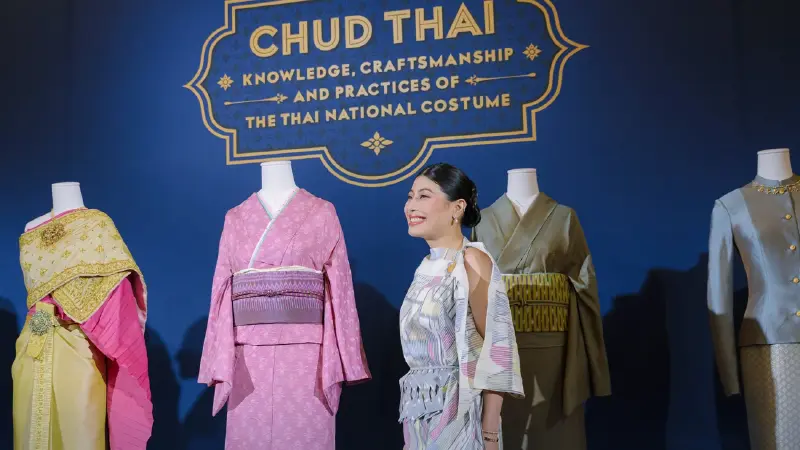


HRH Princess Sirivannavari leads a showcase of Royal Popular Thai Dresses in Tokyo, supporting efforts to secure UNESCO Intangible Cultural Heritage status
- HRH Princess Sirivannavari presided over a cultural fashion showcase of Royal Thai costumes at the Tokyo National Museum.
- The event featured eight styles of women's Royal Popular Thai Dresses (Chud Thai) and three styles of the men's Royal Pattern Shirt.
- The showcase is part of Thailand's official campaign to have its national costume recognized as a UNESCO Intangible Cultural Heritage.
- The presentation also included live demonstrations of traditional Thai craftsmanship, such as silk embroidery and jewellery making, to highlight the costume's living heritage.
HRH Princess Sirivannavari leads a showcase of Royal Popular Thai Dresses in Tokyo, supporting efforts to secure UNESCO Intangible Cultural Heritage status.
Her Royal Highness Princess Sirivannavari Nariratana Rajakanya presided over a cultural fashion presentation in Tokyo on 18th September 2026, showcasing eight distinct styles of Royal Popular Thai Dresses (Chud Thai Phra Ratcha Niyom) alongside three styles of the men's Royal Pattern Shirt (Suea Phra Ratchathan).
Organised by the Department of Cultural Promotion under Thailand's Ministry of Culture, the event—titled "CHUD THAI: KNOWLEDGE, CRAFTSMANSHIP AND PRACTICES OF THE THAI NATIONAL COSTUME"—was hosted at the Hyokeikan building within the Tokyo National Museum.


The showcase presented live craftsmanship demonstrations of high traditional Thai jewellery and artisanal techniques, including:
Gold wire wrapping (phandin) and intricate jewellery creation
Traditional silk embroidery (sadung-krueng-mai)
Gold and silversmithing
Fabric bags featuring ancient gold-pasting techniques (pra-khob-thong)
Auspiciously pattern-woven silk
Presented through a contemporary design lens, the exhibition framed these crafts not merely as static historical artefacts, but as a dynamic, living cultural heritage that continues to evolve.

Royal Foundations of Thailand's National Costume
The global presentation of Chud Thai originates from the royal vision of Her Majesty Queen Sirikit The Queen Mother, who dedicated herself to preserving Thailand's artistic and cultural legacy—most notably its national costume as an emblem of Thai identity.
Through systematic research into historical court attire across the Sukhothai, Ayutthaya, and Rattanakosin eras, Her Majesty commissioned historians and fashion experts to establish standardised dress guidelines for Thai women.
This resulted in the creation of the contemporary "Royal Popular Thai Dresses"—a versatile, elegant, and culturally appropriate wardrobe tailored for modern societal contexts and official duties.


The eight distinct styles of Royal Popular Thai Dresses are named after residential halls and throne buildings within the Grand Palace and Dusit Palace:
Chud Thai Ruean Ton
Chud Thai Chitralada
Chud Thai Amarin
Chud Thai Boromphiman
Chud Thai Dusit
Chud Thai Chakri
Chud Thai Siwalai
Chud Thai Chakkraphat
For men, three styles of the Royal Pattern Shirt (Suea Phra Ratchathan) were introduced—comprising short-sleeved, long-sleeved, and long-sleeved with a sash options—symbolising dignity and the historical evolution of Thai attire.

Cultural Diplomacy and Pierre Balmain Collaboration
Her Majesty The Queen Mother famously utilised Royal Popular Thai Dresses as a instrument of cultural diplomacy, projecting Thailand's international image during official state visits across the United States and Europe in 1960.
These royal visits led to a historic creative collaboration with French couturier Pierre Balmain, who combined traditional Thai silk with haute couture tailoring, elevating Thai textiles onto the world fashion stage.

Royal Advocacy and UNESCO Inscription Campaign
Building directly upon Her Majesty Queen Sirikit’s legacy, HRH Princess Sirivannavari has actively driven the modernisation and global promotion of Thai textiles.
Through her "Sustainable Fashion" and "Pha Thai Sai Hai Sanook" (Thai Textiles for Every Everyday) initiatives, the Princess has worked alongside local weavers and artisans nationwide to introduce modern pattern designs, encourage eco-friendly natural dyes, and generate sustainable local economic development.
Her contributions to cultural preservation earned Her Royal Highness a UNESCO commemorative medal in 2025.

Simultaneously, the Thai government and the Ministry of Culture have mounted a dedicated campaign to secure international recognition for the national dress.
Following a Cabinet resolution in March 2024 approving the submission, "Chud Thai: Knowledge, Craftsmanship and Practices of the Thai National Costume" was formally nominated to UNESCO.
The proposal will be officially reviewed for inscription on the Representative List of the Intangible Cultural Heritage of Humanity at the 21st session of the UNESCO Intergovernmental Committee, scheduled for December 2026 in Xiamen, People's Republic of China.

