
Noodles from the poe


A poe is a big terracotta stove - one of many things you learn touring Phuket's Thalang Road
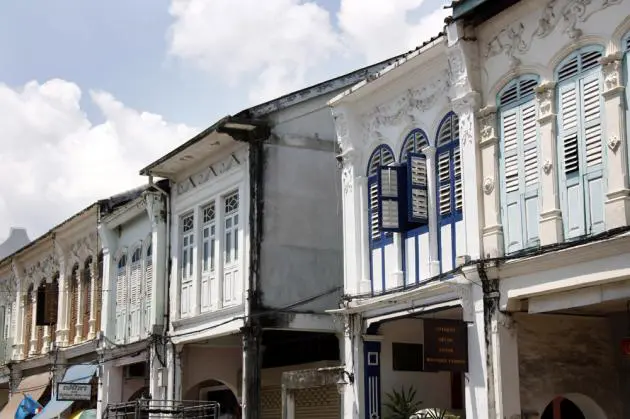
Thalang Road in Phuket Town sure packs a lot of rich history, Old World charm and cultural diversity into its 450 metres. The venerable commercial centre is lined with impressive Sino-Portuguese architecture.
The Portuguese and the British left their imprints on the island when they came to harvest tin in the 16th century, and the Chinese did the same 200 years later.
Thalang Road has a continuous stretch of more than 140 shophouses, some of them beautifully restored and many still inhabited. City workers recently put all the telephone lines underground too, vastly improving the street’s appearance.
You can explore the area on your own, of course, but it’s best to tap the local knowledge and sign up for a two-hour walking tour with the Old Phuket Town Community. It costs only Bt150.
Members of the community have been showing it off for the past three years, taking pride in the way it’s been preserved with sustainability in mind. The tour includes glimpses of neighbourhood customs and visits to significant private residences – “insider views” you couldn’t possibly get if you wander around on your own.
The southern heat and long rainy season meant that traditional Sino-Portuguese row houses always had front verandas. These ngor nga kee linked together, without gates, to form a walkway sheltered from the sunshine and downpours.
The buildings boast intricate European neo-classical and Renaissance-style details in the stucco columns, cornices and arched window frames. The interiors blend of Chinese and European touches, with wooden furniture beautifully carved in the Chinese manner.
The Architect Society of Thailand bestowed its Conservation Award on the 70-year-old home of the Thavornvongwong family. Its Chinese-style entrance resembles a dragon’s visage, meant to enhance the occupants’ creative powers. The double-layered hardwood door has windows for the eyes, ventilation slats as eyebrows and a peephole that slides open.
Conventional shophouses are about five metres wide and extend back some 50 metres. This one, though, is an astounding 180 metres long, allowing ample room for the family of 12.
Still, it matches the usual layout, with a living room up front, ideal for greeting guests, then the large and open-air central jim jae, a multi-use area with a well.
Despite having no roof, the jim jae is the heart of the house, where the washing was customarily done but also a place for recreation. It’s common today to see the jim jae turned into a garden.
Behind this is the kitchen, and upstairs the private family quarters with bedrooms.
Owner Wanna Boonrom has a partition between her front living room and jim jae that’s made of fancy latticework. The idea was that the women of the household could discreetly assess the suitability of callers.
“We spent Bt2 million getting the house back in good condition,” Wanna says. “The work was only completed two years ago.”
Across the road is the century-old Baan Hin Mor, with a grocery shop out front and, deeper inside, a jim jae with a poe – a hefty clay stove complete with a storage compartment for charcoal. You need a poe stove if you want to make Hokkien-style noodles the right way.
A large earthenware water jar keeps dried ingredients safe from hungry insects.
Next door is Nguan Choon Tong, Phuket’s oldest purveyor of traditional Chinese herbs, in business for 100 years and currently run by the founding family’s third generation.
The community has a Chinese shrine, and also Sikh and Buddhist temples, a Muslim mosque and a Catholic church.
“It’s a mixed-up place, but we live in harmony,” says resident and tour guide Punthip Saereepongsakorn. “It’s an example of living peacefully that we’re all proud of.”
The Christian Assembly features an antique floor clock bearing the royal jor por ror at the top, signifying Rama V. King Chulalongkorn, says Punthip, “knew how to accept newcomers from different religions. He gave the Christian Assembly this clock as if to indicate that he would look after foreigners – but don’t try and force Christianity on him.”
The Hokkien-Chinese Tan Luan Jae family erected the nearby Sang Tham Shrine in 1891 and it was fully renovated in 1999. Its design evokes the homeland, including terracotta roof tiles and propitious symbols used as elegant decoration. The interior walls bear a series of murals called Si Yin Gui.
Visitors’ tired feet are soon enough directed toward a shop where the locals serve coffee, tea, soft drinks and some of Phuket’s wonderful sweets.
Ar por is a crepe made with rice flour, coconut milk, sugar and egg. Ban chian kaoy is a spongy pancake of wheat flour and eggs, dusted with sugar and ground peanuts. Iew peung is glutinous rice cooked with pork, dried shrimp and boiled egg and nestled with mung-bean paste.
Refreshed, we’re off to – a restaurant!
Supat Promchan runs the charming China Inn. She was raised in town and had always been fascinated with this particular building, so she rented it and spent more than Bt3 million and two and a half years on its restoration.
Old Phuket Town also has Krabi Road, with another marvellous house owned by Luang Anupat Phuketkarn, an ancestor of the Hongyok family. Dentist Atthaporn Hongyok now lives in the twin connected houses that used to be headquarters for both a mining-supplies firm and a Phuket-Trang sailing business.
The residence is 80 metres long and boasts floors of English ceramic tiles, Chinese wooden furniture and intricately carved latticework. Most striking of all is a wooden spiral staircase erected with mortise-and-tenon joints.
In this neighbourhood of Old Phuket, at least, the good old days have never ended.
(The Cape Panwa Phuket financed the writer’s trip.)
HISTORY STROLL
<< The Old Phuket Town Community tours for a minimum of five people last two hours. The itinerary occasionally changes. The fee is Bt150 per person and includes that refreshment break.
<< Make arrangements with Yindee Manosoontorn at (083) 590 4828 or Punthip Saereepongsakorn at (081) 693 1938.
