
Diversity in the White City


Play
Tel Aviv remains Middle East's theatre capital though perhaps not a theatrical empire
Despite the political climate, I can never turn down an invitation to join the “International Exposure of Israeli Theatre”.
This month’s visit was my third trip in six years. Organised by the Ministries of Foreign Affairs and Culture and Sport in collaboration with the Hanoch Levin Institute of Israeli Drama and the Israeli Council of Culture and Art, the four-day trip took international producers and journalists to watch 15 theatre productions in nine venues across Tel Aviv, Jaffa and Haifa. I call it my performing arts boot camp, and just as in Avignon or Lyon, I enjoyed every minute.
Veteran playwright and actor Roy Horowitz, who heads the programme’s artistic committee, considers Israel a real theatrical empire, and asked us to compare it to Broadway and the West End. “In Tel Aviv alone, we have around 50 different shows every evening, mostly performed to full houses and in 2010, more than five million tickets were sold here,” he told us proudly.
I wouldn’t call it an empire, mostly due to the fact that it’s more difficult to reach than New York and London though I do agree with Horowitz’s description of Israeli theatre as “very intense and multi-faceted”. The range of theatrical activities is truly massive, ranging from standard spoken plays to physical theatre and to visual theatre and performances with multimedia staged in large playhouses to small warehouse cum performance space. Content too is very varied, going from religious, social and, of course, political all the way to farces designed to make the audience laugh and nothing more.
As it was undergoing major renovations during my earlier trips, this was my first time at the Habima National Theatre, established, interestingly enough, as a Hebrew-speaking theatre in Moscow before being moved here in 1928. “We had a national theatre before even having a state,” Horowitz pointed out.
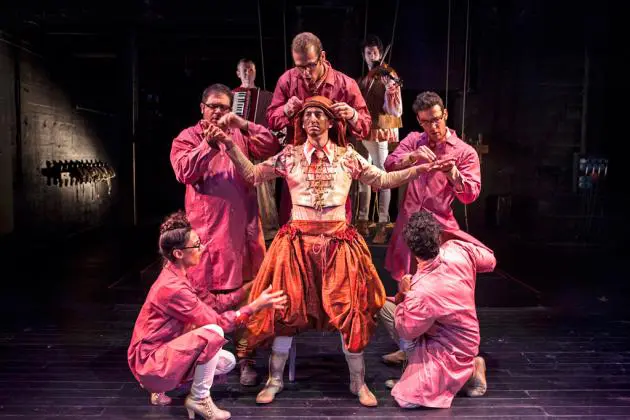
The new building has many performance spaces of various configurations and sizes. At the Bertonuv Hall, in thrust stage configuration, I watched “The Merchant of Venice”, one of the 37 Shakespearean productions in different languages invited to the Globe Theatre’s “Globe to Globe” festival, as part of the cultural Olympiad this summer. The Brits cheekily invited Habima to stage the play with the Jewish villain, but the director Ilan Ronen was cheekier still in adding a prologue, with no dialogue, in which Shylock was ridiculed and beaten by the Venetians. The fine pace, smooth flow from one scene to the next, the deft use of ropes as a visual motif, the pink and red costumes as well as the ensemble casting with just 12 actors, made this one of my more memorable experiences at a Shakespearean play.
The European connection is also strong at the Gesher Theatre, which was started in the early 1990s by a group of Russian immigrants in Jaffa, just south of Tel Aviv. Since then, they have engaged in a number of collaborations with European theatres as well as translated and adapted many European plays, living up to the name “Gesher”, which is Hebrew for “a bridge”. An example is Roee Chen’s adaptation of Jeffrey Hatcher’s “Prima Donna”, the source for the film “Stage Beauty”, staged in a lavish yet audience-friendly style by Bulgarian director Alexander Morfov.
Another pillar is the Cameri Theatre. Their internationally acclaimed production of “Hamlet”, which I saw in 2007, remains a fond memory and they are currently working with Japanese counterparts the Tokyo Metropolitan Theatre in “The Trojan Women” directed by Yukio Ninagawa.
Scheduled to watch their production of “Requiem”, which premiered 11 years ago and is based on three plays by my least favourite playwright Anton Chekhov, my enthusiasm level wasn’t too high. However, it turned out to be another special evening. The large playhouse was filled with a young and enthusiastic audience, many of whom had watched it before and not only understood but also enjoyed a play about living and dying and whose main characters are an old couple living in a rural area. The visual, aural and spiritual elements were in good balance in this production, and I now know why the Institute of Israeli Drama was named after the late playwright and director Henoch Levin.
It’s also noteworthy that the Habima, the Gesher and the Cameri work in the repertory system, like opera and ballet companies in Europe, and the performance schedule of each production spreads out over the year, instead of being crunched up over a few weekends. This gives more choices to audiences who may return to the same venue two evenings later and watch another show. It’s also a challenge for the actors, as they may have to perform in more than one show in any given week.
Smaller-scale spoken plays like the Elephant and Mouse Company’s farce “Repertory Theatre” has enjoyed success in overseas fringe theatre festivals, thanks to its universal physical comedy and English script.
The centre of experimental theatre remains at the Tmuna Theatre, where a warehouse was turned into four small performance venues, and artists enjoyed their experiments. Eyal Weiser’s “Mein Jerusalem: A Performance by Sabina Sauber” smartly traced the life of a fictitiously realistic photographer who lived in Berlin before and after the fall of the wall. As the title suggests, it’s another wall to which our attention is drawn.
I also witnessed examples of how the line between dance and theatre is blurring – indeed, in many cases has already blurred. Among these were Oded Zadok and Kazuyo Shionoiri’s “Atom”, Gabrielle Neuhaus’s “The Woman Who Didn’t Come Down to Earth”, Ruth Kanner Theatre Group’s “At Sea”, the Home Made Ensemble’s “Shall We Dance?” as well as Habima’s “Polaroid”.
But ultimately my personal favourite was Hani Quality Theatre’s “An Israeli Love Story”, a monodrama written and directed by respected novelist and playwright Pnina Gary, based on her biography, and performed by a true chameleon actress Adi Bielski, who’s fluent in both Hebrew and English. The story of a young girl falling in love with a young soldier against all social and political obstacles and dating back to the latter part of the last world war is simple and straightforward, but never naive, and it subtly reflects the contemporary social and political situations.
I’m sure some of these shows will be either here or in our region soon.
The writer's trip was supported by the Embassy of Israel in Thailand and Israel’s Foreign Affairs Ministry. Special thanks to Kuntheera Satityuthakan and Dina Zohar.
