
Making Bangkok better
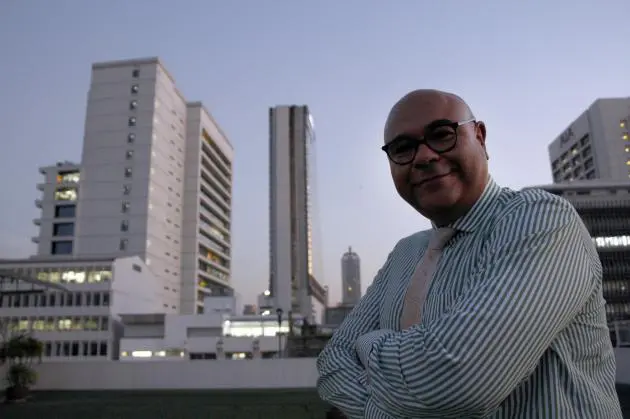


Gubernatorial candidate Suharit Siamwalla lays out his visions |and plans for a friendlier and more efficient city
An unorthodox DJ with a penchant for outrageous outfits and avant-garde stage shows, Suharit Siamwalla sprung a major surprise on his fans when he announced last year that he intended to run for Bangkok governor.
Campaigning hard via Twitter and Facebook as the race reaches its final stages, Suharit reiterates: “My strange dressing has nothing to do with my brainpower ... I won’t delete my original pictures from Facebook as I want you to see who I am.
“I hear continuous complaints of boredom about Bangkok. So, it is time for me to step up and make changes. Bangkok needs these changes, because it should be as equally developed as other big cities in Asia before the Asean Economic Community starts in a few years’ time. Then, Bangkok will be a more glamorous city, the capital city of heaven,” says the 45-year-old Suharit, who also runs DHS Siamwalla, a multi-million-baht stationery business.
“There needs to be more discipline in our city. People do anything they want without regard for public safety. The law isn’t as rigid as it should be, especially on the footpaths, which are taken over by stalls. The time has come for us to have a disciplined management system.
“Everyone has their own political views and gives their opinions in the cyber world, but nobody comes out and does something. If we don’t stand up and do something about Bangkok, it will never get better,” he adds.
Suharit is running as an independent candidate and is using the modest budget bestowed by the Bangkok Metropolitan Administration’s election committee rather than investing a large amount of money in his campaign.
“I’m not planning to spend Bt20 million on my campaign just to receive a Bt100,000 salary. It doesn’t make sense to me. I will utilise other channels to convey my visions rather than just plaster posters of my face all over town,” he says. “During the election campaign, I won’t discredit and comment on other candidates’ policies.”
His policy is divided into the short and long term, and is entirely concerned with urban improvement, covering public transportation, public spaces and the creative environment.
“The short term focuses on nine solutions, including the chronic problem of our footpaths,” says Suharit. “People play Russian roulette with their lives by walking on the road or sitting at the bus stop surrounded by stalls. We all pay the same taxes so why do we have to risk getting hit or killed by cars? Stalls can be set up on each footpath but in compliance with the law. Right now, there are two zones: temporarily permitted and not permitted. In areas like Siam Square, the law doesn’t allow street vendors to sell on the footpath at any cost. During Maj-General Chamlong Srimuang’s tenure as the Bangkok governor, he was dead against roadside hawkers, who stopped selling their wares every Wednesday.
“Other solutions include putting trash cans back on the pavement and installing more lamp posts and surveillance cameras in public areas to beef up security. The solution to our traffic congestion problems isn’t just constructing more BTS or MRT lines but making people realises the inconvenience of driving into town. If these become reality, people’s lives will be better in the next four years.
“After that, I will announce 50 new charming resources in each of Bangkok’s 50 districts, for example making Lat Krabang into a centre for technology featuring a science museum and research institute. I would also like to see Bangkok become a fully creative city.”
The long-term plans include “Boutique Bangkok”, which focuses on the preservation of ancient buildings as tourist spots. “Modernity is inside the building,” says Suharit.
“Bangkok Fun and Fame” will see art centres set up around the city.
“Art isn’t only painting and music but also street games such as skateboarding. Bangkok should be a melting pot of Singapore’s disciplinary system, Malaysia’s green areas, and Australia’s excitement. ‘Citywide Angel’ emphasises safety for women. They should have lives after work,” he says.
“For ‘public transport network’, I’m not interested in a mega-Skytrain project but smaller transport solutions such as a monorail and cycling. I am not talking about motorbikes here. Everyone must acknowledge that the bicycle is a vehicle, not an exercise machine, then facilities such as parking facilities at shopping complexes and BTS will follow,” says Suharit, who rides a bicycle in his daily life.
GOOD AND BAD
LOVES
n Way of life: “I prefer eating cheap street food to expensive hotel food.”
n Smiling faces: “The smile is the unique charm of Thai people. You hardly see foreigners smiling.”
n Atmosphere: “I feel good about what I do here, like for a festival.”
n Heaven: “If Bangkok is well managed, it will be a city of heaven.”
HATES
n Traffic congestion: “Like other people, I’m still driving my car, because I have no choice.”
n Stalls on footpaths: “I don’t feel good whenever I have to walk on the road instead of footpaths, which have been taken over by stalls.”
n Traffic regulations: “Traffic problems will decrease if everyone respects traffic regulations.”
ON THE WEB
n Watch a video of Suharit at NationMultimedia.com
n On Twitter he’s @Suharit
n “Like” his campaign at www.Facebook.com/suharit.surprise
