
Vietnam hanging by a thread


Play
Bamboo puppets touch the hearts of audiences with an authentic depiction of rural life
It is just another day in the Vietnamese countryside. A mother lulls her baby to sleep, a boy plays the flute sitting on a buffalo’s back, men and women sing as they harvest rice, and a woman rows a boat through a lake of lotus flowers.
Suddenly the scene stops. The audience applauds.
Up on the little stage, the colourful puppets make their exit.
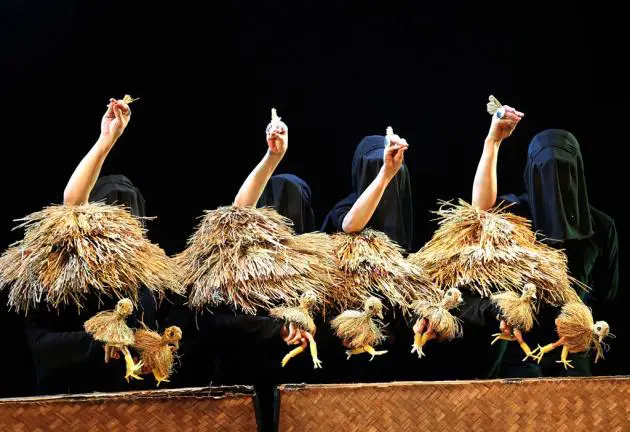
These are the handmade creations of the Vietnam Puppetry Theatre. They may just be straw and bamboo held together with string, but they have touched the hearts of many in the audience with scenes of the country life they remember from their childhood.
The show, titled “Nhip Dieu Que Huong” (“Countryside’s Rhythm”), was a big hit with Ha Noi audiences when it premiered in April, and will be performed in Canada at the end of this year to celebrate the 40th anniversary of diplomatic ties between the two countries.
The 90-minute performance features stick, string and hand puppetry.
“I hope that audiences will get a sense of the soul of Vietnamese culture through our puppetry. I would be very happy if we make them feel proud of their culture and if we inspire the interest of foreign audiences,” says the show’s director Nguyen Tien Dung, who is also the deputy director of the theatre.
Audiences at the show’s Vietnamese debut were full of praise for Dung’s achievement.
“I was very impressed to see that our artists could create so many beautiful characters with bamboo and straw. Even the plants and animals were given life,” says Nguyen Thanh Ha, a 30-year-old teacher. “Those puppets take me back to my wonderful childhood.”
Dung says that while bamboo puppets are an age-old performing tradition in Vietnam, this is the first time that his 60-year-old theatre has used them to tell diverse stories about the countryside. The artist wants to promote the image of bamboo, a plant he has loved since a young age, as well as traditional Vietnamese rural life.
Bamboo, which grows almost everywhere in Vietnam, is a significant symbol of the culture and a fixture of daily life.
It is also the backbone of the Vietnam Puppetry Theatre’s central cast of characters.
Closely woven bamboo baskets, normally used to carry shrimp and fish, were cut up and used to form the bodies and faces of the play’s rural girls, farmers and fishermen, while their hands were made from small bamboo segments connected by string.
To complete the buccolic stage scene, farm animals – pigs, buffaloes and chickens – were fashioned from the same material.
The result of all this effort is an authentic and poetic depiction of the countryside and daily life here. Traditional music adds even more character to scenes of a noisy local market or a joyful village festival.
Dung found an orchestra to perform the accompaniment using a dan tranh (16-chord zither) and dan bau (monochord), among other traditional instruments.
The puppets are manoeuvred to dance and sing along to the music, creating an engrossing spectacle. The creative team has even worked with musicians to recreate the rural cries of frogs and toads.
The theatre’s 18 artists are required to operate the puppets on the stage. It is an intricate and intensive business and rehearsals took a whole month.
Puppeteer Nguyen The Long says that bamboo puppets are harder, rougher and heavier than their traditional counterparts, which are usually made from old clothes. So he and his fellow artists have had to train longer than for other shows.
“Sometimes when we handle the puppets too hard, we get hurt. But the show is a new idea and we are very excited to perform it, despite the occasional bruises and cuts,” says Lan Huong.
Nguyen Thuy Trang, who has worked at the theatre for 35 years, also appreciates the originality of the show.
“The play is performed in a modern style and so it is very suitable for young dynamic artists. The show allows us to show off our talent and technique and helps us quickly improve our skills,” she says.
