
Vietnamese eco-village grows bamboo bicycles


Play
Cam Thanh fashions the wonders of Mother Nature into a haven for visitors
Land in the bustling city of Hoi An and you are instantly immersed in a current of mopeds that flows through the ancient streets. Fear not, intrepid traveller, a village nearby offers refuge from the madness of 21st-century urban Asia.
Instead of cars and motorbikes, bicycles fill the peaceful streets of Cam Thanh, an eco-destination that is luring more and more visitors with a mixture of Mother Nature’s wonders and human ingenuity. They come for its 30 hectares of nipa palm forest, but also its unique culture carved out of the lush surroundings.
Soon, they will have the choice of riding around on bamboo-frame bicycles, which are being made by a local craftsman – green wheels for a green village.
Cam Thanh, which has a population of 2,000, offers bicycle tours, trips in bamboo boats through the palm forest, and visits to see how the local craftspeople create the distinctive traditional bamboo furniture that gives homes here their distinctive character.
Visitors can pedal along 5km of winding flat roads around the tranquil village, just 3km from the hubbub of Hoi An. Bikes, available for rent in Hoi An, are the perfect stop-start way of travelling throughout the area.
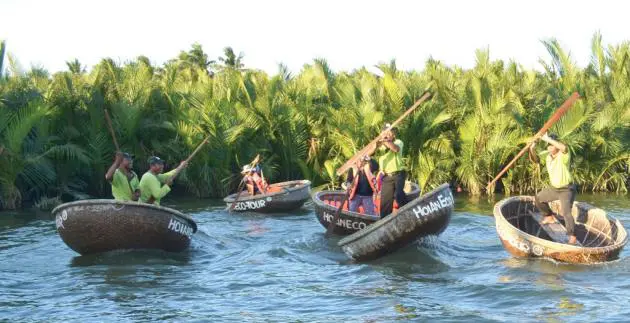
The nipa palm forest fringes the Thu Bon River, where tourists can explore the wetland ecological system in coracles, craft of woven bamboo covered with pitch that date back to prehistoric times. The forest swamps are home to a rich store of shrimps, fish and bird life. Visitors can use nets or lines to fish from their odd, bowl-like little craft.
Spend a full day in the forest and you can barbecue your fresh catch of fish and prawns for a picnic lunch. Hoi An tour operator Pham Vu Dung says the bicycle rides and fishing from coracles is a unique combination that tempts plenty of visitors.
For the past 100 years, Cam Thanh locals have planted nipa palms to protect the village from the floodwaters of the Thu Bon River, as well as to harvest to make handicrafts.
The forest, which is part of the world recognised Cham Island bio-reserve, also helps protect the village from storms while at the same time helping to create a stable income for villagers.
Craftsman Vo Tan Muoi, 71, and his son Vo Anh Tan, create unique bamboo furniture and can also build whole houses using bamboo and palm leaves for the roof and walls.
“A house with walls made of split bamboo panels and a palm-leaf roof can be used for 30 years,” Muoi says, adding that the structures stay cool in summer, but retain warmth in winter.
His son, Vo Anh Tan, has even created a bamboo bicycle and is waiting to roll it out for visitors.
“I replaced parts of the steel frame with bamboo for those who might want to enjoy an unusual, environmentally friendly means of transport in a green village,” he says. “However, I just started production last year and the new design is still being tested.”
Dinh Thi Thu Thuy, head of the city’s trade and tourism office, says Cam Thanh by bicycle offers visitors a great taste of Vietnamese culture. “The forest of nipa, which connects Tra Que village and Cua Dai beach, is a full-day tour option. Visitors can also learn how to plant vegetables and rice with farmers in Tra Que before testing their skills on bamboo and palm furniture production at Cam Thanh.”
