
Heroism to yearn for


Play
His biographer calls this 18th-century warrior "the ultimate underdog" Meet the triumphant true-life inspiration behind "The Count of Monte Cristo".
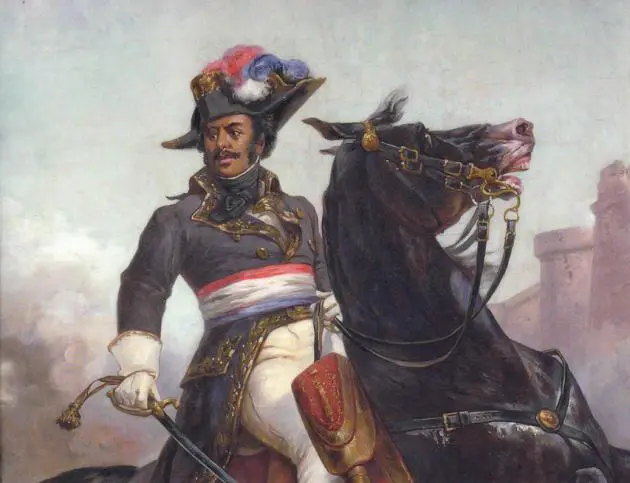
OCCASIONALLY YOU come across a larger-than-life character of no particular prominence in history who was so virtuous, so heroic, so committed to the good of mankind, that it makes you weep for their absence in the world today. One such person in revolutionary France was also supremely gifted in the social graces as well as the martial arts. Your head shakes. He was half-black in an all-white world as well. Your jaw drops.
And he was the father of Alexandre Dumas, esteemed author of “The Three Musketeers” and “The Count of Monte Cristo”. In fact, Dumas Senior was a musketeer. He was that count. And yet he had been a slave.
What an amazing tale Tom Reiss has assembled in “The Black Count”, not just because of the astonishing “Alex Dumas”, as the general signed his name, but also because there is so much to learn in the richly marbled background of his life. You discover the real roots of slavery and how France championed freedom for all, long before any other nation, before sinking into bigotry once more. You learn with surprise about the comparative magnanimity of life under the various kings Louis before the revolution cast the monarchy forever into disfavour.
And you witness the glory that was Haiti. Today a vat of crime, corruption and earthquake debris that discourages foreigners of even the noblest intent, Haiti is vividly depicted in the early 1700s as a paradise in full bloom. It was called Saint-Domingue at the time, less than half of Hispaniola, the island shared with Spain, but far wealthier than its neighbour.
This is where Alex Dumas was born as Thomas-Alexandre de la Pailleterie, to a French sugar planter and his black wife. The old man was a scoundrel – he sold off his wife and other children when he returned to France and, to pay for the voyage, “pawned” his son too. He didn’t want to lose the boy altogether, having trained him well in the arts of war, and, once he retrieved him and brought him to Europe, ensured that he learned the social graces as well.
The young man grew up to be the toast of Paris. His story is a wondrously ornate window through which to view the pageant of French history, from the democratic uprising that echoed and then far exceeded the American colonies’ revolt against England, to the unholy zealousness of the Terror that swept the country, to the glory that Napoleon restored – and then destroyed in an all-consuming bonfire of hubris.
History always offers lessons for the present, and, in this book, surprise follows surprise as the origins of today’s most worrying issues become clearer, not just in Europe but in the Middle East as well, and Egypt in particular, the object of Napoleon’s curiously “trendy” wanderlust.
His celebrated military-scientific expedition into the Land of the Pharaohs was hardly a triumph, the “discovery” of the Rosetta Stone notwithstanding. General Dumas was there, suffering terrible agonies along with the rest of the French troops and scholars.
The Muslim clergy in Cairo offered to recognise Napoleon as ruler of Egypt if he and his people converted to Islam – and he was sorely tempted, Reiss reveals. Then it dawned on him that, even though he could easily turn his back on Christianity, like any good revolutionary, he’d have to be circumcised and say goodbye to wine forever! The great vanquisher relished change, but not this one.
“There were many things wrong with the French Republic at the time of Napoleon’s coup,” Reiss writes, “but there was one thing most modern people would see as marvellously right: it offered basic rights and opportunities for people regardless of the colour of their skin.” For a fleeting moment, blacks and people of mixed race were welcome in society and in government. By comparison, “the American Congress at that time would rarely admit a black person into its presence except to serve refreshments or sweep the floor.”
Tragically, all the advances that France made in that benign era – all that equality, fraternity stuff – were reversed after Napoleon seized power and crowned himself emperor. He decided that the slavery industry, which had never faltered anywhere else beyond France’s domain, was essential to the sugar plantations of the West Indies, whose income was needed to finance his conquest of the world.
Napoleon had never liked Dumas, his senior in years and, to begin with, in military rank. They’d first met when Napoleon was a mere lieutenant in the artillery. This black man was too bold and confident for his tastes, and too successful. Not unlike his great British foe Lord Nelson, the emperor wanted only one hero in the picture, and that had to be him.
And so, after poor Dumas – having emerged from the Egyptian quicksand only to be captured by the Neapolitans and imprisoned for two years – finally made it home to France, there was nothing of the gleaming republic left. The army shunned his services, though he was only about 40, and refused to compensate him for his incarceration or lost wages. And his rights as a citizen had vanished in a blizzard of rewritten laws that now enshrined racism once more.
He died not long after, lucky enough not to have been deported. His son, the future novelist, was only four years old. “The Count of Monte Cristo”, the future novel, would be about him, if lightly cloaked in fiction. Knowing what Dumas the Elder endured, it can never again be read the same way.
The Black Count
By Tom Reiss
Published by Vintage, 2013
Available at Asia Books, Bt425
