
Worth the Extra Study


Play
The National Research Council taps more government agencies to make information available to all
Soottiporn Chittmittrapap is big on the benefits of research in our daily lives, but then he would be. The professor is secretary-general of the National Research Council of Thailand.
Recent concerns over possible contamination of the rice we buy every day offer a good example of how research can provide immediate answers.
“It’s not about pointing an accusing finger at anyone,” Dr Soottiporn says at the Thailand Research Expo ending today at the Bangkok Convention Centre in Central World. “We should take this crisis as an opportunity to improve our rice-manufacturing process.
“It’s hard to say, ‘Don’t panic,’ but when the facts are known it will be possible to devise means of prevention and remedies.” The council is forming a team with representatives from concerned government agencies to find a solution.
Meanwhile the branches of government involved in research all gathered for the first time at the exposition. They are the National Science and Technology Development Agency, the Thailand Research Fund, the Health Systems Research Institute, the Agricultural Research Development Agency, the National Science Technology and Innovation Office, and the Office for National Education Standards and Quality Assessment.
“We hope this will usher in a new era of integration in research to improve business, society and the economy,” Soottiporn says.
There are four types of research, he says. The most basic is aimed at improving knowledge. The others address economics, social issues and state policy.
Economic research, largely generated by the business and industrial sectors, is crucial for any developing nation, he says. “Today Thailand is standing where countries like the US, Japan and South Korea stood previously. We are viewed as a production base. But, as our cost of living rises and critical resources become depleted, we see that we’ve lost much of our competitive advantage to newer economies like Vietnam, Laos and Myanmar.
“It’s a critical time for us to develop technologies that will enhance our competitiveness in the long term. For instance, one of our manufacturers could develop a technology that foreign investors value enough that they would want to keep their facilities here instead of moving somewhere with lower production costs.”
Research on social issues has an equally important role, Soottiporn says. “Every year the government comes up with a campaign to promote safe driving during long holidays. They never work.
“But our research showed that there are three major factors behind the increase in accidents – the physical condition of the road, for which we now have more warning signs and blinking lights on overpasses to mark the lanes; drinking and driving, against which we now have new laws; and behaviour.
“People simply don’t comply with regulations. We need to find out how to establish social sanctions at the school and community levels to promote good behaviour. Singapore taught its citizens to stop littering with hefty fines, and now, years later, Singaporeans simply regard littering as unworthy of them.”
When it comes to developing state policy, Soottiporn cites tourism as an example. “It’s quickly becoming Thailand’s No 1 income source, but 70 per cent of the money is concentrated in hotels and transport. How about the rest of the country? It’s important to develop policies that will evenly distribute the income, to improve the economy as a whole.”
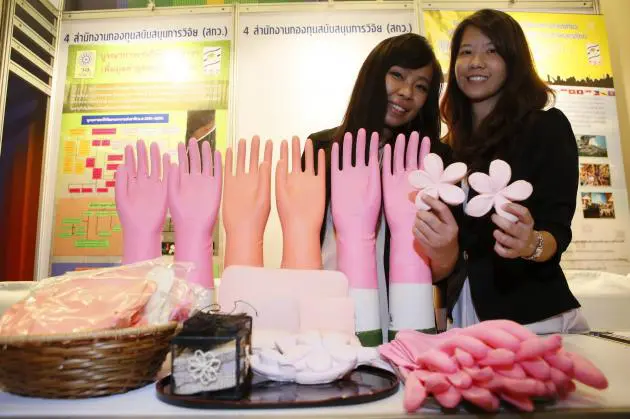
This year’s Research Expo aimed to make research data and capabilities more accessible to the grass roots – to citizens and small and medium-sized business.
“People can come in get the answers,” Soottiporn says. “For instance. There’s a small district in Pranburi that suffered from water pollution. They came to us for a solution. We found out there were factories on one side of the canal and farmland on the other. The factories were complying with regulations, but not all were doing so properly, so we offered recommendations.
“Among the farms, chemical contamination was quite high and waste was going into the canal. The irrigation dyke opened on a fixed cycle, so we advised the Irrigation Department to test the water quality and treat it if necessary before releasing water. We recommended they change the opening mechanism to let good water through while retaining the sludge. Problem solved!
“This is the role of research in real life.”
