
Seamless synergy


Play
Some of the world's best known textile designers and artists showcase their works in a new exhibition at Jim Thompson Art Centre
A NEW EXHIBITION at Jim Thompson Art Centre demonstrates that textile art goes far beyond dyeing, weaving or stitching. Rather it is a discipline that explores the limitless possibilities of technological innovation and craftsmanship and reflects both personal emotion and social awareness.
Continuing until February next year, the exhibition “Mnemonikos: Art of Memory in Contemporary Textiles”, which features 29 international artists from 11 countries, takes viewers down to the molecular level of textiles. Curated by Japanese textile expert Yoshiko Iwamoto Wada, the works achieve a perfect integration between traditional crafts and modern chemistry.
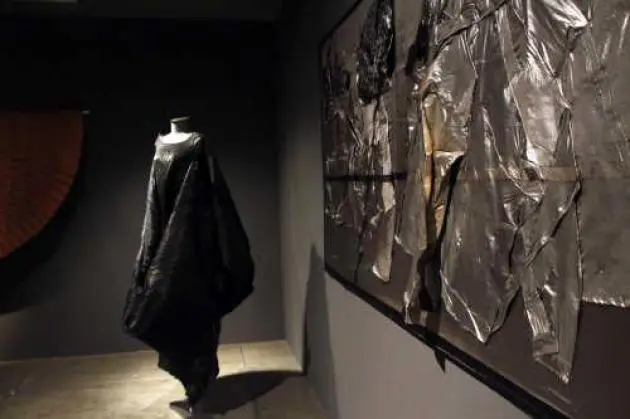
This is more than just knitting cotton and wool into a dangling lamp: here, complex manufacturing techniques are employed for such stunning innovations as a dress made from the nano fibre fabric obtained from gram-negative bacteria cellulose, metallic yarns with computer jacquard weaving and a sculpture-like cooper in a swirly fabric pattern that was achieved though electroplating.
“In Greek, ‘mnemonikos’ means ‘of memory’ or ‘remembering’. I’m interested in memory transcended from the cloth. The way the cloth is folded, compressed, pleated or sewn can record gestures and occasions, all of which serve to embed memories in the fabric,” says Wada, who is the president of World Shibori Network and the founder of Slow Fibre Studios.
“The way the artists, as agents of transformation, interact with materials is very important. Techniques, skills and patterns are the vehicles for cultural identity and each textile object reveals the perspective of all those involved. Memory changes all the time like a river. Through textiles, we can make it clear where we come from.”
Wada is a firm admirer of textile wizard Issey Miyak, whose genius for folding a single piece of cloth into a three-dimensional, ready-to-wear dress is known the world over.
“His work is fun and moves things around. No sewing is required; a single piece of cloth is folded into a square and when it’s pulled upwards, a three-dimensional shape is revealed. It becomes a shirt, a jacket and a dress. The folded pattern visually memorises the shape of folding,” says Wada.
She also considers Junichi Arai as a genius of contemporary textile for his complex techniques of weaving with metallic slit yarn to obtain shimmering sculptured pieces with a shrink and pucker texture.
American Frank Connet has explored the dimensional possibilities of his shibori-dyed fabrics and ventured into electroplating the swirly fabrics with black patina and encaustic into three-dimensional copper sculptures with highly complex surface structures.
Also playing with opposing soft and hard materials, Korean designer Jin-Sook So presents her sculptural textile piece by folding steel meshes into a three-dimensional form. It is then electroplated with silver and painted with silver and gold acrylic paint.
Hanging on a wall like a sculptural piece is a sheet of polyester engraved by laser to obtain complicated layered imagery. The work was conceived by three Chinese artists; Guoxiang Yuan, Kinor Jiang and Rui Xu. Adjacent is their collaborative art-to-wear work – a sculptural, pleated dress with silver pleating –
revealing fluid lines and swirls.
For the work “Memory Clothes-1”, Taiwanese artist Wen-Yin Huang used fibre-optic filament as the weft yarn and combined it with digital jacquard weaving and hand sewing to form a girl’s cotton dress coated with copper thread and her childhood image. Opposite is “Ambre Lilih” by Thai textile designer Kris Yensudjai who uses heat transfer dyeing, sewing and gluing to make nano fibre fabric of pure cellulose from acetic acid bacteria as a prototype for an elaborate dress.
Another young Thai artist Korakrit Arunanondchai hangs his bleached denim and digital print on a wooden flagpole. He burned some denim pieces and captured the burnt flame with a digital camera. The picture of the flame was then digitally printed onto the fabric.
“Denim, to me, is the symbol of the working man. I try to combine an object of the present with a picture of the past,” says Korakrit.
Appalled at the amount of waste in the world, several artists have turned to working though recycling. Korean-born, Los Angeles-based designer Christina Kim is known for ability to utilise all leftover materials down to the even the smallest of scraps. Her “Life of Jamdani” is a hand-reverse applique made with 99-per-cent recycled scraps and natural dyes.
Kim has worked with Indian weavers of the fine cotton muslin known as jamdani to turn the life cycle of 100 saris, whose produces leaves behind an enormous quantity of scraps, into recycled fabrics and reduce waste to just one per cent.
“The 100 saris, woven from looms with 11 metre warps, each warp yielding two saris, 5.5 metres in length, can produce 200 garments with 11 kilograms of scraps. She turns these scraps into 90-metre recycled yardage, which can later produce 48 garments with 4.8 kilograms of scraps. These leftovers are then recycled into handmade paper and talismans and just one per-cent of scraps is left,” explains Wada.
Swiss artist Mascha Mioni was inspired by her experience of living in South Africa to work with recycled material. Her art-to-wear dress “Rooibos Teabag Dress” is made entirely of recycled bags of the South African national tea rooibos (redbush). It’s delicate, but absolutely wearable.
“The colour of dried rooibos tea reflects Africa to me. Each of the more than 500 teabags has made tea that others have drunk. I worked by hand and machine using different techniques,” says Mioni. “This creation is a symbol of the necessity to use our resources wisely and recycle where we can, thereby protecting our ecosystem as much as possible.”
Young Thai artist Hatairat Maneerat offers a nostalgic memory of the countryside through her sculpture “Diary from the Countryside 2”. The work is made from recycled fabrics – obtained from the old clothes and sarongs of the rural elderly and is coiled with other abandoned objects like a spindle and a cowbell to form a chedi-like structure.
“I use the objects that are left unused and abandoned in the countryside and create a new context. The material expresses its historical pattern visually,” says Hatairat.
FABRICS NOT FORGOTTEN
>>“Mnemonikos: Art of Memory in Contemporary Textiles” continues until February 22, 2014 at the Jim Thompson Art Centre.
n The centre is on Soi Kasemsan 2 near the National Stadium BTS station and open daily from 9am to 5pm. Call (02) 216 7368 or visit www.JimThompsonArtCenter.org.
