
The greenest of valleys


Play
Bhutan on its way to becoming the world's first fully organic country
Bhutan is renowned for espousing Gross National Happiness, but now the isolated Himalayan nation is also looking to become known as a world leader in organic farming.
“We are nearly all Buddhists, so being kind to the environment and the planet has a central meaning for us,” says Kesang Tshomo, coordinator of the Ministry of Agriculture’s national organic programme.
Pesticides, herbicides and chemical fertilisers have found little acceptance among Bhutan’s population and have only been used on around 1.5 per cent of the country’s agricultural land. Soon it is hoped this figure will drop to zero, allowing Bhutan to be recognised as the first country to be 100-per cent-organic.
“We had this idea several years ago: The air was clean, the soil uncontaminated and the rivers were not yet polluted,” explains Kesang Tshome. “It would be a real pity if we did not keep things this way.”
The small country of approximately 700,000 inhabitants was virtually closed off to the outside world until the 1960s, but has begun opening up in recent decades. Television and the Internet were made available to its citizens in 1999, while a democratic government has been in power since 2008.
The unusual approach to economic development, centred on protecting the environment, was made public six years ago, but there is still no set timeframe in place. “We might achieve it by 2020,” says Kesang Tshomo. “We would love to be a fully organic country tomorrow, but we have to be practical and consider the realities facing farmers.”
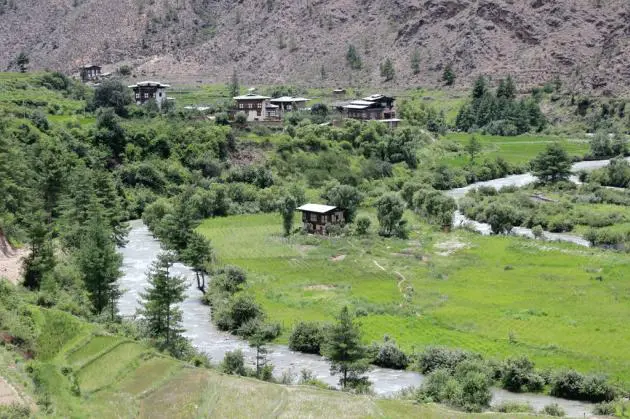
In the village of Khariphu, a two-hour walk to the nearest road, farmer Chencho Dorji faces many of the problems that are preventing a speedy implementation of the project. “Life is difficult for us in the valley because the slopes are so steep and fields so small,” explains the 27-year-old.
Like most farmers in the country, Chencho Dorji uses oxen, since agricultural machinery is not economically viable.
Around 70 per cent of Bhutan’s people make a living from agriculture, but many still have to buy wheat and vegetables. The population is growing rapidly, while large numbers are migrating to urban centres in search of work. Over half of the country’s rice is now imported from neighbouring India.
“We are going to have to increase productivity along with the switch to organic farming. This is the greatest challenge,” admits Kesang Tshomo.
Farmers are learning different composting methods, as well as how to handle manure correctly so that the nutrients are not lost through evaporation and leaks.
“We are also making an extract from chillies, garlic, onions and pepper that can drive off pests,” says Thinlay, who works in plant protection for the Agriculture Ministry.
Products such as neem oil protect against insects, while, if there is a snake plague, the creatures are trapped, thrown in a hole and sprinkled with salt. “This way they dehydrate and die,” explains Thinlay.
Farmer Lotto Zam would love to grow all her crops organically, but the 45-year-old believes it’s not always possible to get by without pesticides, citing the example of the spread of the army worm through the rice crops in her valley.
“We had no other choice. We had to buy pesticide sprays from the government,” she says in front of her market stall in the village of Shaba, where she sells organic peaches, tomatoes, green beans, potatoes, chillies, peas, garlic and cucumbers.
Pesticides are not manufactured in Bhutan but imported by the ministry. They can only be purchased through official outlets. “We only give out herbicides and insecticides in emergency situations and not on a routine basis,” says Thinlay.
This type of policy is only possible because, for decades, Bhutan has put the population’s “gross national happiness” above economic growth by looking at the spiritual, physical, social and environmental health of its citizens and natural environment.
As part of Bhutan’s environmental-protection measures, the country is constitutionally bound to ensure at least 60 per cent of the land remains forested. The figure currently stands at 72 per cent.
Bhutan has also set itself the target of remaining carbon-neutral and is currently actually carbon-negative. “The next logical step was obviously to promote organic agriculture,” says Peldon Tshering, chief strategist of the national environmental commission.
Kesang Tshomo believes Bhutan has to prioritise the export of niche products. Due to the lack of mechanisation in agriculture and the small size of fields, which are for the most part tended by independent farmers, only small amounts can be produced. “Ginger powder, herbal teas and homemade soaps made from mustard oil are examples of some the products we could export,” she says.
