
From Ranau with love


An artists' collective puts it tiny town on the creative map
"There are more to Ranau than being home to Sabah Tea,” says Jerome Manjat, one of the founders of Sabah–based art activist collective Pangrok Sulap, referring to describing his mountainous district home ituated at the foot of Mount Kinabalu in Sabah, Malaysia.
Outside the famed tea brand being one of Ranau’s famous exports, this little town has also been rising in altitude as an artistic and community–based hub centred on Pangrok Sulap’s activities.
The art collective – firmly adhering to do-it-yourself (DIY) ethos – has come a long way since it first started involving itself in volunteer and outreach work in the rural areas and schools of Sabah. The Pangrok Sulap mission statement, as Manjat reveals, is to empower those who would otherwise be marginalised.
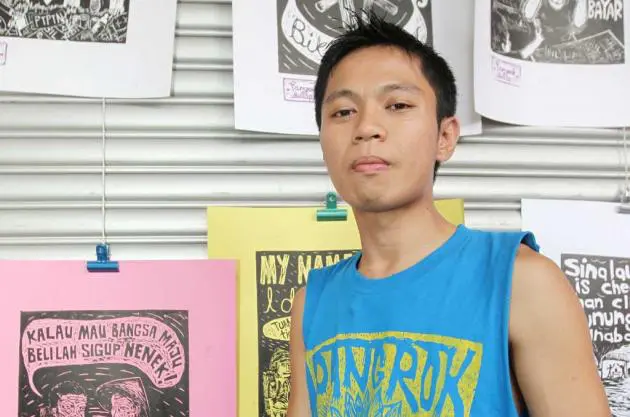
Manjat, who studied art at a local art academy in Selangor, holds down the production duties – making decisions on the process and raw material used – in the collective. At the moment, the group’s core also includes Rizo Leong, 29, and Mc Feddy, 24, who handle most of the creative direction and designs found on Pangrok Sulap’s woodcut prints. All three hail from the Dusun ethnic community.
“The story of Pangrok Sulap goes back to 2010 when the name was used for a cartoon we used to draw. The artwork back then was to reflect daily life in our tiny town, and we were also a part of the punk music scene in Ranau – making T–shirts and designing posters,” says Manjat, 29, who was in Kuala Lumpur recently to introduce Pangrok Sulap’s artwork, mainly woodcut printing, at the Malaysiaku celebration in Bangsar.
Despite Ranau’s pocket–sized township, it has become the heartbeat of a pro-active DIY community, with Pangrok Sulap and its rag-tag network of friends organising a tour circuit in western Sabah and beyond for artists, international DIY musicians, underground bands from Peninsular Malaysia and cultural activists.
The collective’s name speaks for itself: Pangrok means “punk rock”, while Sulap means a farmer’s resting place/hut.
In recent years, this patchwork community has given rise to noise/punk gigs, art galleries, film screenings and T–shirt bundle festivals showcasing whatever |part of the non-main|stream it deems inspiring enough.
“We started out as a bunch of friends in Ranau and our plan was to use our resources to engage in community projects and workshops encouraging creativity to occupy the youngsters with something positive,” he adds.
Often enough, the collective with a punk aesthetic has moved and connected beyond Ranau when it engages in interactive school–based projects. It has held art workshops in Kota Kinabalu, Tawau, Sandakan and Lahad Datu.
“In a sense, we have developed a new way to communicate through art – to the younger generation as well as the older ones.
“What we do is also tied in with the people’s identities, mostly in Ranau, and the familiar issues faced by local communities in Sabah,” Leong says.
Last month at the Malaysiaku street art bazaar, the Klang Valley masses got a sampling of Pangrok Sulap’s artwork and social activism, which was represented mainly by its own version of Malaysia Day–inspired woodcut prints and assorted cloth patches.
The messages – some with distinctly local flavour, some with tried–and–tested “punk–isms” – spoke of the struggles faced by the marginalised populace in Sabah and the urgent need for self–actualisation.
Pangrok Sulap works mostly with woodcut prints. Using hand tools, they sketch, carve and then hand-colour the prints.
“The basic drive is to create awareness with our work. We also want to strike a balance between this sustainability that we aspire to have and rampant development that we struggle to deal with,” Leong says. There is nothing raw about Pangrok Sulap’s ideals. By looking at each and every woodcut print, it’s obvious a lot of thought has been invested in delivering pertinent messages.
Among the messages that cut across are Pangrok Sulap voicing out its concerns on the illegal immigrant issue, the so–called “Project IC” case, traditional trade (betel nut/tobacco leaf street vendors) being ousted by the influx of illegal cigarette imports, tourism in Sabah being priced out for locals, the need for a DIY mentality and also a piece inspired by Eleanor Goroh, an indigenous activist and bead artist.
“Two months ago, we put up some posters about local traders’ livelihoods being endangered around Ranau town, and the message, somehow, got to the authorities.
“Why should our elderly street vendors – who make an honest living selling traditional home-made tobacco – be muscled out of business by illegal cigarette sellers? The authorities acted and cleaned up the town with an operation. At the very least, the young generation is standing up for these elderly people,” Leong says.
“I don’t think any of us has the luxury to call what we do ‘art’. We just want to get our messages out, that is why we exist,” added Manjat.
Despite Pangrok Sulap increasing its commu-nity–based activities since the beginning of this year, Leong revealed that he and his |comrades have to maintain regular jobs to keep them afloat.
“Whatever artwork we sell, we reinvest the money into our community projects – to buy paint, raw materials and others. With this more autonomous source of funding, we can be self–reliant,” he says.
“Finding support from people in Peninsular Malaysia, who understand our work in Pangrok Sulap, is something humbling. We would like to fly over more often, but our work is based in Sabah. And the roads out of Ranau aren’t in the best of shape, so travel time might take a little longer than expected if there is a landslide. But we always get to our destinations ... eventually,” says Manjat with a laugh.
