
Battle of the books


Play
Japan adopts a novel way of encouraging reading among its citizens
The warriors gather on the battlefield, facing their opponents with a sense of anticipation while observers watched on the sidelines ready to make the decision on the winner. But there are no swords in the hands of the warriors, just books.
An increasingly popular activity in Japan, the biblio battle calls on the “fighters” to make presentations about books they recommend, and the audience decides at the end of the battle which of the titles they will most want to read.
The bigger groups are usually composed of students and are held inside the schools, as well as at libraries where every reader is invited to join in. The activity has caught on with groups of family and friends too, with participants saying it’s a great way to build friendship.
The term biblio (“book” in Latin) battle was coined by Tadahiro Taniguchi, an associate professor of Ritsumeikan University when he was a fellow researcher at Kyoto University’s graduate school in 2007.
Each presenter gets five minutes to introduce a book. After a battle, participants vote on “the champion book” – the book they want to read the most.
When the battle is introduced as a school activity, it helps encourage children to pick up a book, and it also works well as a library and bookstore event.
The Tokyo metropolitan government and other authorities have organised a “biblio battle capital tournament” every year since 2010, attracting 3,000 observers.
A popular trend has been for small groups of four to 10 book lovers to hold battles.
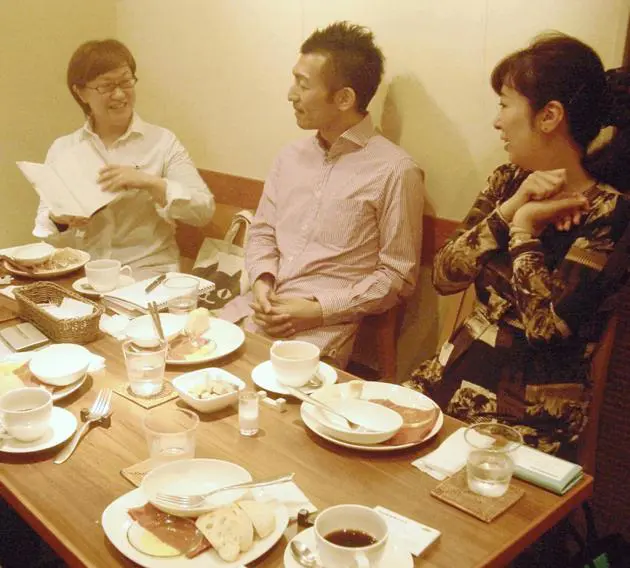
Minori Cafe in Bunkyo Ward, Tokyo, is a popular battlefield. Regular customer Yukiko Sekine, 36, is the organiser. Sekine, a company employee, first participated in the game held at a library in spring last year and felt like organising a similar event at a more casual place.
She called her friends and acquaintances to join and held her own biblio battle for the first time in September. Since then, it has become a monthly event.
The battle held in early November attracted six presenters and three observers.
“Do you know the very first line of your favourite book?” asked Tetsuya Hara, 40, a company employee, in introducing “Kakidashi Bijutsukan” (The museum of opening lines), published by Kyoikusha. The book is a collection of opening lines from 489 literary pieces.
“The book [I recommend] has nothing but opening lines. What I like about this book is that it’s up to readers to imagine how the rest of the story unfolds,” Hara said.
Presenters were given five minutes to introduce their books. Then they answered questions from the other participants and observers for two minutes. Organisers then decide by a show of hands what book they want to read.
At the event, period novel “Honjo Okera Nagaya”, published by PHP Inc, was named winning book. Some of the participants met each other for the first time at the event. After the battle, they continued individual biblio talks.
“In a small group, participants meet new people through the battles and have extensive conversations. It’s fun,” Sekine said.
Yuko Takizawa, 41, a civil servant in Tokyo, became interested in biblio battles after reading Taniguchi’s book. She then called her friends with children to hold a “biblio battle with kid”" at a meeting room in her condominium building.
Nine mothers with their children came to the event. One of their daughters, a fourth-grade primary school student, participated as a presenter.
“I felt we became closer after introducing books to each other,” she said.
Sekine received positive feedback from the other participants and plans to continue the event.
Since this spring, Kazuaki Takahashi, 23, a college student in Chiba, has held biblio battles with his parents and two brothers once or twice a month during holidays.
“Since we have the conversation topic of introducing books, conversation comes more easily,” he said.
According to Taniguchi, if there are too many presenters, listeners can’t stay focused. He thinks four to six presenters is adequate.
“If participants know each other, they can choose a book by guessing their preferences and have an exciting conversation. It is better for all participants to takes turns as presenters,” he said.
