
A nose for new talent
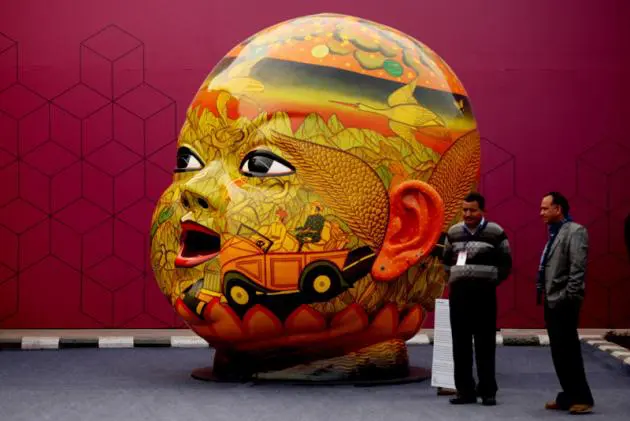


Zing returns to Indian art market as young professionals join traditional collectors.
THINGS SEEM to be looking up for the Indian art market after several years of gloom. A recent art fair in New Delhi drew 100,000 visitors, quite a few of whom were buying as well as looking. Nearly all of the 72 galleries reported sales at the event, which followed a highly successful auction of modern Indian masters by Christie’s in Mumbai in December.
“The Christie’s auction and the 2014 edition of the Delhi art fair indicates that art is back on the map,” says Shireen Gandhy, director of the 50-year-old Mumbai-based Chemould Prescott Road gallery.
The market for contemporary and modern art in India had galloped after the turn of the century, growing by 485 per cent up to 2007,but the bubble burst post-2008 with a worldwide economic downturn. With prices stabilising and the entry of new collectors – young professionals and well-heeled buyers from smaller cities outside the usual art centres of Mumbai, New Delhi and Kolkata – the market for contemporary art seems to have steadied and is moving forward.
“There was a bubble in the early ’80s, with some works selling at very high prices. The market has not returned to that level and perhaps it should not,” says Neha Kirpal, founder of the India Art Fair.
Gandhy says in the five years leading to 2008 – when India was posting 9 per cent economic growth – there was a large number of buyers collecting art with no notion of the real value.
“Anything was selling at any price. With the economic downturn, collectors wanted to sell their purchases and the market was completely unable to absorb these prices so suddenly.”
Modern masters like MF Hussein, Amrita Shergill, SH Raza and VS Gaitonde, continued to hold up prices, if not sales, but the market for more contemporary art was badly hit.
“The Christie’s sale was a huge boost for modern masters,” Gandhy notes. The auction house raised US$15.4 million (Bt503.2 million), doubling pre-sale estimates, and a Gaitonde sold for $3.7 million, a record price for a modern work of art sold in India.
“Traditionally Indian contemporary art has been collected by a handful of wealthy Indians. But we are now seeing a new generation of younger, financially independent Indian collectors from second-tier cities such as Chandigarh, Pune and Jaipur,” Kirpal says.
The new generation is also more receptive to installation art and non-traditional media like photography, video and neon works among others, gallery owners say.
Artists whose work sold at the fair ranged from modern masters like Husain and Souza, contemporary greats such as Rameshwar Broota and Nalini Malani, to art works by little-known names, at least in India, from China, Thailand, Europe and Africa.
Most contemporary works that sold were big and bright and several were within 500,000 rupees (Bt263,000), according to gallery owners.
“It’s picking up, there is great energy and activity. But it’s not a soaring market,” says Mumbai gallery owner Priya Jhaveri.
She sold several paintings and installations, and only one, a red-and-white installation by Rana Begum, was above $15,000.
Chinese contemporary art however seems to be way ahead of Indian.
“The level of government support is so much higher and influential European and American collectors continue to add Chinese works to their collections,” Kirpal says.
“We need to convince appropriate government departments that contemporary art is good for the economy, good for India’s image and deserves government help.”
“Customs laws are fraught with red tape and high duties. Import or export of art is a very, very trying thing. We work in a climate that is completely not conducive to selling,” Gandhy says, ]
“This can be seen by the response to our fairs, new gallery openings, the arrival of India’s first art biennale in Kochi in 2012, Christie’s first-in-India auction as well as the increasing presence of Indian contemporary artists exhibiting internationally,” Kirpal concludes.
