
The artist as nomad
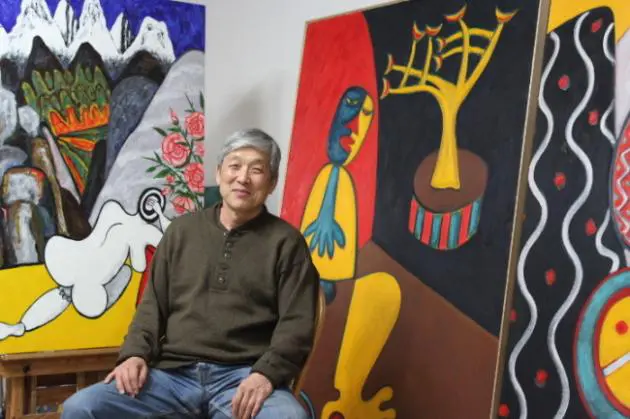


Chai Yong-yull's 37 years of painting and wandering is illustrated in all its diversity
Artist Chae Tong-yull's dynamic life story fascinates everyone who hears it. Born in Busan in 1951 in the middle of the Korean War, Chae went to university at age 15. He quit school, volunteered to serve in the marines and participated in the Vietnam War as a military intelligence officer.
Thus far, Chae’s life doesn’t sound much like that of an artist. His life took a more dramatic turn when he decided to go to the US on an exchange-student programme. There he lost his interest in studying and instead embarked on a string of jobs – working at a factory, teaching judo and taekwondo, and bartending.
In 1977 he had a life-changing experience in New Orleans. He met the woman who would become his wife and art partner, LD Lawrence. His first piece of art was made spontaneously. Recalling his childhood admiration for Paul Gauguin and Vincent Van Gogh, Chae painted a jumping horse on 100 metres of meat-wrapping paper.
His flamboyant, expressive and symbolic paintings have the spontaneity, free spirit and vigour that define his life.
Works from Chae’s 37-year artistic career are on exhibit in Seoul until March 11. The exhibition features about 50 paintings, prints and drawings he’s created since 1977.
The paintings offer a glimpse of Chae’s nomadic lifestyle. He has travelled to rarely visited places around the world in search of artistic inspiration and close interaction with the places he has set out to depict.
The series “Inside and Out” (1984-2014) depicts the inside of houses seen from the streets in Yucatan, Mexico; Korean bedrooms; nightscapes in New York; and magnificent views of the Himalayas. With paintings made during his stay in Yucatan he rose to instant fame in the American art scene. He held exhibitions in the East Village in New York, then the most vibrant art spot, with burgeoning experimental and post-modern art by Andy Warhol, Jean-Michel Basquiat and Keith Haring.
Chae also lived in cities along the Silk Road, in the land’s end village of Haenam and on Jindo Island in South Korea and in India. The variety of places he’s been to is reflected in the mix of Oriental and Western features in his paintings.
“I’ve never had a permanent home – I’ve always lived in places where I travelled,” Chae says. “I had to live in those places in order to draw and paint from the viewpoint of a resident, not a traveller.” The places where he stayed the longest are New York and Washington state, where he raised his daughter. “I wanted to give my daughter the sense of a hometown, which I don’t have,” he says.
Last year the artist spent six months in the Himalayas, three months in the US and the last three months in Korea. “I’m used to sleeping in a sleeping bag while trekking in the Himalayas. I still sleep in one while staying in Daegu.” Chae currently lives at a studio in that southeastern Korean city, where he works on his paintings.
He’s planning to go back to the Himalayas in October this year.
Asked whether he feels anxious or worried about moving from place to place, Chae says he keeps the word “nimble” in his mind. The word appears in Homer’s “Odyssey”.
“While holding onto my mission as an artist, I have to be nimble, be adaptable and skilful in whatever circumstances I’m in.”
