
The dinosaur as art
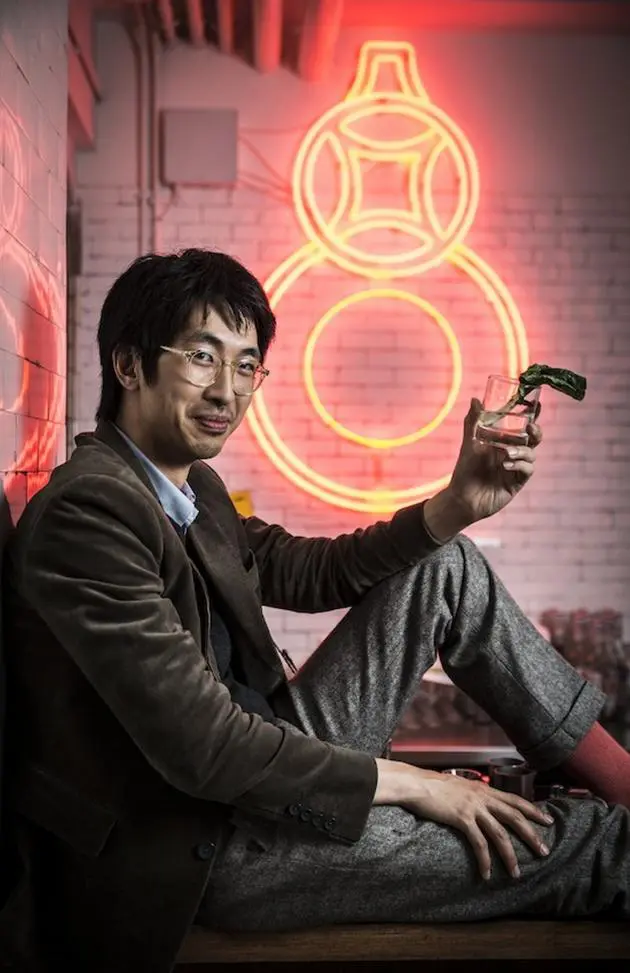


Artist Adrian Wong talks about judging the first Art Forward Fund Award and his latest project, formulating a project around a Triceratops skull
The inaugural Art Forward Fund Award finally has a winner – Tanaphon Inthong from Bangkok University’s School of Fine and Applied Arts.
His miniature sculpture, “Wedding Ring, Statue of a Gentleman and Screw”, which symbolises the importance of his family, beat the photographic, installation, mixed media and fashion design works submitted by 162 senior year students to the competition.
In addition to a generous Bt100,000 scholarship, Tanaphon is also being sponsored for his own art exhibition with professional curators and will travel to Stockholm to take part in the Absolut Art Awards.
“I’m very impressed by the sophistication and technical proficiency of the work,” says guest judge Adrian Wong, who collaborated with Absolut vodka as Art Ambassador.
“It didn’t feel like I was looking at works of undergraduate college students at all. There’s professionalism in there.”
The Chicago-born, Hong Kong-based artist is known for his research-based method in art practice that is portrayed through different genres including installation, video and sculpture that explores the intricacies of his relationship to his environment. The psychologist-turned-artist’s recent exhibitions include the travelling exhibition “Troglodyte See the Light” and “A Passion for Creation” for the Hong Kong Sculpture Biennale. His videos have been screened at several experimental film festivals around Europe and Asia.
He sat down with us to chat about art, art prizes and a dinosaur’s past life.
As an artist and an academic, how do you think this award contributes to the local art scene?
Looking back at on my own education, I think that some of the most meaningful experiences have been environments that are conducive to art production and to engaging with other artists. Through the way that we have done this award, we have given opportunities to these young artists to meet each other and form a collaborative community. Artists work in a field that falls more outside the boundaries than most other professions, and I think it’s hard for us to find each other. That’s a tertiary result of what’s going on here. There’s some really amazing works here, and with art you don’t have the same categorical constraints as in other facets of life. For example if you’re a plumber, you repair sinks and bathtubs. If you’re a doctor, you heal sick people. But if you’re an artist, you can do a wide range of things – research-based practice, drawing, painting, making robots, dance, write plays and so on. A lot of things fall under the wide umbrella of art and that makes it more difficult for these types of community to naturally form.
With such a variety of techniques, isn’t it difficult to judge which is best?
It’s difficult also because of the diversity of practices – you’ve got people with background in engineering and some in experimental films. So, yes, it’s really hard to really judge. It’s like comparing an orange to an apple. How do you compare a painting to a movie? For a long time art prizes were corporately sponsored with emphasis on flat works because they were easier to incorporate with the living environment. You can put an artwork on a wall and look at it as an image. But you don’t have to consider the ramifications of bringing a work of art into a space where you have to live with it. My own training is in sculpture. One of the reasons why I gravitated towards sculpture is that I wanted to create something that became an object and could be brought into the space we live in.
This year you became the first sculptor to win the Sovereign Asian Art Prize. How does that feel?
To be awarded an art prize as a sculptor for the first time was so exciting. It shows that there’s a transition, a shift, to different ways of making art. That’s also why this partnership with Absolut feels very natural to me, because they also try to create experience. Art is moving more and more beyond the image to something that needs to be felt. It has landed in a conflict with the computer and information age. The wave that art is moving is emphasising things that you can’t get through a computer screen. You have to smell, touch and walk through.
What made a psychologist become interested in practising art?
I really tried to understand how perception works, how the brain works, how language develops. Coming at art from that other field sort of shapes that way that I see what arts do.
There’s a combination of factors. I found that within academia, most fields have a very clearly demarcated area of things that you’re supposed to study. My area is psychology, and if I step too far into the intervention I’m treading on people involved in social work. If you’re too involved in language processing, you’re doing the work of a linguist. My interest always pushes me to the boundary of what I supposed to be doing. Art is one of the few fields that you can work in between boundaries, and have time and space to develop an idea without having to worry about what it is you’re actually doing.
Is there a project going on right now? Do you still stick to the research-based method?
Sort of. In 2013 a group of paleontologists gave me a giant 65-million-year-old dinosaur head, a skull of a Triceratops which is about 3-metres long and 2-metres tall. Within a frame of research, I was asked to develop a project around this dinosaur head. So what I’ve been doing for last year is assembling a team of animal psychics and now I’m working with 25 animal communicators in Hong Kong. These are the people that speak to spirits of animals that have passed on. I’m reconstructing a memoir of this dinosaur’s life through academically interpreting interaction between these psychics and the skull. We’re on to the next stage now that involves sketching by forensic illustrators. I don’t really know what’s going to happen. So in a sense it’s academic, but I’m working outside the boundary of what is and what is not. It’s emphasising that empirical truth is no long a prerequisite to creating things that are interesting at a human level.
Artists learn how to produce art. Do you think the public needs to learn to consume art as well?
There are a lot of opportunities for the general public to understand what’s going on. One of the ideas is that the audience should be educated and I think it’s great. Education is never a bad thing. But it can be alienating too. Some people, for example my parents’ generation who are working class and don’t have exposure to arts in their upbringing, see contemporary art as strange and exclusive. They don’t understand it so they think it’s not for them. That’s a real problem. Art is supposed to be weird, hard to understand, playful, disconcerting and new. I don’t think a lot of people realise that the people who are on the inside often times are just as confused as the people on the outside.
What’s your next exhibition?
My next project will be in Hong Kong in November. I’m working with Platform China gallery, and it’s a soft launch of the dinosaur project I talked about.
Miniatures and more
The works of the15 finalists in the inaugural Art Forward Fund Award are on show till the end of the month at the Museum of Contemporary Art on Vipawadee-Rangsit Road. Bangkok,
Call (02) 953 1111 or visit www.MocaBangkok.com and www.ArtForwardFund.org
