
Fastest camera in the East


Play
If Fujifilm cameras get any speedier than the X-E2, you'll need a time machine to keep up with them
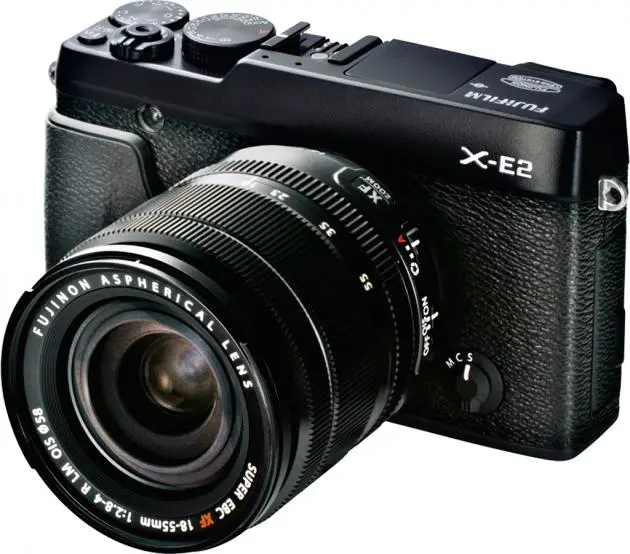
The Fujifilm X-E2 is a mid-range, mirrorless, interchangeable-lens camera with excellent image quality and ultra-fast autofocus.
The X-E2 features a 23.6x15.6mm APS-C X-Trans CMOS II image sensor, whose architecture eliminates the need for an optical low-pass filter and integrates the firm’s original colour filter array to reproduce scenes with high resolution and clarity.
The camera’s EXR Processor II doubles the processing speed of the previous generation. The camera exits “sleep” mode fast, and when power is turned off, it enters sleep mode for up to 24 minutes. Switch back on and it awakens in half a second, a big jump on the normal start-up time of 0.92 seconds. The figure is based on having an XF27mmF2.8 lens attached but in my test I used the provided kit lens, a Fujinon Super EBC XF 18-55mm F2.8-4.
The fast processor works in tandem with the CMOS II sensor to deliver impressive performance, resulting in shooting intervals of just half a second and a shutter lag time of five one-hundredths of a second.
Autofocus is also extremely fast at 0.08 seconds thanks to an intelligent hybrid focus system that assesses both contrast and phase-detection pixels that are integrated into the image sensor.
All this speed lets the camera record a burst of up to 28 frames at seven frames per second in High-Speed Continuous Shooting mode when equipped with the XF35mm F1.4 R lens.
You get a very good electronic viewfinder as well, with a negligible display lag of 0.005 seconds.
The high-performance, three-inch LCD monitor packs 1,040K dots. The screen is protected against scratches by reinforced glass. The retro body can be either Classic Silver or Discreet Black.
If you’re an experienced photographer and can adjust shooting parameters, you can use the X-E2 easily because several dials and buttons are at hand so there’s no need to dig deep into menus.
There are dials for changing the values of the aperture, the shutter speed and for exposure compensation. Shutter speed can be changed with a large-label dial, the aperture value from the main dial. These dials can be turned with your right hand, by feel, while you’re looking through the EVF, and you see the results instantly.
There are buttons for changing the ISO sensitivity and white balance as well. And, making everything quite convenient, there’s a “Q” button that brings up the setting menus.
The internal flash is very useful for lighting subjects where the main light is coming from behind or the environment is a little dim.
Another nice feature wireless connectivity. With a Fujifilm Camera Application on your phone, you can link to X-E2 and easily transfer images to the social networks.
If ever you’re unsure about your shooting parameters, you’ll find the Bracketing option handy. Activate it with the “Drive” button to prompt the camera to take three shots at different parameters. You can select AE Bracketing with different exposure values, ISO Bracketing with different ISO values, Film Simulation Bracketing with different choices of picture styles and Dynamic Range Bracketing with different dynamic ranges.
The Drive button is also used to select video, panorama and multiple exposure modes as well as Advanced Filters.
Multiple Exposure is a nice cheat, allowing you to superimpose one shot atop another for results that would be impossible in normal shooting. You can frame and shoot a second frame while viewing the first in the LCD monitor, lending precision to your positioning and focus.
You have several fun, advanced filters – Toy Camera, Miniature, Pop Colour and Soft Focus – and other filters to capture only the red, orange, yellow, green, blue or purple in the scene.
Fujifilm revisits its popular film stocks digitally in its X-system cameras to offer various picture styles. With the X-E2 you get seven “film simulation modes”: Provia / Standard, Velvia / Vivid, Astia / Soft, Monochrome (+Ye / R / G filter), Sepia, Pro Neg.Std and Pro Neg.Hi.
The X-E2 has four exposure modes: Programme AE, Shutter-priority, Aperture-priority, and manual. P mode is the only automatic exposure mode available. You must set both the shutter speed and aperture to “A” or automatic to activate P mode.
During my test I mostly used P mode and obtained pleasing results. I enjoyed shooting with the Vivid film simulations, capturing shots in intense colours both indoor and outdoor.
The kit lens with an F/2.8 aperture captures beautiful portraits with backgrounds that look “professionally blurred”. The image sensor has a 1.5x crop factor, so the 18-55mm kit lens has an equivalent focal length of 27 to 82mm. The 27mm focal length is great for capturing landscapes.
The Fujfilm X-E2 with the Fujinon Super EBC XF 18-55mm F2.8-4 lens retails for Bt 39,990.
KEY SPECS
Image sensor: 23.6x15.6mm (APS-C) X-Trans CMOS II with primary colour filter and 16.3 million effective pixels
Storage media: SD memory card / SDHC memory card / SDXC (UHS-I) memory card
Lens mount: Fujifilm X mount
Sensitivity: ISO 100, 12800 and 25600
Exposure control: TTL 256-zone metering, Multi / Spot / Average
Exposure mode: Programmed AE, Shutter Speed priority AE, Aperture priority AE, Manual exposure
Shutter speed: 30 to 1/4000 seconds
Focus mode: Single AF / Continuous AF / MF Distance Indicator
Focus type: Intelligent Hybrid AF (TTL contrast AF / TTL phase detection AF), AF assist illuminator available
Viewfinder: 0.5 inches, 2.360K-dot OLED colour
LCD monitor: Three-inch, aspect ratio 3:2, 1,040K-dot, colour LCD monitor
Movie recording: Full HD 1920x1080 60p / 30p; continuous recording up to 14 minutes; HD 1280x720 60p / 30p; continuous recording up to 27 minutes
Wireless transmitter: Standard IEEE 802.11
Terminal: USB 2.0, HDMI mini connector, microphone / shutter release input 2.5mm, stereo mini connector
Power supply: NP-W126 Li-ion battery
Dimensions: 129x74.9x37.2
Weight: 350g including battery and memory card
