
The Buddha within


Play
Love is underlined in the Zen celebration of the Lord Buddha's birthday
ONE OF the world’s most respected Zen masters, Vietnamese-born spiritual leader Thich Nhat Hanh has shared many words of wisdom over the years.
Of Vesak, the day that marks the Lord Buddha’s birth, enlightenment and death, he says: “Love is an amazing source that flows among the world of hardship. People are too busy with competition of success or failure, so we have gradually lost the beautiful nature of love. Lord Buddha was born as an awakening of compassion without boundaries. Celebrating Vesak is an opportunity for us to be closer to each other; so the seeds of love and joy in our hearts can bloom beautifully. We now join our palms as a lotus flower, and may the light of peace from the Buddha shine brightly in the 10 directions”.
This year Vesak – or Visakha Bucha as it is called in Thailand – fell last Monday and I chose to celebrate it not at my local temple but in the Plum Village tradition, which teaches the art of mindful living and practice in the way of peace and joy.
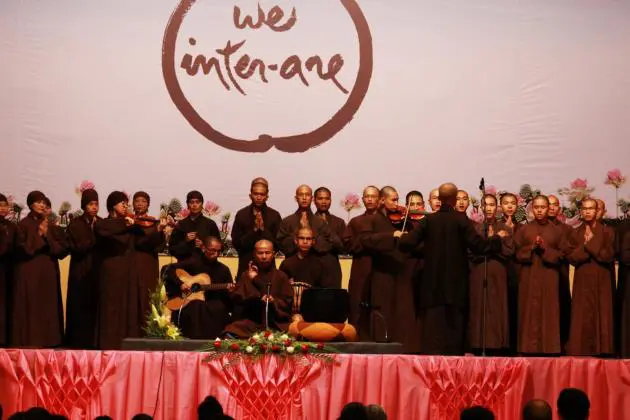
Despite the absence of the master, who is now recovering from hemiparesis in the nourishing and peaceful environment of Plum Village in France’s Aquitaine region, some 80 Zen monks and nuns celebrated the Buddha’s birthday at the Mahachulalongkornrajavidyalaya University in Ayutthaya. The brown-robed monks and nuns were joined by hundreds of Thai saffron-robed monks and lay people from Thailand and Vietnam. The celebration was one of the several retreats and public events organised across Thailand as part of the Plum Village Spring 2015 Asia tour.
Thai Theradava Buddhists usually mark the day by offering alms to monks in the morning. Some go to temples, listen to sermons, spend time meditating and join a circumambulation at a temple. Practitioners of this Zen Buddhist lineage are guided to become mindful of and enjoy every breath and act they perform in daily life – from singing and chanting to eating and walking.
Indeed another of Thich Nhat Hanh’s well-known teachings encourages the mind to free itself from all thoughts: “Breathing in, I know that I am breathing in. Breathing out, I know that I am breathing out. Breathing in, I enjoy breathing in. Breathing out, I enjoy breathing out.
“Breathing in, breathing out, I am blooming as a flower. I am fresh as the dew. I am solid as a mountain. I am firm as the earth. I am free. Breathing in, breathing out, I am water reflecting what is real, what is true. And I feel there is space deep inside of me. I am free. I am free. I am free.”
Inviting us to participate in a singing meditation, a young nun noted that in some Buddhist traditions, monks and nuns are not allowed to sing. “But at Plum Village we are allowed to sing. Songs can make us peaceful.”
After singing, we chanted. “We chant to open our heart, to have power to heal our heart. We chant to remember and generate energy to our loved ones and people suffering in hospitals including those affected by earthquakes,” Brother Phap Dang told us, before illustrating how the Buddha himself had sought to find ways out of suffering.
As a young prince, Siddhartha accompanied his father on a rice-ploughing ceremony and witnessed how all living beings killed one another to survive. He saw a farmer, his body burnt by the sun, labouring in the field but whose ploughing was killing worms and insects. The young prince also saw little birds catching the worms for food only to be eaten themselves by bigger birds. As he grew older, he experienced the gate of birth, old age, sickness and death as well as the corruption of ministers in the Sakya Kingdom.
“The importance of what the Buddha found under the bodhi tree is the insight into inter-being, the realisation of the law of interdependent co-arising (cause and effect),” Brother Phap Dang explained.
“Thay (the name by which Thich Nhat Hanh is known to his students) reminds us on the Buddha’s birthday that we all have a baby Buddha in us,” added Sister Chan Khong, Thich Nhat Hanh’s lifetime student and the eldest nun in the Plum Village Tradition.
“In life we all face emotions of agitation, fear and anger. These are the times when we should call on the Buddha in us to manifest. When these feelings arise, we should say, ‘Buddha, are you there?’ And smile. Things may not go as we wish. But never mind. The Buddha in us can smile. The Buddha in us can forgive. We need to train ourselves for the Buddha to manifest. If we do not train, the Buddha in us will remain asleep,” explained the nun, about whom Thich Nhat Hanh has said, “Many of my students are my teachers, and Sister Chang Khong is one of the foremost among these.”
As the representative of the host, Phra Sophonvachiraphorn, vice rector for Foreign Affairs of the Mahachulalongkornrajavidyalaya University, welcomed the monks and nuns of Plum Village and also requested participants to practise the Zen master’s teachings and chant to wish him good health.
“Thich Nhat Hanh’s teachings are not different from those of the late Buddhadasa Bhikkhu and Ven PA Prayutto. The key principle of Thich Nhat Hanh’s teaching is based on the four foundations of mindfulness: body, feelings, mind and object of mind. When we are mindful in all the objects, we call it Khanika Samadhi (momentary concentration), which Thich Nhat Hanh calls the ‘here and now’,” he explained.
Eating too, we were told, offers another opportunity for meditation. “We might not think of eating as an important activity. We might eat quickly and wish to finish so we can do other, more important things. But eating can nourish not only the body but our hearts,” said the nun guiding us in eating meditation.
“When we eat in silence, we see beyond the food in front of us. We see where food comes from. It comes from sun, rain and hard work. This is another way of seeing inter-being.”
As dusk fell, participants prepared for the circumambulation around the pond. With a strong breeze blowing, we were each given a rose or chrysanthemum to hold rather than a candle to remind us to be fresh and peaceful as we walked.
“The Buddha was born more than 2,600 years ago and he comes to the fore when we make peaceful steps. We learn how to touch the Buddha within.”
Mindfulness and meditation
For an update on the Thai Plum Village’s retreat and activities, visit www.ThaiPlumVillage.org.
TOGETHER AS ONE
“When we practice alone, we may face difficulties. When we practice together as a sangha, difficulties will become easy. We do not feel tired. A sangha has collective energy. Without collective energy, it is hard for our practice to develop.
“Sangha is a body, and each of us is a cell in that body. Together we form one Sangha body, connected by the practice of mindfulness. With our collective energy of calming and looking deeply, it is possible for us to support each other on the path of transformation.” – Thich Nhat Hanh
With the help of friends everywhere, it is planned to build a new monastery known as the Thai Plum Village International Practice Centre in Nakhon Ratchasima’s Pak Chong district.
Donations in support of the project can be made through Bangkok Bank’s Siam Paragon branch, account number 855-0-12889-9, account name Plum Village Foundation. The Swift code is BKKBTHBK.
