
Animation's not kid's stuff


Play
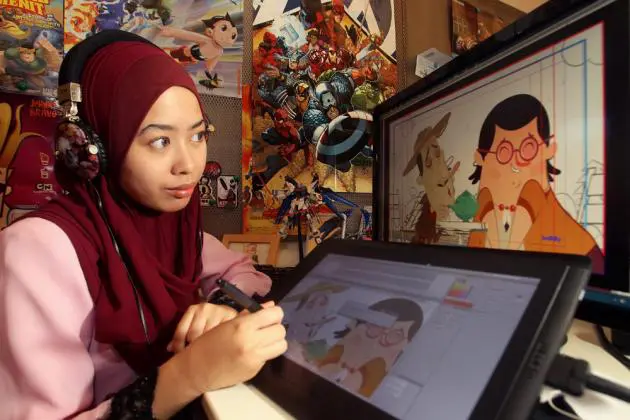
Creating cartoons is a lot tougher than it looks, The founders of Malaysian studio Inspidea discovered
Taking risks and being able to live with uncertainty is a prevalent theme in entrepreneurship.
How else could one explain the entrepreneurial journeys undertaken by Andrew Ooi Kok Hong, 43, and See Chin Joo, 44, who started their digital animation production company, Inspidea Sdn Bhd, with no background in the business?
See, now the sales and marketing director, says he started the company with Ooi, currently managing director, and two other partners in 2002. This was after he lost his job of nine years as a financial analyst in investment banking.
“I didn’t know what to do at the time,” See recalls with a wry smile.
Ooi, on the other hand, was a town planner by training and worked as a specialist in software engineering. He quit his job when a new manager came in and ushered in a very different style of management.
While downsizing and change of management have cause quite a few people to lose their job, not many go on to take the “red entrepreneurial pill”. But See and Ooi had no such qualms, saying they were happy if a little nervous to step into a world vastly different from the one they once inhabited.
“We were motivated then by the government’s call to teach maths and science in English, and started to think about developing an educational animated series for children. Our thinking was that local television stations would be interested,” Ooi recalls.
With this one bright idea in their heads, they took a leap into the dark – neither one of them had an inkling how animation was done.
Their new business operated out of See’s house with about RM200,000 (Bt1.8 million) in working capital, mainly from savings and borrowings from family members as well as capital from two shareholders. Six months later, they moved to a rented office in Plaza Mont Kiara and hired about 10 workers to help them realise the animation series they had in mind.
Called “Johan the Young Scientist”, it consisted of 26 episodes of 12 minutes each revolving around Johan, a six-year-old who explores the world of science.
“It was challenging as we had no income at the time. Our shareholders decided to leave, so we bought their shares with whatever savings that we had left,” Ooi says.
Their hard work paid off after they completed the series in 2004, two years after forming their company. They visited a trade fair for buyers and producers of films and animation in France, and met the representative of a local TV content provider from the Middle East who expressed interest.
“Our investments of close to half a million ringgit eventually paid off, and since then, the programme has been aired in over 33 countries including in Malaysia, UAE, Portugal and the US,” See says.
Their revenue stream include collecting licensing fees from clients, with the amount ranging from US$200 to US$60,000 (Bt6,800 to Bt2 million) or the entire series for one run, and a repeat within a year or two.
The actual amount depends on the population size and the per capita income of the country. Additional re-runs would mean additional fees – all of which makes for a very good business model since there’s no further production cost, only unrealised revenue.
Talk about a golden goose!
Later that year, they began their next project: “Mustang Mama Football Fever”, a 26-episode series of two-minute animation which they completed in 2006. It was about an outrageous grandmother who’s fanatical about football.
See says they timed it to coincide with the 2006 World Cup. It became an instant hit globally, with TF1, Cartoon Network Japan, Nickelodeon and Astro Ceria all coming onboard.
Having built up a reputation, they no longer had to face doubts over their ability to complete an unfinished product they were trying to sell.
Ooi says clients were also concerned that there would be discrepancy in quality between the pilot they were showing and the complete finished product.
“In the end, we always had to complete a series before approaching clients. With no grants at the time, we either did not take any salary or paid ourselves minimum wages to survive,” Ooi says.
But things are different now. These days, Inspidea receives many requests from both local and international TV content providers, including Disney XD, Cartoon Network, TFOU, Xilam, ASTRO, Yahoo! and Mediacorp, to make animati on series. Animation sub-contracting services fees from such projects range from RM300,000 to RM6 million.
“Some would fully own the product by paying the full production fees, while some would only pay part of it while we absorb the rest. In such instances, they would own the rights to use it for a limited period of time, after which they would have to pay us royalties, ” Ooi explains.
Inspidea currently occupies a rented office with 2,415 square metres of work space in Glomac Square, Kelana Jaya. They have about 270 workers and have so far produced 11 animated series that are marketed in more than 70 countries.
It’s no surprise that the company is continuing to attract talent with its “Let The Kid Out” philosophy, which the founders have been emphasising from the early days.
Their motto is that one could have a lot of fun even without gadgets or toys. Ooi and See believe this to be conducive in inspiring creativity.
“Our role now is to look at the creative side and the commercial side of each production that we intend to embark on,” Ooi says.
On the Web:
www.inspidea.com
