
The old pot and its funny new friends


Play
Benjarong porcelain, steeped in history, shares its classic colours with comic characters in a remarkable blend of art and craftsmanship
AT FIRST glance, the cartoon characters Doraemon and Casper the Ghost wouldn’t seem to be of much interest to the Support Arts and Crafts International Centre of Thailand, whose mission is to preserve and promote local heritage artisanship.
But these Japanese and American imports do share certain traits with our traditional arts – as do Siamese fighting fish (although their battles in bottles are something of a tradition, after all). What they have in common are the colours indigo, yellow and red along with black and white, which are all found in Thailand’s Benjarong porcelain.
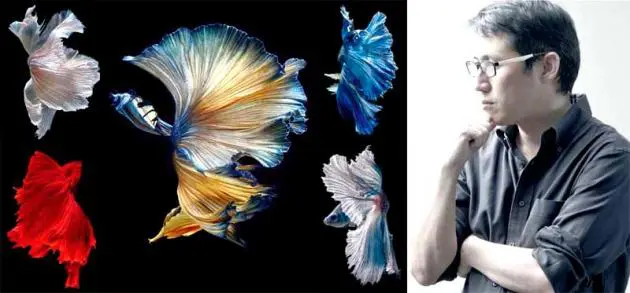
So, to kindle interest in the venerable craft of making Benjarong, the centre has recruited five artists and five designers to create works with those hues in mind. The fish, of course, are famously colourful in their own right, as exemplified in one photographer’s breathtakingly beautiful portraits of them.
Doraemon, Casper, Bad Badtz Maru, Tweety Bird and Elmo from “Sesame Street” have been showcased at a show called “Thai Navatasilp” (“innovative crafts”) opening tomorrow as part of the five-day Bangkok International Gift Fair and Bangkok International Housewares Fair at Bitec in Bang Na.
“Compromise is often the name of the game in ensuring that ancient crafts continue to survive in the modern world,” says Saengrawee Singhawiboon, who’s in charge of the centre’s Product Development and Innovative Craft Department.
“The participating artists were free to explore new elements that might draw people’s attention to the ancient craft, while the designers worked on contemporary products embedded with craft elements.”
It’s Visarute Angkatavanich’s almost mystical photos of the fighting fish (pla kad) that strike the eye first in the show. The images have been endlessly reproduced by online sharing sites around the world, but they’re still best viewed on Visarute’s own domain, https://500px.com/bluehand.
Visarute, 44, declines to comment on recent speculation about the fighting-fish wallpaper on the new iPhone 6s, but the five pictures he’s contributed to this exhibition pack even greater “wow” power anyway. Each fish is in one of the five primary colours of Benjarong, marvellously set off by the inky black background. “Benjarong originated in China, and the word literally means ‘five colours’,” says the Chulalongkorn University advertising graduate. “It was later adapted with classical Siamese patterns and the primary colours were mixed to produce different tones. Similarly, the pla kad we see today have been bred with multiple colours.”
Visaruth set out to capture “the beauty hidden in the continuous movement, which is too fast for our eyes to see”. His biggest challenge is finding “the right model”.
“I go to Chatuchak Weekend Market and study each fish’s shape, colour and movement and the size of the tail and fins. Some of them look ferocious and others just stay still. I have to figure out how to portray the individual characteristics, so there’s a lot of imagination involved, and it can be difficult.”
He waits patiently for an unusual movement. “I have to predict how it will move in the next second and be ready to press the shutter.”
His process is well documented: Nikon, Canon and Sigma cameras with 85 to 105mm lenses, image resolution up to 36 million pixels, a tank of water filtered of impurities. The black background is entirely the result of the high contrast between the light reflecting off the fish and the light hitting the water. Post-production is minimal – brightness and contrast adjustments and dust particles erased – and the colours are utterly natural.
“Photography is based on truth, and that’s why I have to examine each fish’s unique character at the market. If we distort its essence digitally, it’s not a photograph.”
Thaweesak “Lolay” Srithongdee, known for funky, figurative pop paintings, hasn’t been shy about adding distortion to an indigo Doraemon, the Japanese robot cat, in a huge square canvas that’s also populated by the cartoon penguin Bad Badtz Maru with black spiky hair, Tweety Bird in yellow, Elmo in red and Casper in ghostly white.
“I didn’t know much about Benjarong,” he says. “I didn’t know it actually originated in China – I thought it was Thai!” To illustrate the necessity of knowing a subject well, he’s deliberately distorted the characters to such an extent that they’re barely recognisable. “You have to look from a particular angle to get a clear picture.”
Ceramist Wasinburee Supanichvoraparc and artists Pornpraseart Yamazaki and Rush Pleansuk round out the “art” contingent in the show, while Kultirat Meesaiyati of the brand Gavang leads the designer parade.
Kultirat has overseen the creation of a batik piece, but rather than infuse it with the hues of Benjarong as might be expected, she’s done it in monotone. She worked with Tanintorn Ruksawong of Dahla Batik in Krabi to develop a cloth in shades of white, and there’s a method to this seemingly counterintuitive approach.
“Each of the five designers worked on a particular shade, based on the five colours of Benjarong,” Kultirat explains. “My task was to develop white products using, in place of the usual vibrant batik, a ‘white on white’ material that’s simple yet elegant.”
The challenge was to give the single-tone silk and cotton material dimension. “Making the simplest thing is the most difficult,” Tanintorn points out. “It requires precision in every detail and incredible patience. I applied two patterns – ylang-ylang and prajae jeen (a wrench-shaped fretwork motif) – in distorted forms. The patterns aren’t clearly seen, just the shining contours.”
Kultirat then fashioned the fabric into scarves and ready-to-wear dresses and also created a handbag and clutch woven from pandan leaves, with bleached leather integrated, and silver-plated rings with white-enamel crowns.
Varongkorn Tienparmpool of the brand Patapian, admired for the way he combines traditional craftsmanship and contemporary design, has made small containers and trays and brass rings and earrings enhanced by woven strips of coloured bamboo.
“I was assigned the yellow,” says the Rangsit University graphic-design graduate. “I immediately thought of the yellow moon, so these pieces have the yellow and black of the night.” Classical motifs – nam lai (the chevron) and poom khao bin (the lotus bud) are modernised with overlapping and rhythmically rearranged dots, playing dice and triangles.
Designers Nimmawadee Krainara, Decha Archjananun and Thitiporn Chanawangsa have meanwhile tackled the indigo, black and red.
INNOVATION IS TIMELESS
The exhibition “Thai Navatasilp” runs tomorrow through Friday at the Bangkok International Gift Fair and Bangkok International Houseware Fair at Bitec in Bangna.
Find out more at www.SACICT.or.th and the “Thai Navatasilp” page on Facebook.
