
Portrait of a city on the stage


Play
A new play puts Yogyakarta firmly in the spotlight
AS THE SHOW begins and the performers appear one by one on the stage, the audience slowly realises that this is not an ordinary performance.
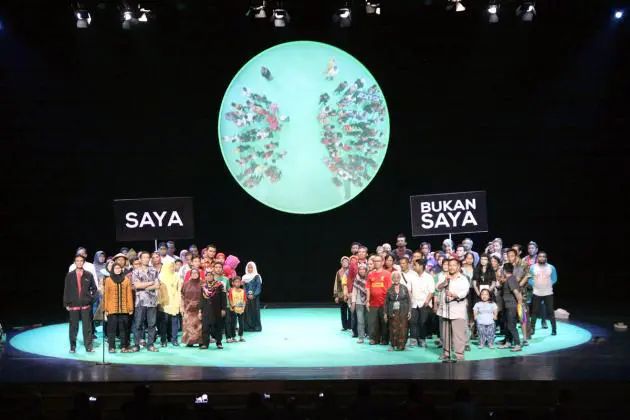
Titled “100% Yogyakarta”, the performance, which has been brought to the stage by German-based Rimini Protokoll in cooperation with local theatre group Teater Garasi, is a fascinating piece of documentary theatre.
Apart from presenting interesting facts about Yogyakarta, the play is also performed by ordinary people – 100 of them, all from different background – with no experience of the stage.
“What we were looking for from the beginning was not actors and actresses, but experts in their respective lives in the context of being residents of Yogyakarta,” explains Naomi Srikandi of Teater Garasi.
The two-hour performance opens with the appearance of 38-year-old statistician Istato Hudayana from the Central Bureau of Statistics, Yogyakarta provincial office.
In his introduction, he talks extensively about statistics; their application in real life and how people can have fun when learning about or doing things with statistics.
“I live in Mlati, so I reflect 11 per cent of Yogyakarta’s population. I am male, thus representing 49 per cent of the population. And because I am Javanese, I am a part of 70 per cent of Yogyakarta’s residents,” Istato says.
After finishing his speech, he introduces the brother of a friend as the second performer who later introduces his son as the third actor in the show. This goes on until the 100 performers have been introduced.
The performers vary widely in terms of age, occupation and social background.
There’s a baby and a 90-year-old woman; the homeless and the wealthy; even transgender participants and people living with HIV/Aids.
Questions are asked over the rest of the play, requiring all on stage to respond.
The questions range from traditional demographic questions, like where the people on the stage were born, what languages they spoke, and so on to more interesting inquiries.
In one part non-voters are taken to a separate part of stage to be asked basic democratic questions.
Then in the anonymous scene, during which the stage is darkened and people are asked to respond using flashlights, questions about intimate and very private matters, including their sex lives, are posed.
More existential questions – about life and death – come later in the play.
Stefan Kaegi of Rimini Protokoll says that through the project, the group wants to show the audience that very different opinions can be brought together and that people can ask questions that may be considered taboo or offensive.
“You can ask these questions on stage and people stand up for their opinions. It is also okay to agree or disagree. This is a democratic process,” Kaegi says.
He also expresses his appreciation that people who had HIV/Aids can share the same stage with those who wanted to have sharia law.
Or people who are afraid of communism working together with people who feel that the government should apologise to the victims of the 1965 incident.
It took six months for the group to prepare for the performance in Yogyakarta.
The casting process was conducted by Teater Garasi in cooperation with Kunci Cultural Studies Centre.
“100% Yogyakarta”, Kaegi says, aims to offer a fresh perspective about Yogyakarta and invite the audience to reflect on the daily realities of their city.
A performance with the same concept was first staged in Berlin, Germany, in 2008 and has so far been taken to 27 cities around the globe.
The performance in Yogyakarta was part of German Fest, an initiative of the Federal Foreign Office, Germany, and was jointly organised by the Goethe-Institut, German Embassy and EKONID.
Naomi says Teater Garasi was interested in being involved for several reasons, among them the interesting format and the theme of talking about a city through the perspective of its residents.
To Helgard Irene Haug of Rimini Protokoll, the most interesting thing were the religious questions asked of the participants.
“That was a big decision. We never experienced it before,” Haug says.
