
In art, a dramatic year ahead


Amid big shows and new venues, the royal crematorium will crown all other achievements
In the death of His Majesty King Bhumibol Adulyadej on October 13 after a long and glorious reign, the Thai arts community discovered an untapped reservoir of creativity within the deep well of emotion and affection. Sadness gave way to a celebration of the life of the revered monarch and grief turned into giving anew of inner talents that consoled a stricken populace.
In the final months of the year artists both professional and amateur created thousands of royal portraits to adorn canvases, walls and the social media. Paintings, sculptures and photographs mingled with computer-generated imagery to produce an unprecedented creative outpouring of love for the late King.
This artistic renaissance, born in loss but carried on in the determination to enshrine the King’s guidance, will continue well into 2017 as an important aspect of the year-old mourning period. At the same several more venues for art are in the works and some interesting exhibitions, and we can export more Thais to make international waves at the big art shows like the Venice Biennale and Germany’s Documenta.
A FINAL FAREWELL
The crematorium to be built for the funeral rites of King Bhumibol at Sanam Luang will be an architectural marvel, likely to far surpass in scale and intricacy all previous such edifices.
Her Royal Highness Princess Maha Chakri Sirindhorn will be overseeing the design team of hundreds of engineers, architects and artisans from the Culture Ministry and Fine Arts Department. The structure is scheduled for completion in September.
As per tradition, the crematorium will symbolise Mount Sumeru, the mythical centre of the Buddhist universe.
“It will rise 50.49 metres and be quite grand, as befitting the prestige of the late King,” says Fine Arts Department director-general Anan Chuchote. “The design is based on Buddhist cosmology and the belief that the king is semi-divine.”
Adjoining pavilions with eight-pointed roofs will represent the peaks surrounding Mount Sumeru and be decorated with sculptures depicting the creatures of the Himmapan Forest at the foot of Sumeru, Anan explains. “The pillars will bear imagery of the garuda that carry Phra Narai,” Anan says.
Several adjacent structures will accommodate 7,400 mourners, who will be able to view an exhibition honouring the late monarch and documenting his Royal Projects and theories, such as the globally acclaimed philosophy of a sufficiency economy.
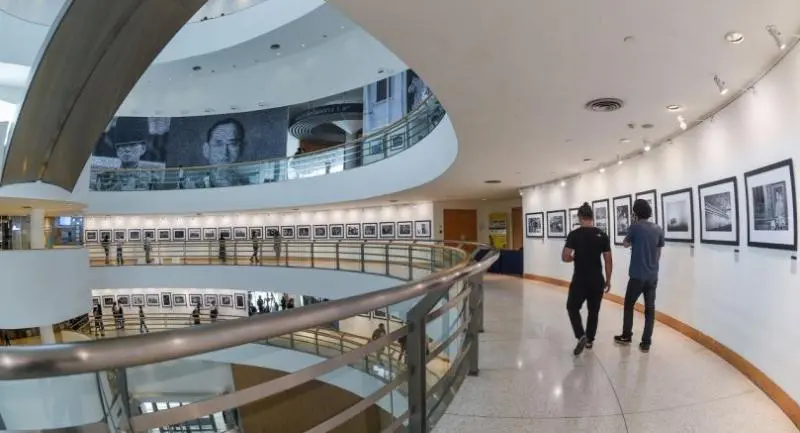
One of the most stirring artistic tributes to the late King will be among the last – the major exhibition “For Our Supreme Artist”, gathering works by more than 120 artists. Professor Apinan Poshyananda of is in charge of the curatorial team assembling the sprawling show at the Bangkok Art and Culture Centre.
“Since the King passed away we’ve witnessed a phenomenal increase in the number of paintings, photographs and music dedicated to him, as well as creativity in the new media,” he points out. “The BACC will present the art of the reign of King Rama IX throughout most of the year. The centre will devote its three main halls on the seventh to ninth floors to this show.”
King Bhumibol’s own paintings will form the highlight of the exhibition. They’ll be joined by hundreds of artworks created especially in tribute to the talented monarch esteemed as the country’s supreme artist.
“Many of the works will be conceptual,” Apinan says, “and from many different venues I will be selecting other outstanding pieces done in the wake of the King’s passing.”
The shifting phases of the show begin early in the year with work by leading graffiti and pop artists like Alex Face, Yuri Kensaku and Wisut Pornnimitr, who’ve been invited to pay homage to the King in their own style on the art centre’s curved exterior wall. At the same time members of art institutes will paint a mural on the wall connecting the centre to the National Stadium BTS station, depicting scenes of people grieving the death of the monarch, along with a tribute to His Majesty King Vajiralongkorn.
Silpakorn University, whose students and alumni initiated the artful public renderings of the late King in the days after his death, is also planning a major art exhibition of its own on King Rama X at its Tha Phra campus.
NEW PLACES TO SEE
Had he lived beyond 2000, Montien Boonma – one of the great pioneers of Thai contemporary art – would be turning 64 on February 25, a date his estate will commemorate by opening a new art archive called Montien’s Atelier.
“His home studio in Nonthaburi has been converted to better present his masterpieces, sketches, documentation and equipment,” says curator Somsuda Piamsumrit.
Montien’s only son opened the family homestead at 408 Ngamwongwan 25, Sub-soi 3, to the public early this year as 408 Art Space. The Atelier retains the cafe on the first floor while housing the archive of work on the second. Somsuda says visitors will also be able to view the installation “House of Hope (Homage to Montien Boonma)” by Navin Rawanchaikul, who Montien mentored.
Much attention will be shifting to Narathiwat Rachanakarin Road, where an arts community called N 22 is further blossoming since the opening of four galleries and studios. Next year two more art studios will open. Visitors will be able to browse the shows, watch movies and enjoy live performances.
N 22 has risen from an abandoned warehouse under the guidance of internationally acclaimed artist Rirkrit Tiravanija. Aiming to help make the Thai art scene more self-sufficient in the absence of steady government backing, it provides a place for conceptual artists to sell their work and gain recognition beyond our borders.
One of the current tenants at N 22 is the Ver Gallery, which moved last February from its former location. There are also Cartel owned by artist Mitr Jai-in and Takerng Pattanopas’s studio and a cafe-gallery-studio Tentacles. Last month Angkrit Ajchariyasophon arrived from Chiang Rai to open the Artist-run Space.
Early next year, we’ll see Kamon Phaosawas and Ruangsak Anuwatwimon open studios there.
OUT IN THE WORLD
The coming year sees a rare convergence of three prestigious art events – the Venice Biennale in that historic Italian city, Documenta 14, which is held every five years, expanding to include Athens as well as Kassel, Germany, and Skulptur Projekte in Munster, Germany, returning after 10 years. Thailand’s Arin Rungjang, among the country’s representatives in Venice in 2013, will be participating in Documenta 14 next spring.
The decision is awaited as to which talents will share their work in the Thai Pavilion at the 57th Venice Biennnale in the summer. The Office of Contemporary Art and Culture is selecting curators who will in turn propose artist-ambassadors.
Thailand has had its own pavilion in Venice since 2003, with Professor Apinan the perennial man in charge.
