
Thailand-Cambodia sea dispute enters crucial UNCLOS phase



Thailand and Cambodia move into a key UNCLOS conciliation stage over their maritime overlap, with a neutral chair to be chosen within 30 days
- Thailand and Cambodia have entered a compulsory conciliation process under the UN Convention on the Law of the Sea (UNCLOS) to resolve their overlapping maritime claims, after Thailand terminated a 2001 memorandum of understanding.
- Both countries have appointed their two conciliators to a commission, with the next crucial step being the selection of a neutral chair to oversee the process.
- A core issue is their differing goals: Thailand wants a complete delimitation of all maritime boundaries, while Cambodia favors a joint development model for energy resources in the disputed area.
- The commission's recommendations, expected within 12 months, will be non-binding but are intended to create a framework for future negotiations rather than a final legal ruling.
Thailand and Cambodia have entered a new round of talks over their overlapping maritime claims under the United Nations Convention on the Law of the Sea, or UNCLOS, with both countries now moving towards a key stage in the compulsory conciliation process.
The latest step follows Thailand’s decision on May 5, 2026, to terminate the 2001 memorandum of understanding, widely known as MOU 44, which had covered negotiations over the overlapping continental shelf area between the two countries.
After the termination of MOU 44, Thailand shifted towards using UNCLOS as the main international legal framework for future negotiations.
Cambodian Prime Minister Hun Manet later submitted letters to the Thai government and the United Nations secretary-general to begin compulsory conciliation under UNCLOS over the two countries’ overlapping maritime area.

Both sides appoint conciliators
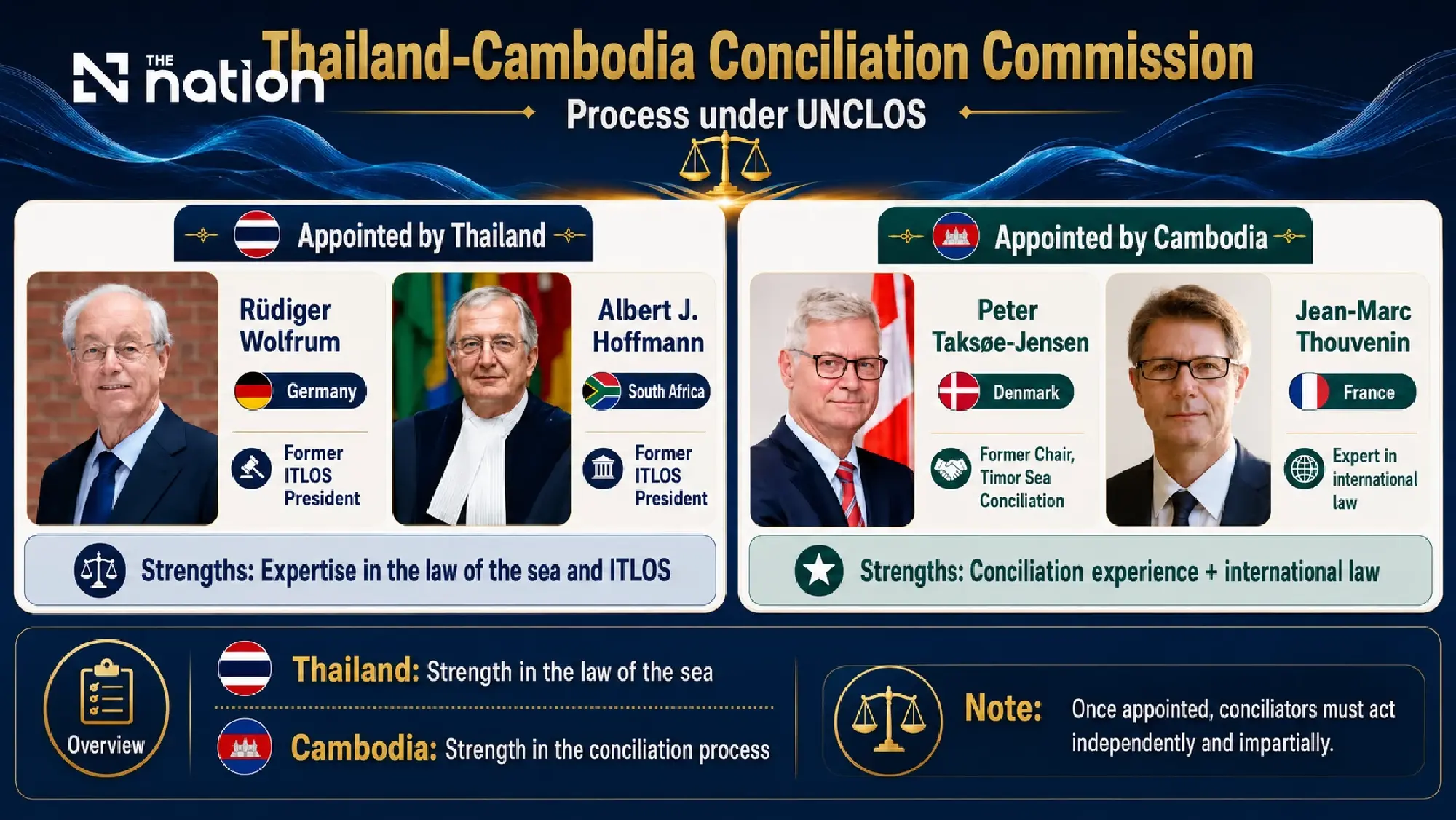
Capt Bundit Sripa, a former merchant-marine captain and maritime policy and logistics analyst, said both Thailand and Cambodia had now appointed all four conciliators, with each side naming two members to the commission.
The remaining task is to select the chair of the conciliation commission. The chair must be a neutral figure accepted by both countries.
“The key step at this stage is the selection of the commission chair, which must be completed within 30 days from the date Thailand formally notified Cambodia on June 19. If no agreement can be reached, the United Nations secretary-general will make the appointment,” Capt Bundit said.
Thailand leans on maritime-law expertise
Thailand has appointed Rüdiger Wolfrum and Albert J. Hoffmann as its conciliators. Both are former presidents of the International Tribunal for the Law of the Sea, or ITLOS, a central institution in the UNCLOS maritime-law system.
Their appointments give Thailand strength in institutional maritime law, particularly on issues involving jurisdiction, baselines, base points, islands, continental shelves, exclusive economic zones and equitable principles in maritime delimitation.
Wolfrum also has direct experience in the Timor Sea conciliation process, meaning Thailand’s team is not simply court-oriented but also familiar with the practical use of conciliation under UNCLOS.

Cambodia signals a Timor-style strategy
Cambodia has appointed Peter Taksøe-Jensen and Jean-Marc Thouvenin, choices seen as strategically significant.
Taksøe-Jensen is a Danish diplomat and international-law expert who previously served as Assistant Secretary-General for Legal Affairs at the United Nations and as legal adviser at Denmark’s foreign ministry.
His most important experience is his role as chair of the Timor Sea conciliation between Timor-Leste and Australia, a key precedent for compulsory conciliation under UNCLOS. That process led to a maritime-boundary treaty between the two countries in 2018.
Thouvenin is a French professor of international law and secretary-general of The Hague Academy of International Law. His strength lies in structuring legal arguments and presenting state claims in the language of international law.
Together, the two appointments suggest Cambodia is giving strong weight to what analysts call the “Timor model”, using compulsory conciliation under UNCLOS to move a stalled bilateral dispute into an international framework, creating both legal and diplomatic pressure.
Two countries still see the dispute differently
Capt Bundit said the role of the conciliation commission is to hear information and legal reasoning from both sides before preparing recommendations for a possible settlement within 12 months.
The process is governed by Annex V of UNCLOS.
However, the central problem remains that Thailand and Cambodia approach the overlapping maritime area from different angles.
Thailand wants maritime boundaries to be clearly delimited, covering the continental shelf, exclusive economic zone and territorial sea, so each country can use resources within its own area without future disputes.
Cambodia, by contrast, wants part of the overlapping area to remain available for joint development of energy resources, in a model similar to past cooperation between Thailand and Malaysia.
“Thailand wants the delimitation to be clearly completed, while Cambodia sees part of the overlapping area as still usable for negotiations on joint energy-resource sharing,” Capt Bundit said.
Recommendations would not be binding
If the 12-month process ends without agreement, the conciliation commission will prepare a recommendation report to guide the next stage of talks.
The report would not be legally binding in the same way as a court judgment. It would not have the power to force either country to accept a boundary line or any direct proposal.
However, Capt Bundit said the recommendation report would still carry practical weight because it would create a clearer framework for further negotiations.
In that sense, the process would make it harder for either side to avoid talks. Both countries would be expected to continue discussions under the recommended framework.
Dispute could move closer to court process
If the conciliation process runs its course and still fails to produce an agreement, or if either side cannot accept the recommendations, the dispute could eventually be raised to an international judicial process.
Capt Bundit said the Thailand-Cambodia case is more complex than the Timor-Leste-Australia precedent because it involves both maritime boundary issues and linked land-boundary sensitivities.
The most delicate areas include Trat province and related border zones, where political and security concerns remain sensitive.
Neutral chair seen as critical
The next appointment could therefore shape the direction of the entire process.
Capt Bundit said the chair of the conciliation commission will be crucial to the success of the UNCLOS process because the role requires more than legal expertise.
The chair must also have diplomatic skill and the ability to build consensus between two countries with different strategic interests.
A successful chair could help keep the negotiations moving and reduce the risk that the dispute will eventually be pushed into an international court process.
