
Chadchart declares victory in Bangkok governor race, heading for landslide second term



Chadchart Sittipunt declared victory in the Bangkok governor election after unofficial results showed him far ahead, giving the independent incumbent a second term to pursue his city agenda.
Chadchart Sittipunt declared victory in the Bangkok governor election on Sunday night, after unofficial results showed him heading for a landslide second-term win and extending a political journey that has taken him from transport technocrat and Cabinet minister to one of the capital’s most recognisable local leaders.
According to the latest unofficial count, Chadchart secured around 1.444 million votes, or 94.99% of counted ballots, comfortably ahead of his nearest rival, Mallika Boonmeetrakool Mahasuk, who received 288,171 votes, with 89.86% of ballots counted on Sunday night.
The result gives candidate No 9 another four years to prove whether his brand of practical, data-driven urban administration can continue to respond to Bangkok’s long-standing problems — from flooding and traffic to inequality, public health and quality of life.

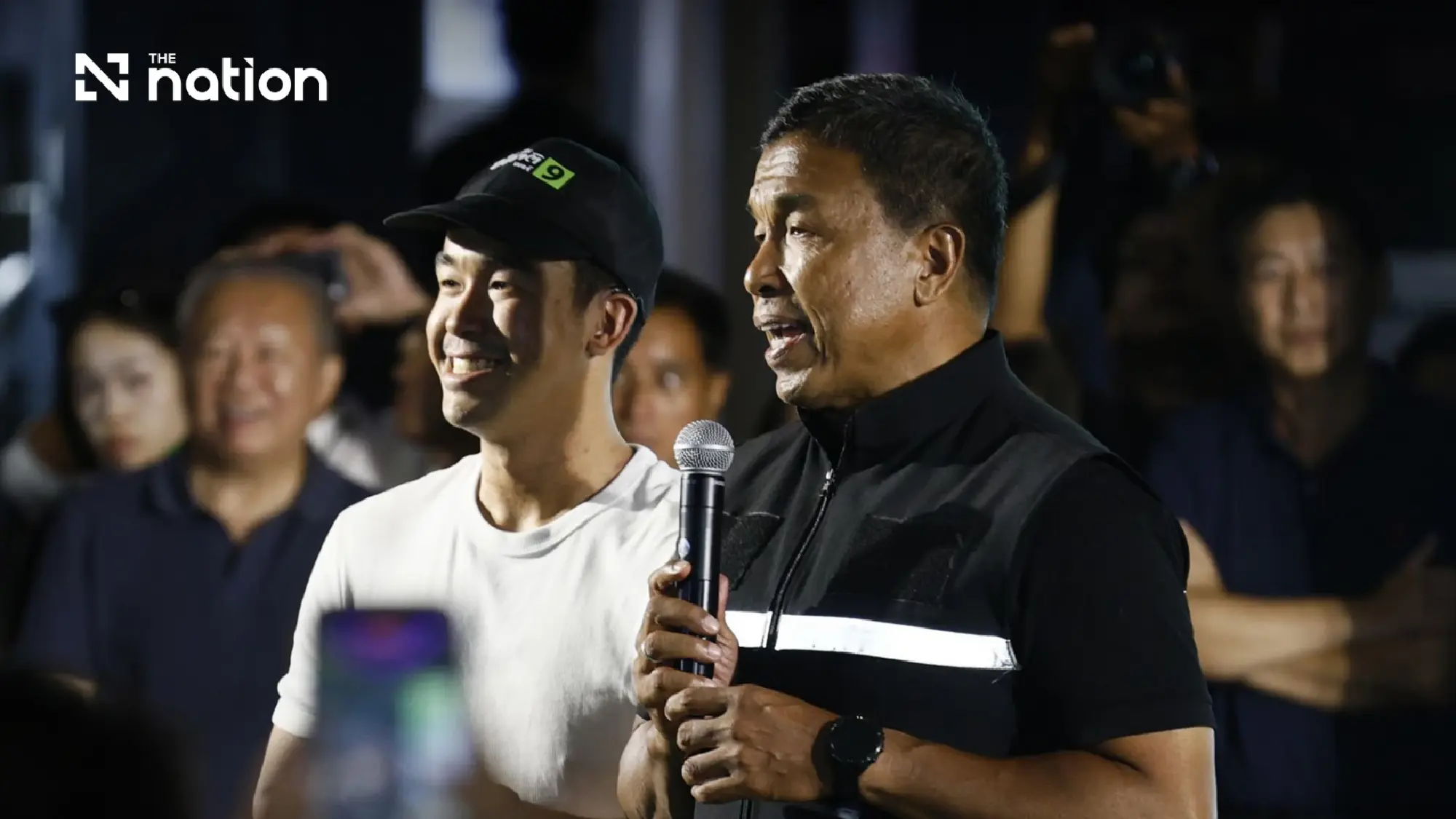
Speaking after the vote count showed him leading by a wide margin, Chadchart said the result was not a moment for celebration, but a signal that his next term would carry heavier responsibility. He thanked voters after more than half the ballots had been counted, saying the task ahead would be more difficult than his first term because public expectations had risen and global conditions and technology were changing rapidly.
‘Not a victory, but a command from the people’
Chadchart said he would serve all Bangkok residents, regardless of whether they had voted for him.
He thanked voters for exercising their democratic right and said every vote carried value. He described the trust reflected in the ballots as a commitment that must be translated into urgent action to improve the capital.

He noted that his share of the vote appeared to have risen from around 51% in the previous election to about 64% in the early count this time, saying the trend reflected broader acceptance of his team’s policies among Bangkok residents.
“This is not a victory, but a command from the people,” Chadchart said, adding that the moment should be used to prepare carefully for the work ahead.

First 100 days to focus on difficult problems
Chadchart said that once the Election Commission officially endorses the result, his first task will be to turn more than 260 policy plans prepared by his team into a clear strategic plan.
The policies will be prioritised, with an urgent action plan drawn up for the first 100 days of the new term.
He said the administration would focus first on the most difficult and complex problems because they require more time to address and deliver results.
Transparency and anti-corruption will also remain a priority, he said, after the issues became a public concern during the campaign.
Chadchart said his administration would continue to pursue these matters seriously in order to honour the trust voters had placed in him.
Ready to work with all sides
Chadchart said he had received a phone call from Chaiwat Sathawornwichit, the People’s Party candidate for Bangkok governor, who congratulated him and shared policy proposals.
The proposals included issues related to early childhood development centres and flood prevention. Chadchart said useful policies from all parties would be studied and considered for future cooperation.
“Cooperation with all sectors should not be a problem. Once the election is over, everyone is an ally, everyone can talk, and everyone can help develop this city together. Every vote cast by the people is valuable, no matter who they voted for,” he said.
He added that he was ready to listen to all views and use them to find the best solutions for Bangkok residents.
Chadchart said the election result was not the achievement of one person alone, but the result of hard work by his campaign team, support staff, volunteers and others who helped communicate his policies throughout the campaign.


From engineer to transport policymaker
Chadchart’s path into politics did not begin as that of a career politician.
Trained as a civil engineer, he first became known for his specialist expertise in transport and infrastructure. Before entering elected politics, he worked behind the scenes as an adviser to the Ministry of Transport from the second Thaksin Shinawatra administration through to the Samak government.
His major political turning point came in early 2012, when then-prime minister Yingluck Shinawatra invited him to join her Cabinet.
He first served as deputy transport minister before becoming transport minister in October of the same year. He was later named one of Pheu Thai’s prime ministerial candidates in the 2019 general election, placing him firmly on the national political stage before he repositioned himself as an independent contender for Bangkok’s top job.
First landslide built his City Hall platform
After years away from front-line politics following the 2014 coup, Chadchart returned in the 2022 Bangkok governor election as an independent candidate.
He won that race by a landslide, receiving 1,386,215 votes in the unofficial final count, with turnout at 60.73%, according to Thai PBS.
That victory gave him a strong mandate to run City Hall from 2022 to 2026 under the slogan “Bangkok, a liveable city for all.”
The slogan became the central message of his first administration. It framed Bangkok not only as a city of roads, drains and infrastructure, but also as a place where public services, safety, opportunity and inclusion should reach people across all districts.
First term built around data and systems
A key part of Chadchart’s first-term work was systematic water management.
His administration introduced the “Water Traffic Control” approach, using water-level sensors and drainage mapping to improve the city’s ability to monitor and manage flood risks.
The approach reflected his engineering background: Bangkok’s problems, he often argued, could not be solved only through emergency response. They required data, coordination and better systems.
That thinking also shaped his broader administrative style. His team sought to use technology, district-level problem tracking and public communication to make City Hall more responsive to residents’ everyday complaints.
Social policy broadened his first-term record
Beyond infrastructure, Chadchart’s first term also became notable for social policy.
In 2026, the Bangkok Metropolitan Administration received the UNDP Gender Equality Seal Gold, becoming the first public institution in Asia and the Pacific to achieve Gold certification under the programme. UNDP said Bangkok scored 94.8% in its final evaluation and met 38 out of 40 indicators.
The BMA’s gender-equality initiatives included the establishment of 31 BKK Pride Clinics, efforts to reduce the gender wage gap and policies allowing staff to dress according to their gender identity.
These achievements helped broaden Chadchart’s image from an infrastructure-focused governor to a city leader promoting inclusion as part of urban management.
Second term brings tougher expectations
Winning a second term brings a different test.
In 2022, Chadchart entered City Hall with the momentum of a landslide and high public expectations. In 2026, he returns with a record that voters can now judge — and with pressure to show that first-term projects can deliver deeper, more visible results.
The second term is likely to test whether his administration can move from problem-tracking and pilot projects to structural improvements in areas that matter most to Bangkok residents: traffic congestion, drainage, pavement quality, public transport links, waste management, safety, green space and public health.
It will also test his ability to work with the Bangkok Metropolitan Council and national agencies, since many of Bangkok’s biggest problems cannot be solved by City Hall alone.
Goal: make Bangkok a leading global city
Chadchart said his key goal over the next four years is to make Bangkok a city that can compete internationally and stand alongside leading cities around the world.
He said he believed Bangkok had the potential to achieve that goal if residents, officials and all sectors worked together.
For Bangkok residents, the question is no longer whether Chadchart understands the city’s problems. After four years in office, the bigger question is whether his second term can deliver solutions that are faster, deeper and more clearly felt in daily life.
