
Maysak and Typhoon Bavi storms put Asia on weather alert
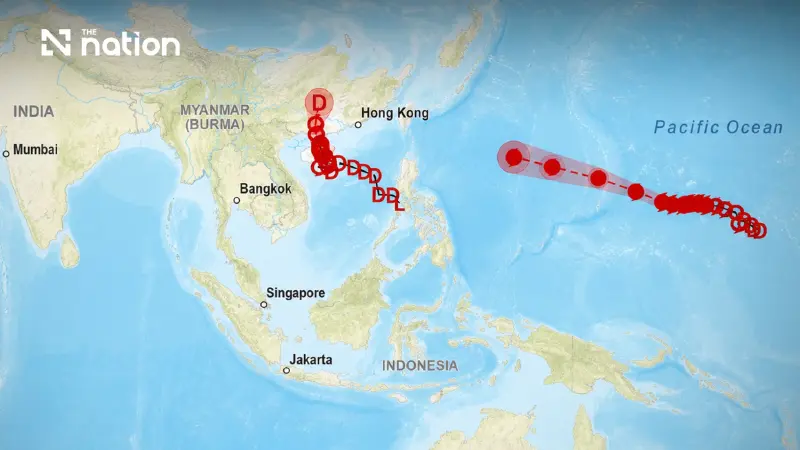


Thailand is bracing for heavy rain and rough seas as Maysak moves towards southern China and Bavi strengthens in the western Pacific
- Tropical Storm Maysak is moving across the South China Sea, expected to bring very heavy rain to Hainan Island and several provinces in southern and eastern China.
- Typhoon Bavi is intensifying over the western Pacific Ocean and is forecast to track towards the Philippines, Taiwan, and mainland China, bringing heavy rainfall.
- The influence of Maysak is also causing wider weather alerts, bringing heavy rain and hazardous marine conditions to Thailand and prompting warnings of potential floods.
Two tropical storms forming over Asian waters are being closely monitored, with Tropical Storm Maysak moving across the South China Sea and Typhoon Bavi intensifying over the western Pacific.
Chawalit Chantararat, chief executive officer and chairman of TEAM Group, said Maysak, the 10th storm of 2026, had formed in the South China Sea and was moving northwards with a slight westward track.
The storm was expected to bring very heavy rain to Hainan Island and parts of southern and eastern China, including Guangxi, Jiangxi, Anhui, Jiangsu and Shandong, before weakening and dissipating around July 8.
The Thai Meteorological Department, in its third announcement on Maysak, said the tropical storm was located over the upper South China Sea, or south of Hainan Island, at 4pm on July 3. Its centre was about 400 kilometres south of Nanning in China, near latitude 18.3 degrees north and longitude 109.9 degrees east, with maximum sustained winds near its centre of about 74 kilometres per hour.
The department said Maysak was moving slowly northwards and was expected to pass over Hainan Island on the evening of July 3 before making landfall near Nanning in southern China between July 4 and 6. The centre of the storm was not expected to move into Thailand. Earlier TMD information also placed Maysak over the upper South China Sea and forecast landfall in southern China during July 4-6.
However, Maysak’s influence, together with the monsoon trough over the North and upper Northeast and a fairly strong south-westerly monsoon over the Andaman Sea, Thailand and the Gulf of Thailand, is expected to bring more rain to Thailand.
Heavy to very heavy rain is forecast in some areas of the North, upper Northeast, East and South from July 3 to 4. From July 5 to 6, heavy to very heavy rain is expected to continue in parts of the upper North and upper Northeast.
From July 3 to 8, Thailand is expected to see heavy to very heavy rain in some areas of the upper Northeast, and heavy rain in parts of the North, areas bordering Myanmar, the Central region, the East and the west coast of the South. Rain is expected to ease during July 6-8 as the monsoon trough shifts northwards across Myanmar, Laos and upper Vietnam.
Authorities have warned of possible flash floods, forest run-off and overflowing waterways, particularly in foothill areas, near watercourses and in low-lying communities.
Marine conditions are also expected to worsen. Waves in the upper Andaman Sea are forecast at two to three metres, rising above three metres during thunderstorms. In the lower Andaman Sea and the upper Gulf of Thailand, waves are expected to reach about two metres and exceed two metres in stormy areas.
Boat operators have been advised to proceed with caution and avoid sailing in areas with thunderstorms. Small boats in the upper Andaman Sea should remain ashore during the period.
Maysak first developed in the upper South China Sea and moved northwards with a slight westward direction. It was forecast to make landfall over Hainan on July 3, bringing very heavy rain, before moving inland and affecting southern Guangxi on July 4-5.
It is expected to weaken into a depression during July 6-7, bringing heavy rain to Jiangxi and Anhui, before tracking north-north-eastwards and affecting Jiangsu and Shandong during July 7-8, then dissipating.
Another system, Typhoon Bavi, the ninth storm of 2026, formed over the Pacific Ocean and has been moving westwards. It strengthened rapidly on July 3 and was forecast to intensify further while moving west-north-west.
Weather agencies and international reports were also monitoring Bavi’s rapid intensification over the western Pacific, with forecasts indicating that the storm could strengthen further as it tracked westwards. Reports from Taiwan said its possible impact on Taiwan remained uncertain at that stage because the system was still far away, while other forecasts pointed to a possible track towards Taiwan and mainland China next week.
According to the forecast cited by Chawalit, Bavi is expected to bring heavy rain to northern parts of the Philippines on July 9, before making landfall and causing very heavy rain in Taiwan on July 10.
The system is then forecast to move towards China, bringing very heavy rain to Fuzhou during July 10-11, heavy rain to Wuhan during July 12-13 and heavy rain to Nanjing during July 14-15, before weakening and dissipating.
The TMD has urged people to plan travel and daily activities carefully during the affected period and to follow official weather updates closely.
