
PM Anutin presents Thailand FastPass to attract Australian investors
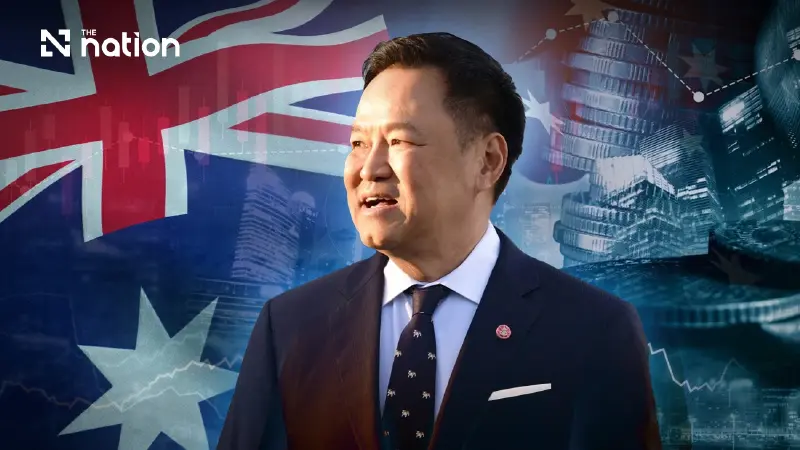


Australian firms signalled plans to expand in Thailand, while labour ministers were tasked with addressing concerns over work visa periods.
- Prime Minister Anutin Charnvirakul presented the "Thailand FastPass" policy during a visit to Australia to attract investment from Australian businesses.
- The FastPass is a one-stop service from the Thailand Board of Investment (BOI) intended to facilitate investment and remove obstacles for foreign companies.
- The initiative, which included business matching events, reportedly resulted in several Australian companies deciding to expand their operations into Thailand.
- The visit was also framed as a "win-win" that created opportunities for Thai investors to grow their businesses in Australia.
Prime Minister Anutin Charnvirakul invited Australian businesses across several sectors to expand their operations in Thailand during an official visit that he described as highly satisfactory.
Anutin made the remarks in Canberra at 5.40pm local time on Wednesday (August 19, 2026), 3 hours ahead of Thailand, after completing the visit, which ran from August 17 to 19.
The government presented the Thailand Board of Investment’s (BOI) Thailand FastPass policy, a one-stop service intended to facilitate investment and remove obstacles for foreign investors through a single point of contact.
Business matching between the private sectors of both countries helped the visit exceed expectations, Anutin said.
The initiative created opportunities for exchanges and further negotiations leading to joint ventures involving large-scale businesses, while fostering what he described as a “win-win” trading environment with substantial economic value.
“Several companies told me during the talks that they had just decided to expand their operations in Thailand.
Ultimately, they will choose Thailand as a new production base.
The visit was successful on 2 fronts.
It not only attracted investors to Thailand but also opened opportunities for Thai investors to grow in Australia.”
Major Thai business groups had also undertaken numerous mergers and joint ventures in the energy, chemical and hotel sectors, Anutin added.
He highlighted Frasers Property Limited, part of the Thai Charoen Corporation Group (TCC Group), saying the group’s property holdings in Australia were valued at up to THB230 billion.
Their presence had helped show Australians that Thailand was not solely an agricultural economy, but also home to major investors capable of investing in large-scale industries abroad.
Concerns over the duration of work visas for Thai workers were also raised during the visit.
The Australian prime minister acknowledged that the validity periods might be too short, and the labour ministers of both countries were tasked with discussing a joint solution.
“Foreign countries once worried that Thai workers would arrive and refuse to return home. Today, Thais no longer go abroad merely to provide cheap labour. We bring skills, expertise, knowledge and technology.”
The success of young Thais working for a global technology company such as Canva offered another example of how their capabilities and intellect could help drive a leading organisation.
The visit also covered the arrests of Thai nationals on allegations of smuggling drugs into Australia.
Anutin said the alleged conduct was not a matter of ignorance.
His government was firmly opposed to drug trafficking in all forms and could not assist anyone found to have broken the law.
Anutin told Australian Prime Minister Anthony Albanese that Australia should take full legal action against anyone found to have violated its laws.
The Thai government would not interfere in or intervene in any judicial process.
Albanese responded that he understood the cases involved individual wrongdoing and did not consider them damaging to Thailand’s reputation.
Australia continued to regard Thailand as an important partner in combating cybercrime and scam gangs.
Thai authorities had already cracked down on such networks and frozen assets worth more than THB50 billion and possibly as much as THB60 billion.
