A three-front oil shock is squeezing crude, refined fuels and shipping as Thailand confronts rising costs and a 61.5bn-baht fuel fund deficit
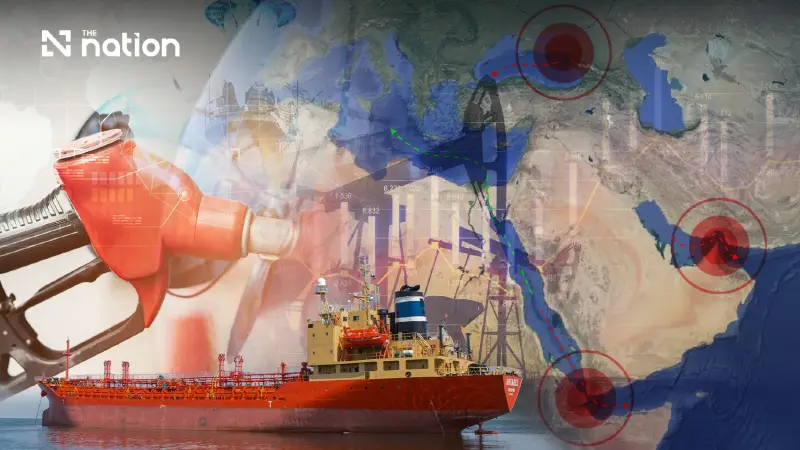
A global oil crisis is escalating due to simultaneous supply disruptions in three key maritime routes: the Strait of Hormuz, the Bab el-Mandeb strait, and the Black Sea.
The crisis is testing the Thai government's weakened ability to manage fuel prices, as its primary buffer, the Oil Fuel Fund, has fallen into a significant deficit of 61.5 billion baht.
Unlike the 2008 demand-driven price surge, the current shock stems from conflict affecting shipping lanes and refinery capacity, which directly increases the cost of refined fuels, freight, and insurance.
The government is challenged to shift from costly blanket fuel subsidies to targeted assistance for vulnerable groups while pursuing long-term strategies to reduce oil dependence.
Brent crude’s return above US$100 a barrel has exposed Thailand’s weakened ability to cushion fuel prices, as conflict threatens three major export routes and raises the cost of refined products, freight and insurance.
Brent futures settled 7% higher at US$100.69 on Thursday, July 23, their highest close since May 22. Yemen’s Houthi movement said it had attacked two Saudi tankers in the Red Sea. Saudi authorities confirmed that one vessel caught fire after an assault but did not identify the attacker.
The attacks have added the Bab el-Mandeb strait to a supply problem already centred on the Strait of Hormuz, where conflict involving the United States and Iran has severely restricted normal traffic. A third disruption has emerged on Russia’s Black Sea coast after suspected drone strikes forced the Caspian Pipeline Consortium to suspend operations at its terminal near Novorossiysk, prompting Kazakhstan to reduce production.
Hormuz and Bab el-Mandeb together carry the equivalent of roughly a quarter of global oil supply, while the Caspian route handles about 2% of daily crude supply. The simultaneous pressure is affecting not only crude availability but also refinery supplies, finished-fuel exports, tanker availability and insurance costs.
Only one oil tanker crossed Hormuz on July 23 and none entered the strait, the lowest daily traffic since May 7. Saudi Arabia has diverted more crude through its East-West pipeline to Yanbu, but most Asia-bound cargoes would then normally pass through Bab el-Mandeb, where Houthi attacks and the group’s declared blockade of Saudi oil shipments have led some vessels to change course.
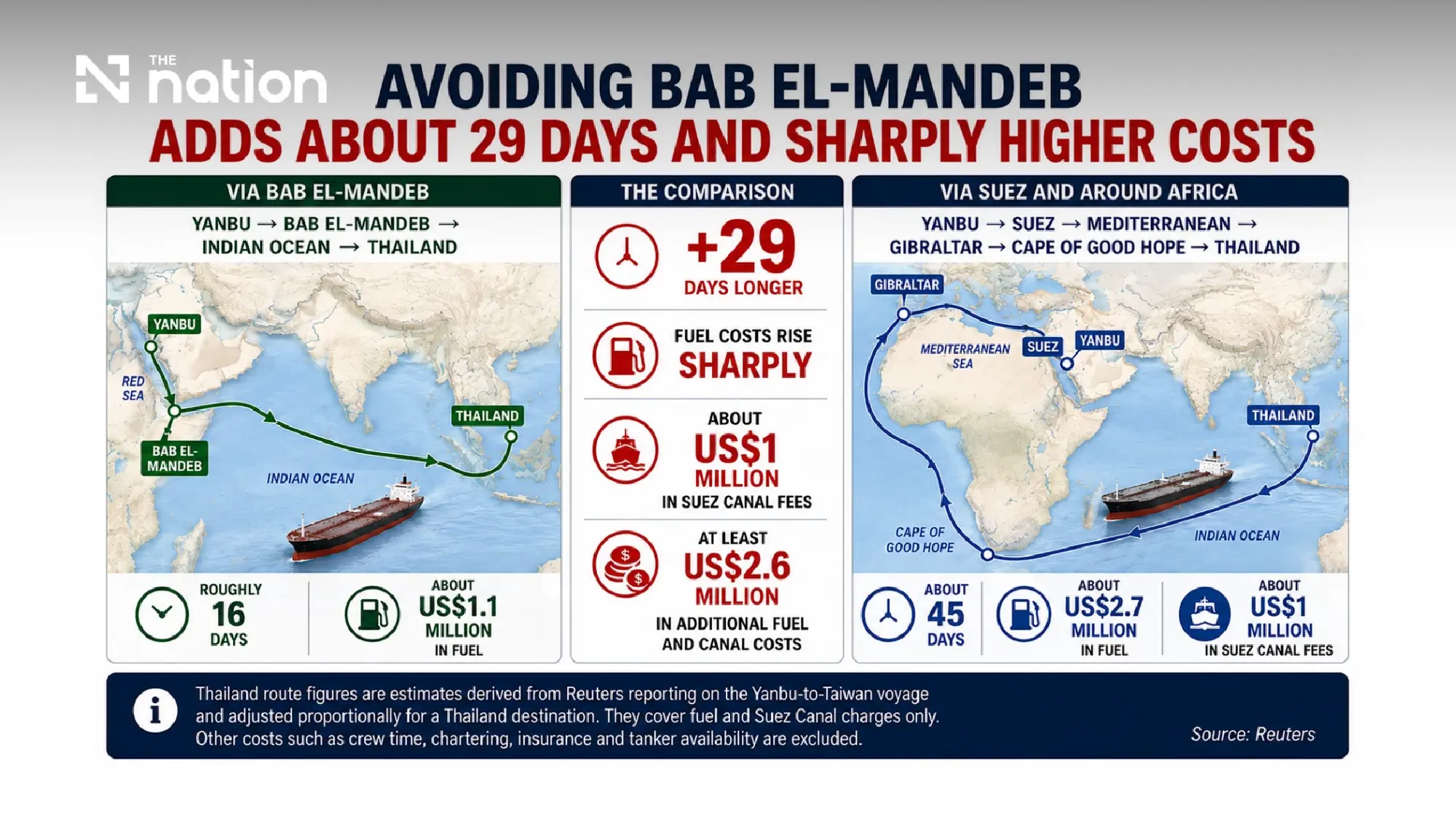
Avoiding Bab el-Mandeb substantially lengthens voyages. A tanker sailing from Yanbu to Thailand would take roughly 16 days via the strait, compared with about 45 days via the Suez Canal, the Mediterranean, Gibraltar and the Cape of Good Hope. The detour would also sharply increase fuel costs and incur about US$1 million in Suez Canal charges.
In the Black Sea, output at Kazakhstan’s Chevron-led Tengiz field fell to about 406,000 barrels a day from a July average of 925,000 after operations at the Caspian terminal were suspended. Russia blamed Ukraine for the suspected attacks; Kyiv had not commented.
Why this is not a repeat of 2008
The 2008 surge was driven mainly by years of global demand growing faster than production and processing capacity. Rapid expansion in emerging economies met limited spare output and tight inventories. The International Monetary Fund identified sluggish supply growth and stretched spare capacity as central causes.
Brent approached US$147 a barrel in July 2008. It then averaged US$39.95 in December as the global financial crisis crushed production, trade, transport and travel. Prices fell rapidly because demand was destroyed, not because supply constraints had been quickly solved.
The current shock is more directly rooted in war, threatened shipping lanes and lost refinery capacity. Brent has remained below the 2008 record partly because China has cut imports, US production reached a record 13.93 million barrels a day in April, and emergency stocks and alternative routes have replaced some missing Gulf supply.
Emergency reserves are also falling. The US Strategic Petroleum Reserve dropped to 311.4 million barrels in the week ending July 17, its lowest level since March 1983 and more than 104 million barrels below its level when the conflict began in late February. Official reserves across advanced OECD economies were already at their lowest level since December 1990.
Refined fuel, not Brent alone, drives Thailand’s risk
The tighter market may increasingly be diesel, petrol and aviation fuel rather than crude itself. Some Middle Eastern producers can use pipelines to move crude outside Hormuz, but refined products have fewer alternatives because much of the Gulf’s refining and export infrastructure still depends on the strait.
Damage to Russian refineries has added to the pressure. Ukrainian attacks were estimated to have disrupted about a quarter of Russia’s refining capacity of roughly seven million barrels a day, removing part of the supply from one of the world’s leading diesel exporters.
Singapore gasoil, the regional benchmark used in diesel pricing, closed at US$156.72 a barrel on July 22, up 43% from its post-ceasefire low on June 26. Singapore petrol reached US$119.70.
Despite increased shipments from India, Asia’s imports of light and middle distillates in July remained an estimated 18% below their average during the three months before the conflict. Additional Indian exports have therefore not fully replaced lost Middle Eastern and Russian supplies.
Thailand’s pump-price formula makes those benchmarks decisive. Domestic prices begin with an ex-refinery cost influenced by Singapore product prices, then include taxes, Oil Fuel Fund payments or subsidies, energy-conservation levies, retail margins, the baht exchange rate and import-related transport costs.
A 10% increase in Brent therefore does not automatically produce a 10% increase at Thai pumps. Government intervention can delay the adjustment, while a weaker baht, higher freight charges or a sharper rise in Singapore diesel and petrol can push domestic costs up even when crude stabilises.
Thailand’s fuel fund is back in deficit
The Oil Fuel Fund had assets of 39.84 billion baht and liabilities of 101.34 billion baht as of July 19, leaving a net deficit of 61.5 billion baht. Its subsidy bill was running at about 651.31 million baht a day, while most standard petrol, gasohol and diesel prices rose by 90 satang a litre on July 23.
During the 2008 price peak, the fund was about 3.3 billion baht in positive territory. The government also used excise-duty cuts to lower domestic diesel and gasohol prices despite high international costs.
The fund briefly returned to a surplus in February 2026 before subsidies during the Middle East crisis pushed it back into deficit. Even then, outstanding liabilities and earlier borrowing obligations restricted the financial space available.
Energy economist Praipol Koomsup has warned that continued blanket subsidies could push the deficit towards 100 billion baht. He has urged the government to protect vulnerable households and businesses directly instead of subsidising every consumer.
Thailand’s immediate danger is therefore not simply whether Brent again reaches US$147. It is whether Singapore fuel prices, the baht, freight and war-risk insurance rise faster than the fund and temporary government measures can absorb them.
Four priorities for Thailand
A ceasefire or negotiations that restore confidence in passage through Hormuz and Bab el-Mandeb would provide the quickest relief. Recovery at Russian refineries and the Black Sea terminal would also ease pressure.
A prolonged three-front disruption would instead combine fewer available cargoes, longer voyages and lower refinery output.
Domestic policy can reduce the impact through four priorities
1. Replace blanket subsidies with targeted assistance
Support could be directed to low-income households, farmers, small businesses and essential transport operators through state welfare cards, direct transfers or limited fuel discounts.
IMF research on Thailand estimated that broad subsidies were about 17 times more expensive than support limited to people below the national poverty line. Households above median income received about 71% of total fiscal assistance because wealthier consumers generally used more energy.
2. Keep the Oil Fuel Fund and tax cuts temporary
The fund can smooth sudden price changes but cannot hold retail prices below cost indefinitely. Each intervention should have a time limit, spending ceiling and exit condition, accompanied by a plan to rebuild the fund when international prices decline.
Temporary excise-duty reductions could be reserved for fuels essential to public transport, freight and agriculture if prices rise sharply, with fixed expiry dates to limit lost revenue.
3. Cut demand and support essential transport directly
Fuel vouchers, distance-based compensation or temporary low-interest loans could protect buses, taxis and freight operators without subsidising diesel for every user. Controls would be needed to prevent duplicate claims or fraud.
Greater use of public transport, car-sharing, efficient freight scheduling, remote working where practical and lower energy use by state agencies and businesses would reduce the import bill and subsidy burden.
4. Strengthen reserves and reduce long-term oil dependence
Thailand should review strategic and commercial stocks of diesel, petrol, aviation fuel and liquefied petroleum gas, not only crude, while maintaining diverse suppliers and alternative transport arrangements.
Praipol has called for faster petroleum exploration and production, including concession bidding for potential resources in the Andaman Sea. New domestic production would take years, however, and would require transparent bidding, credible reserve estimates and environmental safeguards.
A faster reduction in structural demand could come from high-mileage vehicles. The government is developing a 24-billion-baht programme to replace as many as 80,000 ageing taxis, tuk-tuks, buses, trucks and other commercial vehicles with electric models, potentially using subsidies, low-interest loans and tax incentives.
Thailand cannot reopen Hormuz or Bab el-Mandeb, restore disrupted Black Sea supplies or dictate global fuel prices. It can, however, decide how the shock is absorbed at home. The immediate priority is to protect vulnerable households and essential transport without exhausting the Oil Fuel Fund.
The longer-term test is whether temporary relief is matched by stronger reserves, more diverse supplies and faster reductions in oil dependence. That balance, rather than holding pump prices down at any cost, will determine whether Thailand can withstand a prolonged crisis.