
Opposition challenges THB400bn loan over unclear energy plan
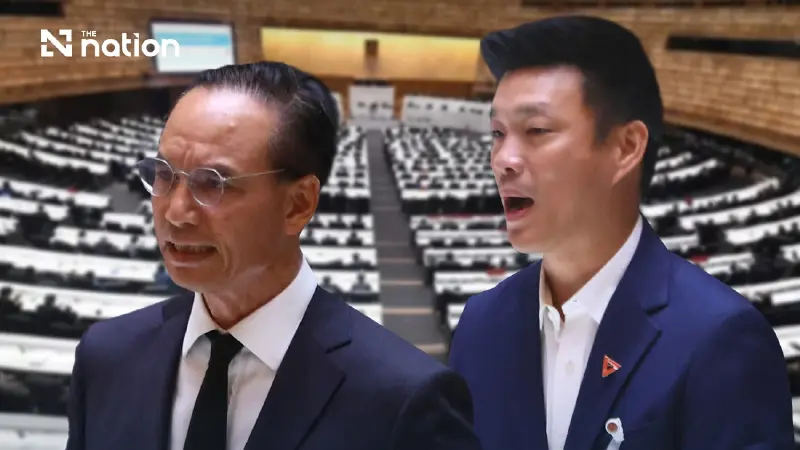


Natthaphong demands details on the second THB200bn, while Korn warns borrowing could push public debt beyond Thailand’s 70% ceiling.
Opposition MPs challenged the government’s THB400 billion emergency borrowing decree in the House of Representatives on Wednesday, demanding a detailed plan for the half earmarked for energy transition and questioning whether that spending was sufficiently urgent to justify extraordinary borrowing.
People’s Party leader and Leader of the Opposition Natthaphong Ruengpanyawut said he did not dispute the constitutional basis for the first THB200 billion intended to provide relief from the energy crisis.
However, he said he could not approve the entire decree unless the government explained how it would use the remaining THB200 billion, what structural changes it intended to achieve and why the programme had to be financed through government borrowing.
Korn Chatikavanij, a party-list MP and deputy leader of the Democrat Party, reinforced the opposition’s challenge by questioning whether the proposed rooftop-solar programme could be implemented within the borrowing period. He also warned that the decree could place further pressure on Thailand’s public-debt ceiling.
House Speaker Sophon Saram presided over the first sitting of the second annual ordinary session on Wednesday (August 26, 2026), with the decree listed as an urgent item on the House agenda.
The Emergency Decree Authorising the Ministry of Finance to Borrow Money to Address the Effects of the Energy Crisis and Advance the Country’s Energy Transition B.E. 2569 allows the ministry to borrow up to THB400 billion.
The government has attributed the need for the decree to the Middle East conflict and its effects on energy prices, living costs and people’s daily lives. It has also said its options for financing major measures through the regular annual budget are limited.
Relief half draws less opposition

Natthaphong said the opposition had repeatedly made clear that it did not object on constitutional grounds to the first THB200 billion intended to provide immediate relief.
The energy crisis affected national economic security, he said, while the government had an urgent responsibility to ease the burden on the public. Opposition MPs might disagree with the government over how the assistance should be delivered, but not necessarily over the need for relief itself.
The remaining THB200 billion required closer examination because it was intended for a longer-term transformation of Thailand’s energy system rather than immediate assistance, he said.
Natthaphong acknowledged the government’s argument that its annual budget options were constrained.
Under laws governing budget procedures and fiscal discipline, the amount the government can borrow to finance a budget deficit is linked to the revenue it collects. Higher state revenue allows the government to establish a larger annual expenditure framework and borrow more to cover a deficit.
Thailand’s fiscal space had narrowed, while government revenue as a proportion of gross domestic product was declining, Natthaphong said. He understood why the government might therefore believe it had few alternatives to an emergency borrowing decree.
That constraint did not, however, automatically establish that borrowing outside the annual budget was appropriate.
MPs had to examine whether an extraordinary source of funding, raised through an emergency decree rather than the regular expenditure process, was justified and suitable for the projects proposed, he said.
Parliament still must test urgency
Natthaphong also addressed the prime minister’s reference to the Constitutional Court’s ruling on the decree.
He said citing the ruling was not wrong, but stressed that the court had considered whether the decree complied with Section 172, paragraph one, of the Constitution.
According to Natthaphong, the court did not have the authority to decide the separate issue under paragraph two: whether the circumstances constituted an urgent and unavoidable necessity for issuing the decree. The court’s consideration centred on the constitutional conditions in paragraph one.
Parliament therefore retained full authority to scrutinise the executive’s use of an extraordinary legal mechanism and decide whether the decree met both the constitutional and practical tests of legitimacy, urgency and appropriateness, he said.
Natthaphong referred to constitutional provisions dating from 1932 that allowed the executive to issue emergency decrees when Parliament was unable to respond quickly enough or was not in session.
Later constitutions expanded that authority, allowing the government to issue a decree when it believed the parliamentary process would take too long, even during a parliamentary session, before seeking legislative approval afterwards.
The power should therefore be used only when the necessity was genuinely urgent and unavoidable, he argued.
Natthaphong said MPs had to consider two questions regarding the THB200 billion for energy transition.
The first was whether there was an urgent and unavoidable necessity that justified using an emergency decree.
The second concerned the substance of the spending plan: how the money would be used, which projects would receive it and whether those projects would produce a genuine structural energy transition.
Simply attaching terms such as “clean energy” or “rooftop solar” to large procurement projects was not enough, he said. The government needed to show how each investment would change the country’s energy structure.
The two questions could not be separated because a properly designed energy transition should proceed in stages, with investment directed to the areas where it would have the greatest effect.
Government borrowing was not the only available source of capital, Natthaphong said. Private investment, state enterprises, the three electricity authorities and existing funds could also contribute to the transition.
He added that four experts who had given evidence to the Constitutional Court had also questioned the clarity of the government’s energy-transition plan, placing the responsibility on the government to explain its objectives in detail.
People’s Party presents 12-year alternative
Natthaphong cited the proposed conversion of conventional buses to electric vehicles as an example of a project the government had linked to the second THB200 billion.
The People’s Party did not oppose replacing buses with EVs, he said, but changing vehicle technology alone would not amount to a structural energy transition.
A credible programme would also need investment in charging infrastructure, domestic supply chains powered by clean energy and an electricity system that relied less heavily on fossil fuels.
The government should explain how the THB200 billion would fit into a wider five- to 10-year plan and how much it would increase the share of clean energy used in Thailand, he said.
Natthaphong warned against securing approval for the decree through the relief component and then selecting energy projects afterwards.
A government that borrowed first and searched for projects later had “no plan”, he said. If a plan existed, ministers should be able to state its objectives, investment priorities and measurable targets.
The People’s Party had developed its own 12-year energy-transition proposal, divided into three four-year phases with combined investment of THB400 billion.
Natthaphong said most, or potentially all, of the investment could be financed without the government borrowing any of the money itself.
Under the party’s roadmap:
- Phase one, from 2027 to 2030, would prioritise infrastructure investment in Bangkok and the Eastern region, which the party says together account for 75% of Thailand’s electricity consumption.
- Phase two, from 2031 to 2034, would extend investment to other regions to support a more open electricity market and wider use of clean power. By the end of 2034, the programme would cover areas representing 87% of national electricity consumption and 53% of electricity users.
- Phase three, from 2035 to 2038, would expand the programme nationwide and upgrade the electricity system to a smart grid.
The final phase would also support electricity-market liberalisation, strengthen Thailand’s position in response to geopolitical pressures and increase its bargaining power, Natthaphong said.
The party wanted electricity in Thailand to be affordable, clean and fairly priced, while enabling the country to become an ASEAN hub for trading clean electricity. The phase-one dates and sequence are also set out in Natthaphong’s published plan.
Natthaphong said he was willing to discuss the roadmap with the government, but ministers first needed to explain their own targets and financing arrangements.
“If the government cannot provide clarity on its plan or explain why borrowing is necessary for the structural energy transition, we genuinely cannot approve this borrowing decree,” he said.
Korn questions solar timetable and debt impact

Korn told the House that Thailand faced four principal economic problems: weak growth, structural difficulties reflected in a widening current-account deficit, falling household incomes and persistently high prices.
He agreed with the government that oil prices had contributed to those pressures.
However, the Constitutional Court’s finding that the government was permitted to issue the decree did not answer the separate question of whether the proposed spending would solve the problems cited, he said.
Borrowing money to finance public handouts might generate a brief economic lift, but it would not resolve the underlying difficulties faced by households, Korn argued.
He then questioned the feasibility of the proposed fund to support rooftop-solar installations.
Korn said reports had placed the government’s target at between 500,000 and one million households using money from the decree.
About 100,000 households nationwide installed rooftop-solar systems in 2025, while installations were expected to reach 140,000 households in 2026, he said.
Even if the number rose to 200,000 households in 2027, as he assumed for the purpose of comparison, it would still be below half the government’s lower target of 500,000 and only one-fifth of the upper target of one million.
Reaching one million households would therefore take about five years, undermining the argument that the full amount had to be borrowed urgently, Korn said.
The decree requires the borrowing to be completed by September 30, 2027, or in just over a year.
The government should not borrow the entire amount and leave unused funds sitting in an account, Korn argued, because it would incur additional financing and interest costs.
“The actual timeframe is lengthy, so there is no urgent need to rush into borrowing,” he said. “There is no urgent necessity to borrow the whole amount.”
Korn also warned that the decree could affect fiscal stability and add to the debt ultimately borne by the public.
He said public debt currently stood at about 67% of GDP. The government would still have to complete borrowing to cover the remaining FY2026 budget deficit and borrow another THB800 billion under the FY2027 budget.
When combined with the THB400 billion decree, public debt could increase by between THB1.8 trillion and THB1.9 trillion within one year, equivalent to about 10% of GDP, he projected.
Such an increase could overwhelm the ceiling of 70% of GDP, Korn said.
The resulting constraints could leave the FY2028 budget without sufficient borrowing capacity to meet the statutory 20% investment threshold. The government might then need another emergency borrowing decree but be unable to issue one because public debt had already reached the ceiling, he argued.
MPs therefore had to consider more than whether the decree was legally permissible or whether the government wanted it approved, Korn said.
They had a duty to decide whether the measure was the most appropriate response to household living costs and an economy that, in his view, was growing more slowly than those of all Thailand’s neighbouring countries.
“My answer is clear: this emergency decree is not the answer,” Korn said. “I, Democrat Party MPs and opposition MPs do not agree with issuing it.”
