
Sihasak opens UNCLOS conciliation, defends Thai sovereignty
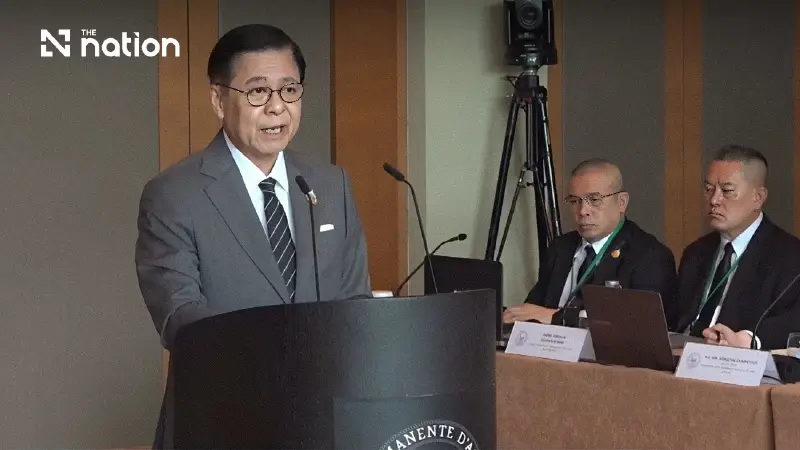


Sihasak vows to defend Thai sovereignty and maritime rights, accusing Cambodia of distorting facts and insisting Koh Kood is outside the UNCLOS process.
- Thailand's Deputy Prime Minister, Sihasak Phuangketkeow, opened the UNCLOS conciliation meeting with Cambodia, vowing to defend Thai sovereignty and maritime rights.
- He accused Cambodia of distorting facts, portraying itself as a victim, and failing to engage sincerely in bilateral diplomacy to resolve their differences.
- Mr Sihasak stressed that the conciliation is strictly limited to maritime delimitation in the Gulf of Thailand and does not concern sovereignty over land territory, such as the island of Koh Kood.
- Thailand justified its participation by stating its commitment to international law and diplomacy, while arguing Cambodia had used these for political gain rather than seeking sustainable solutions.
Deputy Prime Minister and Foreign Minister Sihasak Phuangketkeow opened the first meeting of the Conciliation Commission between Thailand and Cambodia under the United Nations Convention on the Law of the Sea (UNCLOS) in Singapore by vowing to defend Thai sovereignty and maritime rights.
He accused Cambodia of distorting facts, portraying itself as the victim and failing to engage sincerely in efforts to restore bilateral relations. He also stressed that the process concerns maritime delimitation in the Gulf of Thailand and does not extend to sovereignty over Koh Kood.
Thailand defends dialogue and international law
In his opening statement on behalf of Thailand, Sihasak told the commission that the country had a clear objective of finding a way forward on maritime delimitation that would safeguard its rights while allowing Thailand and Cambodia to move ahead as neighbours.
He contrasted Thailand’s preference for dialogue with Cambodia’s approach to managing bilateral differences. Thailand, he maintained, had consistently sought to keep communication channels open, rebuild confidence and pursue sustainable solutions through bilateral negotiations.
Cambodia, by contrast, had repeatedly presented itself as an advocate of international law while portraying Thailand as failing to comply with international rules, he argued.
Sihasak challenged that portrayal as one-sided and contradictory. He pointed to Cambodia’s release of a private telephone conversation between the two countries’ leaders, as well as incidents in which Thailand says Cambodian rockets killed Thai civilians and mines laid by Cambodia caused Thai soldiers to lose their legs.
He stressed that Thailand remained firmly committed to international law and the rules-based international order and would vigorously protect its rights. International law and diplomacy, he argued, should work together, with law providing the framework for peaceful relations and diplomacy helping to rebuild trust and reach acceptable and sustainable solutions.

Sihasak calls for rebuilding bilateral trust
Sihasak also argued that the conflict between the two countries had severely eroded trust and caused substantial losses for people on both sides, making confidence-building essential to any lasting settlement.
He recalled that the Thai and Cambodian leaders had reaffirmed their commitment to gradually restoring bilateral relations during the ASEAN summit in Cebu, the Philippines.
When he later met Prak Sokhonn, Cambodia’s Deputy Prime Minister and Minister of Foreign Affairs and International Cooperation, in New York in May, Sihasak proposed practical, step-by-step measures aimed at rebuilding confidence and enabling the two countries to manage their differences.
Sihasak nevertheless accused Cambodia of failing to give those diplomatic efforts a genuine opportunity. Instead of engaging fully and sincerely in bilateral discussions, he argued, Cambodia had repeatedly criticised Thailand, promoted what he described as false narratives, distorted facts and levelled baseless accusations against Bangkok, including at international forums.
He also accused Cambodia of portraying itself as the victim while claiming the moral high ground, suggesting that domestic political considerations might be contributing to such an approach.
For Thailand, Sihasak stressed, bilateral relations and the well-being of people in both countries should not be used as bargaining tools for short-term political advantage. He argued that doing so had fuelled public sentiment, increased tensions and hardened positions on both sides, making the restoration of relations more difficult.
Thailand instead intended to rely on law and diplomacy to rebuild trust, he added, rather than treating diplomacy as a competition in which one side sought an advantage over the other.
Thailand explains decision to end MOU44 framework
Turning to the work of the Conciliation Commission, Sihasak argued that a proper understanding of how relations had reached their current point was essential. Thailand terminated the MOU44 framework because, over the previous 25 years, only two formal meetings had been held and no tangible progress had been achieved, he explained.
Thailand therefore chose to restart negotiations. Cambodia’s recent accession to UNCLOS, in Bangkok’s view, provided an opportunity for the two countries to begin again on a common and more firmly established legal basis.
Thailand had proposed direct negotiations with Cambodia on maritime delimitation and suggested that, even if no agreement could be reached within six months, the two countries could jointly enter a conciliation process.
Sihasak rejected Cambodia’s assertion that Thailand’s termination of MOU44 had left Phnom Penh with no alternative but to initiate compulsory conciliation. He described that argument as untrue and a complete distortion of the circumstances, maintaining that Cambodia had another option but had chosen to close the door on it.
Thailand limits conciliation scope to Gulf of Thailand
Sihasak also set out what Thailand considered to be the scope of the commission’s work, stressing that maritime delimitation between Thailand and Cambodia should concern only the Gulf of Thailand.
Thailand’s maritime position, he noted, was based on the Royal Proclamation of May 18, 1973. Bangkok was seeking nothing beyond the protection of its sovereignty, sovereign rights and legitimate rights under international law, he maintained.
Crucially, Sihasak stressed that the conciliation proceedings did not concern sovereignty over land territory, including Koh Kood. Thailand also continued to reject Cambodia’s unilaterally declared 1972 continental shelf line, which Bangkok regarded as having no legal basis.
Thailand was participating in the proceedings in good faith and with full awareness of its obligations under UNCLOS, he added, expressing confidence in the impartiality and expertise of the Conciliation Commission.
Bangkok hoped the commission could help the two sides identify common ground, narrow differences between their legal positions and return to negotiations capable of producing an equitable and sustainable maritime delimitation agreement.

Thailand remains open to further negotiations
Sihasak emphasised that Thailand remained open to negotiations, as the two countries would ultimately still have to work together to find a serious and good-faith way forward.
The outcome of the conciliation process would also have important implications for future Thai-Cambodian relations, he argued, stressing that the proceedings should not be treated as zero-sum diplomacy with an absolute winner and loser.
Thailand would continue to uphold international law while firmly protecting its sovereignty and maritime rights, alongside its commitment to peace and shared prosperity with neighbouring countries, he added.
Sihasak also pointed to Thailand’s past cooperation with like-minded countries to help bring peace to Cambodia and support the country’s rebuilding, presenting this as evidence of Bangkok’s commitment to a peaceful path.
Progress now required political will from both sides, he stressed. Cambodia had to decide which path it wished to take, while Thailand hoped Phnom Penh would show the political will to move in the same direction.
Thailand and Cambodia would remain neighbours long after the conciliation process had ended, Sihasak concluded. Their shared responsibility was therefore to ensure that future generations could benefit from peace and prosperity between the two countries, with Thailand ready to do its part and hoping Cambodia would do the same.
