
Thailand’s rice and cassava exports decline, falling short of targets
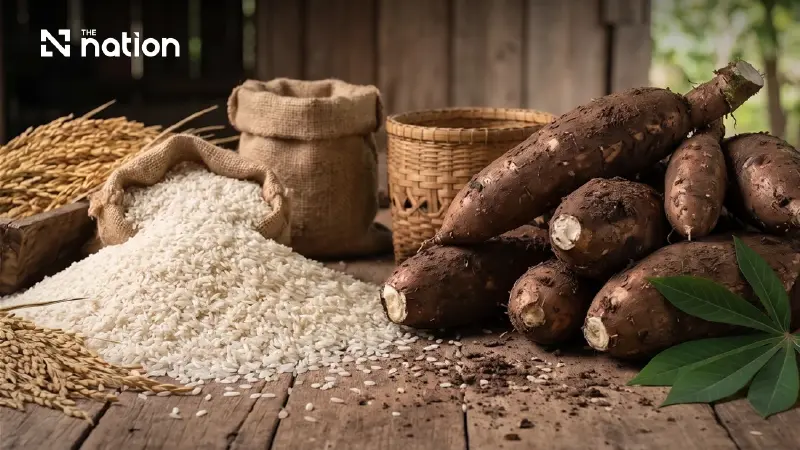


Rice shipments fell to 4.99 million tonnes in January–September 2026, while cassava exports face a target shortfall as domestic output declines.
- Thai rice exports fell by 19.26% in the first nine months of 2026, primarily due to a lack of price competitiveness against cheaper rice from India and Vietnam, a strengthening baht, and disruptions in key markets like Iraq.
- Cassava exports experienced a more severe decline, plummeting by 55.12% in the same period, because a drop in domestic cassava production to its lowest level in years reduced the available supply for export.
- Export targets were also missed due to the failure to secure a new government-to-government deal to sell an additional 500,000 tonnes of rice to China because of disagreements on pricing and delivery terms.
Thailand exported 4.99 million tonnes of rice in the first nine months of 2026 (January–September), down 19.26% from the same period a year earlier, with export value falling 16.84% to US$2.962 billion, according to Arada Fuangtong, director-general of the Department of Foreign Trade.
She noted that the slowdown extended beyond Thailand.
Among the world’s five largest rice exporters, Thailand, Vietnam, Pakistan and the United States all recorded declines.
India was the exception, recording 2% growth and retaining its position as the world’s largest rice exporter.
Price competitiveness was a major challenge.
Thai 5% broken white rice was priced at US$480 per tonne, compared with US$388 for Indian rice and US$420 for Vietnamese rice, giving buyers cheaper alternatives.
With war and energy prices affecting the global economy, many countries were having to control spending and place greater emphasis on prices.
Thai rice exports also faced constraints in key markets.
War had disrupted normal shipments to Iraq, which had previously imported more than 1 million tonnes of Thai rice, while Indonesia had suspended rice imports.
A volatile and strengthening baht, together with higher freight rates, further weakened Thai rice’s competitiveness.

On government-to-government (G2G) rice exports to China, the department had held continuing talks with Chinese state-owned enterprise COFCO but had made no progress and would be unable to secure an additional sales agreement this year, she explained.
Unfavourable timing, higher logistics costs and the baht’s value relative to competing currencies had complicated negotiations.
Thai rice prices had risen when importers wanted to buy, while price offers had repeatedly failed to align, preventing agreement on prices and delivery terms as planned.
The government had aimed to negotiate the sale of an additional 500,000 tonnes of rice to China but had yet to achieve this.
Thailand was nevertheless continuing negotiations on deliveries under an existing 1.22-million-tonne contract, of which 760,000 tonnes had been delivered, leaving about 460,000 tonnes outstanding.
The department would intensify discussions with China during the final two months of the year to settle prices and deliver as much rice as possible.
Cassava exports totalled 3.24 million tonnes in the first nine months of 2026, down 55.12%, with their value falling 28.47% to US$1.6978 billion.
She acknowledged that exports this year were likely to miss the target of 6.1–7 million tonnes because domestic cassava output had fallen to about 24 million tonnes from the usual 30 million tonnes, its lowest level in several years.
Meanwhile, cassava imports from neighbouring countries had fallen to 1.46 million tonnes, mainly from Laos, with a small amount from Myanmar and none from Cambodia.
Higher selling prices for cassava products offered some support: cassava pellet prices rose 10.56%, native cassava starch prices increased 30.74% and processed cassava starch prices climbed 8.53%.
“I acknowledge that external volatility — including geopolitical conflicts, war, disasters and El Niño — is a macroeconomic factor affecting commodities. These factors have a severe, direct impact, creating commodity volatility and making consumption or production harder to predict than ever before. As a result, rice and cassava exports are falling short of their targets. Do not blame the government. As director-general, I take responsibility myself because this is my direct responsibility,” Arada said.
The Department of Foreign Trade was pressing ahead with a market expansion plan to accelerate rice exports.
Its plans included organising public- and private-sector delegations to meet major rice importers in markets including Hong Kong, Japan, the Philippines, South Africa and the United States, as well as targeting the household rice market to maintain its market presence.
The department also planned to hold an international rice conference to facilitate business negotiations between Thai exporters and importers from different countries, and to promote Thai rice.
These efforts aimed to diversify sales across regions, reduce reliance on any single market and generate orders for Thai rice output.
