
Why China and the Wa matter to Thailand’s fight against river pollution
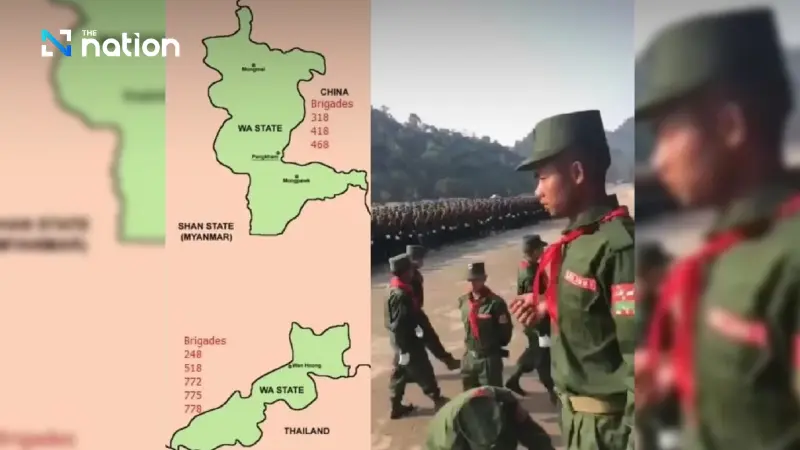


As Thailand and Myanmar prepare to test the Kok and Sai rivers for arsenic, access to suspected upstream mines may depend on Wa authorities and China.
- The United Wa State Army, an armed group in Myanmar, controls some of the territory where suspected polluting mines are located, making their cooperation essential for investigators to access the sites.
- China is directly involved as Chinese miners reportedly operate rare-earth sites under Wa protection, and China is the main market for the minerals being extracted.
- Thailand is seeking China's assistance, as Beijing has offered technical and diplomatic support to trace the pollution and may be asked to intervene if Myanmar cannot regulate the mines.
Thailand is drilling wells to supply clean water to 14 villages in Chiang Rai’s Mae Sai district. Across the border in Myanmar’s Shan State, investigators face a harder task. To trace arsenic in rivers flowing into northern Thailand, they need access to suspected mines in areas where authority is divided between Myanmar’s military and armed groups, including the United Wa State Army.
Chinese miners have opened rare-earth sites under Wa protection, and Beijing has offered to help trace the pollution. On November 27, Thai Deputy Prime Minister Yodchanan Wongsawat told Reuters that Bangkok had asked Myanmar to establish which mines it could regulate. “If they cannot, we will ask China to help,” he said.
What river testing can tell Thailand and Myanmar
Thailand’s Pollution Control Department has detected arsenic and other heavy metals in water and sediment from the Kok, Sai, Ruak and Mekong rivers. At talks with Myanmar and China on November 24, Thai researchers presented evidence that arsenic levels in the Kok and Sai were highest near the border and fell as the rivers flowed further into Thailand. Myanmar officials have asked for more evidence, according to Yodchanan. To identify the contribution of any individual mine, Thai investigators want to collect samples at the site itself.

On November 25, Thailand and Myanmar agreed in principle to take samples at 12 locations on the Kok and Sai, six in each country. The first joint sampling is expected in December 2026 or January 2027. Thailand has also asked Myanmar to suspend operations for six months at mines suspected of contributing to the pollution. That request remains under consideration.
Why access depends on the Wa
The United Wa State Army emerged in 1989 after the collapse of the Communist Party of Burma and reached a ceasefire with Myanmar’s military. It controls two separate territories, one on the Chinese border and another along the Thai frontier. A government agreement reached in Nay Pyi Taw can therefore require the co-operation of Wa authorities before inspectors can visit a mine.

Mong Yawn illustrates the difficulty. Using satellite imagery, the Shan Human Rights Foundation identified two suspected rare-earth sites about 25 kilometres from the Thai border, opposite Mae Ai district in Chiang Mai. The foundation describes the area as jointly controlled by Myanmar’s military and the Wa army. It also documented separate gold-mining activity along the Kok, another potential source investigators must examine.

River communities recognised that division of authority early on. On June 5, 2025, a network representing communities along the four rivers sent an open letter in five languages calling for mine closures and the restoration of the watersheds. It addressed the governments of Thailand, Myanmar and China, and the Wa army itself.
What Beijing can do upstream
China is the main market for Myanmar’s rare earths. A UN human rights report put Myanmar’s rare-earth exports to China at US$620 million in 2025. Reuters documented Chinese miners working at Wa-protected sites in Shan State, although it could not independently establish who owned the mines. China’s foreign ministry said Chinese companies operating abroad were required to comply with local laws.

Prime Minister Anutin Charnvirakul said he had raised the pollution with Chinese President Xi Jinping, who told him China did not support industries that harmed people’s health. Beijing has offered expertise and support for joint surveys. The Thai government says the two countries plan to establish a laboratory at Mae Fah Luang University in Chiang Rai to compare contaminants found in the rivers with samples from suspected mines. For that work to identify a source, investigators still need permission to take those samples upstream.
How Thailand took the issue to Hanoi
At the five-country ACMECS summit in Hanoi on November 28, Anutin said cross-border water pollution affected more than 20,000 households and put more than 16,000 hectares of farmland at risk. He called for the Mekong River Commission and regional governments to expand joint monitoring and alert one another when they detect pollution.
Thailand took over the chair of ACMECS, which brings it together with Cambodia, Laos, Myanmar and Vietnam, for 2027–28. Bangkok also has a trade measure of its own. Anutin said the Defence Ministry planned to announce a ban on exports of chemicals used to process ore in Myanmar on November 30. That would give Thailand a way to restrict what reaches the mines from its side of the border while it seeks the access needed to establish which operations are polluting the rivers.
Source: Krungthep Turakij
