
Thailand accepts UNCLOS conciliation with Cambodia but says outcome is not binding
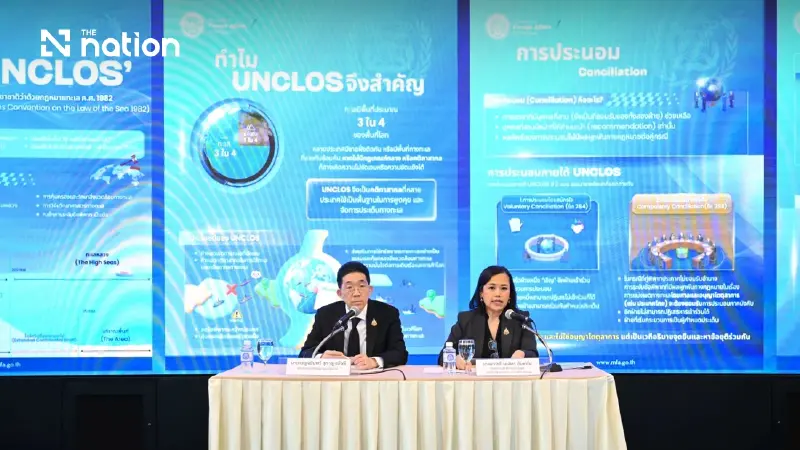


Thailand has formally accepted Cambodia’s UNCLOS compulsory conciliation request over a Gulf of Thailand maritime boundary dispute, while stressing that the process is not a court case and will only produce non-binding recommendations.
Thailand accepts UNCLOS conciliation with Cambodia
Thailand has formally accepted Cambodia’s request to enter a compulsory conciliation process under the 1982 United Nations Convention on the Law of the Sea, or UNCLOS, over their long-running maritime boundary dispute, while stressing that the process is not a court case and that any outcome will not be legally binding.
The Ministry of Foreign Affairs said Thailand submitted its formal response to Cambodia on June 19, after Cambodia transmitted its notification to Thailand on June 2. Bangkok said the process should be limited solely to maritime delimitation under UNCLOS.
Bangkok narrows scope to maritime boundary
In its response, Thailand appointed Deputy Prime Minister and Foreign Minister Sihasak Phuangketkeow as its Agent in the conciliation proceedings, while Songchai Chaipatiyut, Thailand’s ambassador to Kuwait and a former senior official at the Department of Treaties and Legal Affairs, was appointed Deputy Agent.
Thailand also named two conciliators: Judge Albert J Hoffmann of South Africa and Judge Rüdiger Wolfrum of Germany. The ministry described both as internationally recognised experts in the law of the sea.
The four conciliators appointed by Thailand and Cambodia will have 30 days from Thailand’s response to select a fifth conciliator, who will chair the conciliation commission. The commission is then expected to prepare a report and recommendations within around 12 months, unless both sides agree to extend the period.
Ministry says process is not a judgement
Thai officials stressed that compulsory conciliation is not litigation and that the conciliators are not lawyers for either side. Instead, they are neutral experts tasked with listening to both parties, understanding the context of the dispute and helping identify a mutually acceptable way forward.
The Foreign Ministry has said the outcome of conciliation will take the form of a report containing recommendations, which can be used as a basis for continued negotiations between the two countries. The report will not be legally binding, and both sides will still have to discuss any outstanding issues directly.
This position is consistent with UNCLOS Annex V, which states that a conciliation commission’s report, including its conclusions or recommendations, is not binding on the parties.
Thailand wants return to bilateral talks
Bangkok has repeatedly said that the maritime dispute should ultimately return to bilateral negotiations. The ministry said conciliation should provide a framework to help both countries seek a mutually acceptable settlement, rather than replace direct talks.
Thailand has also taken the view that the process should focus only on maritime boundary delimitation. Earlier, the Foreign Ministry noted that Cambodia’s notification appeared to include not only delimitation but also provisional arrangements for joint development and equitable resource sharing, while Thailand believed the scope should be limited to defining the maritime boundary.
Gulf dispute and cancelled 2001 MoU
The dispute concerns overlapping maritime claims in the Gulf of Thailand, an area believed to contain significant natural gas and other hydrocarbon resources. The issue has long been tied to both maritime boundary delimitation and possible joint development of offshore energy resources.
In May, the Thai Cabinet approved the termination of the 2001 memorandum of understanding with Cambodia, also known in Thailand as MoU 44, which had provided a framework for dealing with overlapping maritime claims to the continental shelf. Prime Minister Anutin Charnvirakul said the decision was not linked to conflict with Cambodia but was based on the lack of progress over the past 25 years.
The Thai government said cancelling the 2001 MoU was intended to adjust the cooperation framework, not to end negotiations or bilateral relations. It said Thailand would continue talks with Cambodia on maritime boundary issues using UNCLOS as a common reference point, as both countries are now parties to the convention.
Cambodia later initiated compulsory conciliation under UNCLOS, saying it wanted a peaceful resolution through international law. Thailand, while accepting the process, has continued to emphasise that the recommendations will be non-binding and that direct negotiations remain essential.
