
Why ASEAN Never Quite Came Together — And Why This Time May Be Different


For decades ASEAN's unity was more slogan than strategy. Panellists say geopolitical shocks, AI and climate risk are now forcing the bloc's hand
- ASEAN's historical lack of integration stemmed from its core principle of non-interference and consensus, which prioritized national sovereignty over creating a unified single market.
- Unlike in the past, current geopolitical shocks, including trade wars and investor uncertainty regarding China, are now forcing the bloc to integrate out of necessity, positioning it as a stable alternative for global capital.
- Shared challenges like the AI race and climate change are also driving cooperation, with ASEAN pursuing a "fast-follower" strategy in technology adoption and collaborating on cross-border infrastructure to address environmental risks.
- The key difference now is that the push for unity is driven by pragmatic survival rather than idealism, as the cost of inaction against these external pressures has become too high for member states to bear alone.
For decades, ASEAN's unity was more slogan than strategy. Panellists say geopolitical shocks, AI and climate risk are now forcing the bloc's hand.
For nearly six decades, ASEAN's defining weakness has also been its founding principle. Built on consensus and non-interference, the "ASEAN Way" let eleven sovereign, often competing economies coexist without ever quite merging into the single market its own charters promised.
Intra-regional trade still hovers at roughly a quarter of the bloc's total trade, a figure that has barely moved in a decade – evidence, sceptics argue, that ASEAN talks integration far more often than it practises it.
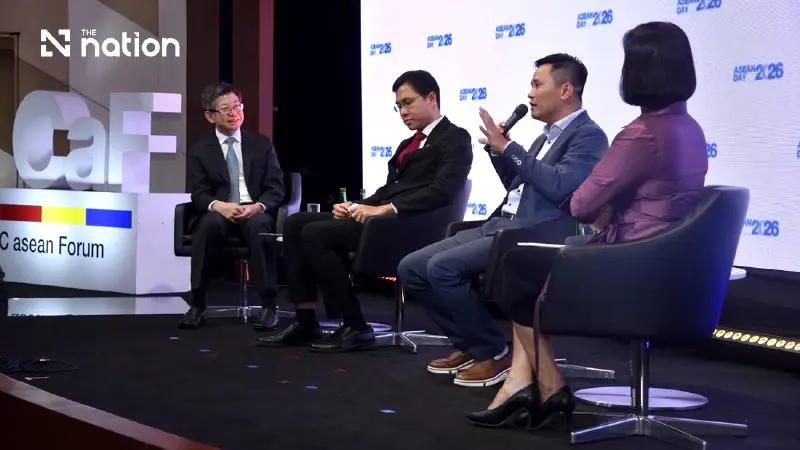
That scepticism framed a panel discussion at the CAsean Forum 2026, held in Bangkok on Friday, 7 August, under the theme "Resilient ASEAN: Connectivity as a Competitive Advantage".
The question posed to three panellists — a Thai macroeconomist, a Singaporean policymaker and a Vietnamese technology executive — was blunt: if ASEAN could not knit itself together during three decades of relative calm, why should anyone believe it can do so now, amid trade wars, AI disruption and climate stress?
Their answer, in short, was that the region no longer has the luxury of choice.
The Case for Now: External Pressure as Forcing Mechanism
Dr Kobsak Pootrakool, director and senior executive vice-president of Bangkok Bank, argued that global fragmentation — rather than threatening ASEAN — is what may finally compel it to integrate.
With tariff regimes shifting unpredictably and investors wary of China, Russia and India, capital is hunting for a stable, neutral alternative.
"The more they fight, the better we become — not because of ourselves, but relative to the alternatives," he told the forum, noting that Bangkok Bank has seen a marked rise in regional investment enquiries over the past two years.
The urgency, he said, is structural rather than sentimental. Thailand alone sends around a fifth of its exports to the United States, leaving it exposed to sudden policy swings; ASEAN's combined market of nearly 700 million consumers offers an obvious hedge, but only if members actually trade with each other rather than around each other.
"This is not the time to protect our own borders," Dr Kobsak said. "One plus one will equal five if we build regional supply chains together."
Notably, he framed this less as idealism and more as necessity: firms he advises, he said, no longer draw up "Thailand strategies" in isolation, because scale now decides who survives.

Cross-Border Zones: Proof of Concept, Not Yet the Norm
If Dr Kobsak made the macro case, Joel Ang, vice-president and head of Southeast Asia and Oceania at Singapore's Economic Development Board, offered the clearest rebuttal to scepticism: examples where ASEAN economies are already pooling strengths rather than duplicating them.
The Johor–Singapore Special Economic Zone pairs Malaysia's land, energy and labour costs with Singapore's capital, intellectual-property protections and logistics network; the Vietnam–Singapore Industrial Parks apply a similar formula, combining Singaporean supply-chain expertise with Vietnamese manufacturing capacity.
Both, he said, have drawn record levels of investment in recent years.
Ang's framing was familial rather than technocratic.
"As brothers and sisters, you may fight most of the time," he said, "but when it comes to important things you need to do together, you come together."
That, he suggested, is the more realistic model for ASEAN cohesion — not a formal political union, but pragmatic, project-by-project cooperation where interests genuinely align, extending now into cross-border power grids such as the Laos–Thailand–Malaysia–Singapore transmission line, which is being expanded to displace costly fossil-fuel backup capacity.
Whether such projects can scale from flagship examples into a general pattern remains, implicitly, the test of ASEAN's sincerity.
A handful of special economic zones is not the same as a single market; it is a proof of concept that unity is possible when the incentives are sharp enough — which is precisely the panel's wider argument about the current moment.

The AI Bet: Fast Follower, Not Frontier Builder
On technology, both Ang and Nguyen Phuoc Linh, chief executive of FPT Thailand and Taiwan, argued ASEAN should abandon any ambition to compete with the United States or China on foundational AI models or chip fabrication. Instead, the region's advantage lies in rapid, applied adoption.
"We should not try to rebuild what the US or China already have," Linh said. "The goal for ASEAN is immediate applicability — deploying AI to optimise supply chains, automate logistics and lift workforce productivity."
He pointed to tangible gains already underway: blockchain-based trade platforms that have cut customs clearance from several days to under two hours, and FPT's own AI Factory infrastructure, which he said now supports more than 30,000 "AI-augmented" engineers across the region.
Linh also flagged quantum computing as a coming inflection point, warning that ASEAN "cannot wait until 2030" to begin building capability, given the pace at which frontier economies are moving.
According to figures shared by FPT, Vietnam posted GDP growth of 7.83 per cent in early 2026 – its strongest in 16 years – driven substantially by digital and data-centre investment, a data point the panel used to argue that fast-follower strategies can already be seen paying off.

Social Resilience: The Harder, Slower Half of the Argument
The panel's most candid moment came when the conversation turned from macroeconomics to social cohesion.
Dr Kobsak, who also works with grassroots NGOs across Thailand, warned that the trickle-down model long assumed to accompany industrialisation has failed rural communities, leaving them stripped of land and forest with little to show for national growth.
"The new paradigm has to be bottom-up," he said, describing a decade of village-level work aimed at helping rural Thais build sustainable local enterprises rather than migrating to Bangkok.
Encouragingly, he noted a growing number of young Thais choosing to return to their home provinces, finding they can live better on less there than in the capital.
Ang described Singapore's answer as institutional rather than grassroots: continuously updated "Jobs Transformation Maps" that link curriculum design, union-led reskilling and lifelong learning to anticipated shifts in labour demand, alongside government-backed exchange schemes – such as ACT with Indonesia and ITX with Vietnam – designed to build the interpersonal familiarity he argued genuine regional cooperation requires.
FPT, for its part, said it is training tens of thousands of staff in AI tools and has committed to training 10,000 semiconductor professionals by 2030, alongside university campuses deliberately sited outside major cities to widen access to technical education.

Verdict: Necessity, Not Sentiment
None of the panellists claimed ASEAN's old obstacles – sovereignty sensitivities, uneven development, and consensus-bound decision-making – have disappeared. What they argued instead is that the cost of inaction has changed.
A trading system no longer neutral, an AI race the region cannot win by building from scratch, and a climate crisis that recognises no border have together removed the option of quiet coexistence. As Dr Kobsak put it in his closing remark: "Don't fight, be decisive."
Whether that translates into durable integration — rather than another cycle of ambitious declarations followed by modest follow-through — is likely to be ASEAN's defining test as it approaches its 60th anniversary next year. The panel's own answer to the scepticism was less a rebuttal than a wager: that this time, unlike before, ASEAN's members may simply have run out of better alternatives.
