
Myanmar pushes back on ASEAN envoy and Suu Kyi release demand
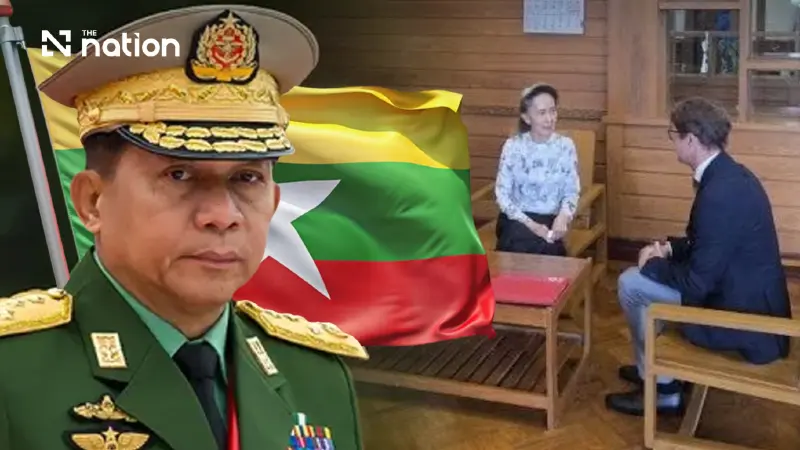


Myanmar says an ASEAN special envoy is no longer needed and insists any full release of Aung San Suu Kyi must follow domestic law.
Myanmar’s military-backed government has rejected the continued role of an ASEAN special envoy and resisted the regional bloc’s call for the unconditional release of detained former leader Aung San Suu Kyi.
The position was set out in a Foreign Ministry statement issued at the weekend, days after President Min Aung Hlaing made a landmark visit to Thailand. Bangkok is seeking Myanmar’s full re-engagement with the Association of Southeast Asian Nations while maintaining that regional concerns over the conflict must still be addressed.
Myanmar argued that political developments following an election held in December and January meant that the ASEAN chair no longer needed to appoint a special envoy for the country.
The ministry said Myanmar regarded the appointment and continued work of a new special envoy as “no longer necessary”.
The election was widely criticised and took place without any substantial opposition. It was won by a military-backed party and allowed Min Aung Hlaing, previously the head of Myanmar’s ruling junta, to become president.

Relations with ASEAN remain strained
Myanmar’s relationship with ASEAN has deteriorated sharply since the military seized power in early 2021, removing the elected civilian administration led by Suu Kyi.
The takeover triggered nationwide unrest and a civil war that has killed an estimated 100,000 people and displaced millions, according to the Reuters report.
Myanmar’s senior political leadership has subsequently been excluded from ASEAN’s highest-level meetings because of its failure to implement the bloc’s Five-Point Consensus, a peace framework agreed with Min Aung Hlaing in 2021.
The plan calls for an end to violence, dialogue among all parties, humanitarian assistance and engagement by an ASEAN special envoy.
However, Myanmar’s pro-military parliament passed a motion in July rejecting the ASEAN framework as interference in the country’s domestic affairs. The motion also called on the regional grouping to reconsider its approach towards Myanmar.
The latest statement indicates that Myanmar’s government remains unwilling to accept a central role for ASEAN’s envoy, despite Thailand’s efforts to facilitate its neighbour’s return to full participation in the bloc.
Following talks with Min Aung Hlaing in Bangkok last week, Thai Foreign Minister Sihasak Phuangketkeow said Thailand wanted peace and stability in Myanmar in accordance with ASEAN’s peace plan.
He also stressed that Thailand’s engagement with the Myanmar government did not mean Bangkok was abandoning the concerns shared by other ASEAN members.

ASEAN seeks access to Suu Kyi
Myanmar’s Foreign Ministry also responded to an ASEAN statement issued on Friday after Suu Kyi met a representative of the International Committee of the Red Cross.
ASEAN welcomed the meeting and reiterated its request for the current special envoy, the Philippine foreign minister, to be allowed to meet Suu Kyi.
The bloc also called for the unconditional release of Suu Kyi and other political prisoners.
Suu Kyi, 81, is serving an 18-year prison sentence following convictions on several charges that she denies.
No foreign leader or diplomatic envoy had publicly met her during her detention before last week’s meeting with the Red Cross representative, according to Reuters.
Myanmar’s government rejected ASEAN’s demand for her unconditional release, saying that any such decision would have to be made under the country’s laws.
The Foreign Ministry said the government had already reduced her sentences on humanitarian grounds, but maintained that a full release could only take place “in accordance with the law”.
The dispute over the special envoy and Suu Kyi’s detention underlines the continuing divide between Myanmar’s military-backed leadership and ASEAN, even as Thailand attempts to promote greater engagement.
While Bangkok has presented dialogue as a possible route towards peace and stability, Myanmar’s rejection of the envoy’s continued role and its parliament’s opposition to the Five-Point Consensus could complicate efforts to restore normal relations with the regional bloc.
Source: Reuters
