
Arsenic contamination disrupts water supply to Chiang Rai villages
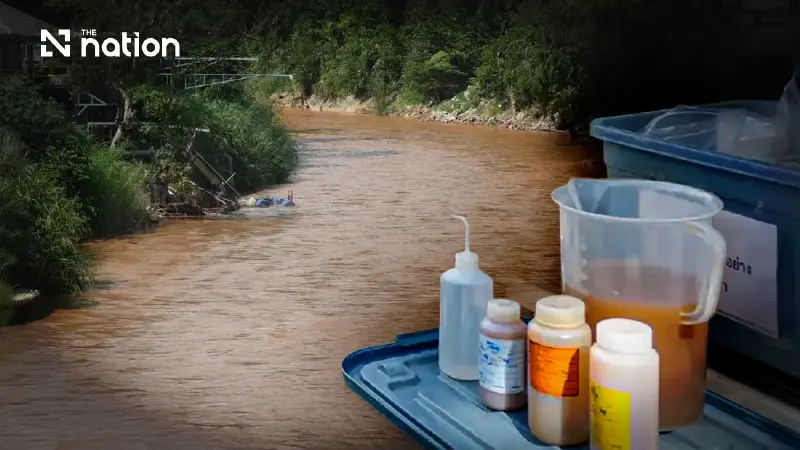


Supplies fell to 60% before recovering to about 80%, while authorities prepared reserve tanks and plans to draw water from alternative rivers.
- Arsenic and extreme turbidity (cloudiness) were detected in the Sai River, contaminating the raw water source for 14 villages in Chiang Rai.
- The contamination forced the Provincial Waterworks Authority to reduce the tap water supply, which has since been partially restored to about 80%.
- Residents reported cloudy, reddish tap water and skin irritation, leading many to buy bottled water for drinking and household use and to stop eating local wild-caught fish.
- Officials attribute the contamination to rain washing chemicals from upstream areas, with previous tests showing contaminant levels reaching 28 times the standard.
Tap water supplies to 14 villages in Mae Sai and Wiang Phang Kham subdistricts of Chiang Rai have recovered to about 80% after contamination in the Sai River disrupted production, Chiang Rai governor Chucheep Pongchai said.
The Provincial Waterworks Authority (PWA) reduced supplies to 60% on Thursday (November 5, 2026), after detecting unusually high contaminant levels in raw water.
Mae Sai branch manager Komsan Samma said preliminary tests found arsenic above the standard and turbidity reaching 14,000 nephelometric turbidity units (NTU), beyond the treatment system’s capacity.
Typical readings were 800–1,000 NTU in the dry season and 3,000–6,000 NTU during periods of high water flow.
Chucheep led water quality testing at Ban Tham Pha Chom (Hua Fai) in Mae Sai district on November 6, after a reduction in river water volume increased contaminant concentrations.
Joining him were Mae Sai district chief Warayut Khombun, subdistrict mayor Anucha Yodchiangkham, Komsan and environmental official Piyanuch Suangkham.

Chucheep said the province had coordinated closely with all agencies from the outset and was working with environmental officials to monitor water quality.
Piyanuch, director of the water, air and noise quality management section at the Environmental and Pollution Control Office 1 (Chiang Mai), under the Pollution Control Department, said monthly monitoring found that contaminant levels in the Sai River had reached 28 times the standard in early August.
They subsequently declined to an average range of 0.012–0.017 milligrammes per litre, which remained high.
She attributed the contamination to rain washing chemicals from upstream areas into the river.
September tests found that the Kok, Ruak and Mekong rivers remained within the standard.
The PWA’s three-phase plan involves preparing to divert Mekong River water to Mae Sai, using the Lao River to extend supplies throughout Chiang Rai, and drawing water from the Kham River in Mae Kham subdistrict, Mae Chan district, for long-term use.

The authority is awaiting completion of a treatment plant in Chiang Saen before switching to Mekong River water for Mae Chan and Mae Sai.
The existing pumping station would then close permanently.
Reserve tanks have also been prepared to store tap water for emergency distribution to residents.
Residents of Ban Tham Pha Chom said people living along the Sai and Ruak rivers had stopped eating wild-caught fish and other aquatic animals, buying pond-farmed fish instead.
They reported itchy skin after using groundwater and growing concern over cloudy, reddish tap water.
Many families were afraid to use it for bathing and were temporarily buying bottled water for drinking and other household needs.
