
PCD finds arsenic above standard in Kok and Sai rivers
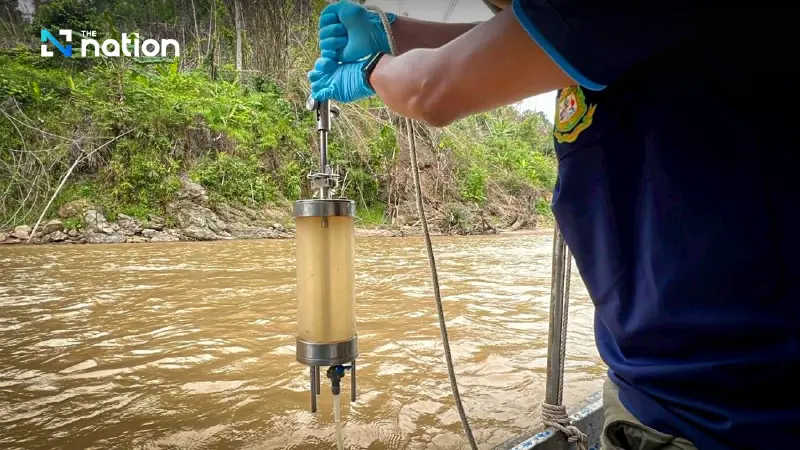


Thailand’s Pollution Control Department reports arsenic levels above surface-water standards at points in the Kok and Sai rivers.
The Pollution Control Department (PCD), under the Ministry of Natural Resources and Environment, has reported the results of its 18th round of water-quality monitoring in the Kok, Sai, Ruak and Mekong rivers, covering areas in Chiang Mai and Chiang Rai provinces.
The monitoring was conducted between April 27 and May 1, 2026, as part of continued surveillance of contamination in water sources.
Laboratory analysis against surface-water quality standards found that most heavy metals — including cadmium, copper, nickel, chromium, zinc, mercury and lead — remained within standard limits.
However, arsenic was still detected above the surface-water quality standard of more than 0.01 milligrammes per litre (mg/l) in some areas, as follows:
Kok River
Arsenic levels above the standard were found at:
- Tha Ton Bridge, Tha Ton subdistrict, Mae Ai district, Chiang Mai province (KK01), at 0.011 mg/l.
- Mae Na Wang-Tha Ton Friendship Bridge (KK02), at 0.012 mg/l.
- Mae Yao-Doi Hang Friendship Bridge, Mueang district, Chiang Rai province (KK05), at 0.011 mg/l.
Sai River
From Ban Hua Fai and the Second Thai-Myanmar Friendship Bridge over the Sai River to Ban Pa Sang Ngam (SA01-SA03), arsenic levels exceeded the standard at all monitoring points, at 0.016 mg/l.
Manganese was also found above the standard at Ban Pa Sang Ngam, Ko Chang subdistrict, Mae Sai district, Chiang Rai province (SA03), at 1.40 mg/l. The surface-water quality standard for manganese is no more than 1.00 mg/l.

Ruak River
From the Ko Chang pumping station of the Provincial Waterworks Authority’s Mae Sai branch in Mae Sai district, Chiang Rai, to Wiang subdistrict, Chiang Saen district, Chiang Rai at the end of the Ruak River (RU01-RU02), water quality and heavy metal levels, including arsenic, were within surface-water quality standards.
Mekong River
From the Golden Triangle permanent border checkpoint at Ban Sop Ruak, Wiang subdistrict, Chiang Saen district, Chiang Rai, to Ban Hua Wiang, Wiang subdistrict, Chiang Khong district, Chiang Rai (NK01-NK04), water quality and heavy metal levels, including arsenic, were also within surface-water quality standards.
The Pollution Control Department said it would continue monitoring water quality to assess the situation and report findings to relevant agencies and the public, in order to maintain surveillance over potential impacts on the environment and public health.
Further information is available at https://www.pcd.go.th/.
