
Vietnam’s ‘fenceless bamboo’ diplomacy reaches Thailand
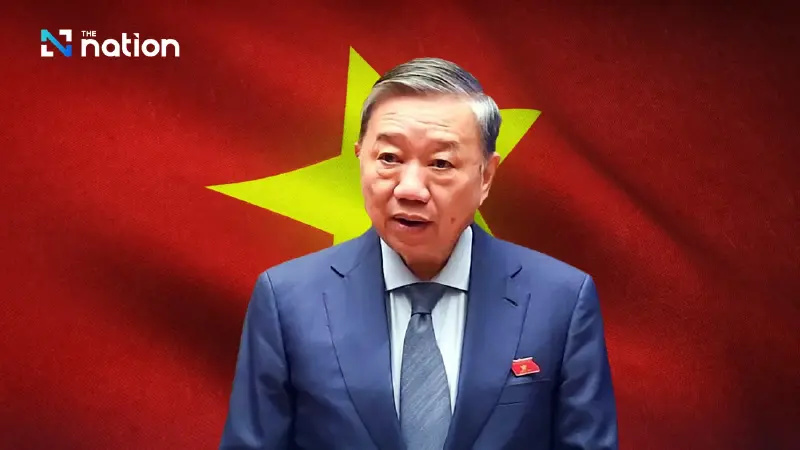


Tô Lâm’s Thailand visit highlights Vietnam’s power shift, growth-first strategy and more assertive bamboo diplomacy.
The official visit to Thailand by Tô Lâm, Vietnam’s State President and General Secretary of the Communist Party of Vietnam, from May 27–29 is more than a routine diplomatic engagement marking 50 years of Thai-Vietnamese relations.
It also marks the arrival of a leader widely seen as Vietnam’s most powerful political figure in decades — a man whose rise has reshaped the country’s traditional collective leadership model and placed greater authority at the centre of decision-making.
His visit comes as Hanoi seeks to accelerate its transformation into a high-income economy while pursuing a more assertive foreign policy dubbed “fenceless bamboo”.

From revolutionary roots to security technocrat
Tô Lâm, now 68, was born on July 10, 1957, in Hưng Yên province, in the Red River Delta of northern Vietnam. He grew up in a family deeply tied to Vietnam’s revolutionary history.
His father, Colonel Tô Quyền, was honoured as a Hero of the People’s Armed Forces and played an important role during the Vietnam War.
Tô Lâm’s own career followed a firmly security-focused path. He entered the Central Police School in 1974 and later built a reputation not only as a public security officer but also as a legal technocrat.
He holds a doctorate in law and was awarded the academic title of professor in security sciences in 2015.
Over more than four decades in the Ministry of Public Security, he moved through key positions, from political protection and investigation work to the top of the ministry, eventually serving as public security minister.

Architect of the ‘Blazing Furnace’
A major turning point in Tô Lâm’s rise was his role as one of the key figures behind Vietnam’s nationwide anti-corruption campaign, known as the “Blazing Furnace”. The campaign swept through the upper ranks of the party and state, forcing out senior officials and contributing to the departure of two former presidents.
After the death of Nguyễn Phú Trọng in 2024, Tô Lâm was chosen as General Secretary of the Communist Party of Vietnam. On April 7, 2026, Vietnam’s National Assembly unanimously elected him State President, giving him control of both of the country’s highest political offices.
The dual mandate marked a major shift in Vietnam’s power structure, which had long been anchored in a four-pillar model of collective leadership. The change is seen as a way to reduce bureaucratic delays and speed up policy decisions.

Growth-first strategy and rapid state restructuring
Under Tô Lâm, Vietnam’s policy direction has shifted from an anti-corruption-first agenda towards an economic growth-first approach. His administration has set an ambitious target of annual GDP growth of up to 10% between 2026 and 2030.
One of the most striking reforms has been the rapid restructuring of the state apparatus. Vietnam has moved to merge its administrative units from 63 to 34, while abolishing five key ministries to cut overlapping functions and streamline bureaucracy.
Tô Lâm has also placed the Fourth Industrial Revolution at the centre of national development, promoting artificial intelligence, quantum technology and digital transformation as key growth engines.
At the same time, his leadership has sought to give loyal local officials greater protection in approving foreign direct investment projects, many of which had been delayed.

‘Fenceless bamboo’ and a more active foreign policy
Foreign policy under his leadership has been elevated into a “fenceless bamboo” approach, aimed at reducing barriers to infrastructure connectivity and trade in support of Vietnam’s rapid economic expansion.
Between 2024 and 2026, Tô Lâm moved actively on the global stage, meeting several major world leaders, including:
- Chinese President Xi Jinping in August 2024 and again in April 2026, with railway connectivity and cross-border infrastructure high on the agenda.
- US President Donald Trump at the White House in February 2026, as Vietnam sought to balance major-power relations and maintain stability in the Indo-Pacific.
- Russian President Vladimir Putin in Moscow in May 2025.
- Indian Prime Minister Narendra Modi in May 2026, as the two countries marked the 10th anniversary of their comprehensive strategic partnership.
His diplomatic outreach has also extended to leaders from Laos, Cambodia, Cuba, Mongolia, Ireland, France, Malaysia, Indonesia, Singapore, Kazakhstan, South Korea, North Korea and the United Kingdom.
Thailand has also been part of this diplomatic push. In 2025, Tô Lâm welcomed former Thai prime minister Paetongtarn Shinawatra in Hanoi as both sides prepared to elevate bilateral relations to a comprehensive strategic partnership.
Tô Lâm’s political message has been captured in one of his defining statements:
“The ultimate goal of Vietnam’s era of rising to the top is to build a prosperous and powerful nation... standing shoulder to shoulder with the great powers of the world.”
