
Kok River livelihoods battered by Myanmar mining pollution
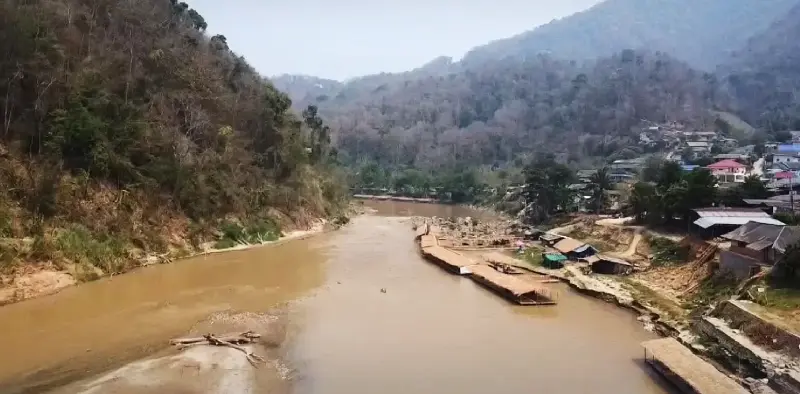


Pollution tied to Myanmar mining is darkening the Kok River, crushing tourism and fishing in Chiang Rai as residents demand clearer answers.
- Unregulated rare earth and gold mining across the border in Myanmar is polluting Thailand's Kok River with heavy metals, like arsenic, and sediment.
- The pollution has severely damaged the livelihoods of Thai communities, causing a collapse in the local fishing industry and devastating riverside tourism.
- In addition to the economic impact, researchers have found dangerous levels of arsenic in the river and its accumulation in local residents, raising serious long-term health concerns.
A stretch of the Kok River that should be running clear at this time of year has instead turned thick and cloudy, carrying sediment, industrial run-off and heavy metals downstream into northern Thailand and leaving communities in Chiang Rai to deal with the fallout.
The contamination, linked by researchers and policy analysts to a sharp rise in unregulated rare earth and gold mining across the border in Myanmar, is poisoning waterways, battering tourism and deepening fears over long-term health risks. Driven by the global race for highly strategic minerals, the cross-border pollution is forcing downstream communities to absorb the cost of a high-stakes geopolitical rivalry.
Flowing out of Myanmar’s mountainous Shan State into northern Thailand, the Kok River has long sustained communities that depend on fishing, farming and tourism. But over the past year, mounting evidence has pointed to mining activity in post-coup Myanmar as a major source of the pollution, with heavy metals and toxic run-off entering the Kok, a major tributary of the Mekong. During the dry season in the first half of the year, the river would normally be clear. Now it is thick and turbid.
Analysis by the Stimson Centre, a US think-tank, using high-resolution satellite imagery and field data, has identified dozens of new mining sites in Myanmar’s Shan State. Researchers say the surge has been encouraged by instability after Myanmar’s 2021 military coup, which weakened oversight in border areas and allowed illicit operations to spread. At the same time, China’s strong push to expand its dominance over global rare earth supply chains has accelerated the extraction of the minerals, which are used in products ranging from electric vehicles to defence technology.
The rare earth mining process is notoriously toxic when safeguards and site rehabilitation are lacking. Water mixed with fertiliser or acid is injected into deforested hillsides, creating a liquid slurry that drains into downhill pools where rare earth raw materials are separated. Water siphoned from rivers is then discharged back into local waterways, contaminating supplies.
Thai university researchers have detected heavy metal contamination above safety standards across the Kok River basin, with arsenic readings reaching more than twice Thailand’s national standard of 0.01 milligrams per litre. In February, researchers from Chiang Rai’s Mae Fah Luang University released a paper reporting arsenic accumulation in people living along the river. Several test participants were found to have neural and musculoskeletal symptoms consistent with heavy metal poisoning, heightening concern in riverside communities.
Thai authorities, however, have tried to reassure the public. The Ministry of Public Health has carried out its own testing on residents and said arsenic levels were within accepted limits, stressing that current exposure did not present an immediate health risk. Provincial officials have stepped up water quality checks and advised residents to rely on treated tap water rather than using river water directly, while also acknowledging the need for continued surveillance of upstream transboundary pollution.
The Pollution Control Department said in March that continuous monitoring showed most heavy metals remained within acceptable limits, although arsenic levels were still exceeding standards in parts of the Kok, Sai and Mekong rivers.
Researchers say one of the biggest unanswered questions is what prolonged exposure may mean. Thailand, they argue, still lacks clear benchmarks for what should be considered dangerous arsenic exposure over the long term, even though the substance is known to build up gradually in the body.
“We face the accumulation of heavy metals: In the environment, in the food chain, in the human body – it slowly accumulates,” Dr Suebsakun Kidnukorn from Mae Fah Luang University in northern Thailand told The Straits Times. “We don’t know when we will have some risk, or physical change, or even cancer. This is what concerns us most.”
Much of Myanmar’s rare earth mining is taking place in resistance-held territory beyond the reach of the junta’s military government. Formal ownership remains opaque, but researchers have identified mining sites that are consistent with Chinese extraction methods, while field reporting has found Chinese-speaking managers and workers at some of the operations.
Myanmar’s rare earth exports also go almost entirely to China, which dominates global processing of the materials. Beijing depends heavily on Myanmar’s rich deposits of heavy rare earths to supplement its own supply and meet industrial demand worldwide, particularly as it tightens environmental controls on mining within China itself.
Dr Suebsakun said that although engaging war-torn Myanmar would be difficult, and China has shown no political will to intervene, Thailand could still use its position as a transit hub between Myanmar and China for critical minerals such as antimony, manganese and tungsten to bring both sides to the table. “We need political will from the (Thai) government to take this issue seriously,” he added.
The growing alarm has raised fears over food safety, water safety and possible long-term health consequences, while already inflicting serious damage on local livelihoods. Communities along the river now find themselves caught between calling for stronger action and clearer answers from the authorities, and trying to limit the reputational damage that has hit tourism and the sale of local agricultural goods, from fish and vegetables to the region’s high-quality glutinous rice used in mango sticky rice. Financial strain has been made worse by the fuel crisis and the blow to tourism caused by the continuing Middle East crisis.
“We want clarity on how much of the fish and water is safe to consume, and how long we can stay in this situation,” said Mr Chayakorn Namphaphiwat, head of Farm Samphankit village near Chiang Rai. “But there has been a lack of a clear response from the government.”
For Mr Siam Kaewdam, the damage is measured day by day on the river. Each morning, the 49-year-old fisherman casts his nets into the Kok and lets them drift downstream before paddling out later in a wooden boat to pull in whatever he can. Lately, that has not been much. His catch, made up mostly of perch and a local catfish prized for pairing well with tom yum broth, now sells for barely one-third of its usual market price.
Mr Siam was one of the test subjects in the Mae Fah Luang University study whose fingernail and urine samples showed higher than normal levels of arsenic. He said the finding initially alarmed him, but he has not experienced any unusual physical symptoms. What has affected him more immediately, he said, is the reaction to reports of the river pollution, which has hit his income much harder and much faster.
His village in Sob Kok, at the confluence of the Kok and Mekong rivers, has seen environmental disruption before. Mr Siam said upstream Chinese construction of giant hydropower dams on the upper Mekong, or Lancang River, had already caused fluctuating water levels and a 70 per cent fall in fish stocks in his area. Now, in addition to the murky water, he said the raised river bed caused by silt and sediment, likely linked to mining run-off, has reduced the number of fish swimming upstream to lay eggs. “Our village has suffered from twin disasters,” Mr Siam said.
Further upstream, around an hour by boat from Chiang Rai city, the Ruammit Elephant Village has also been transformed. Once a draw for tourists keen to bathe and play with elephants, the site has been eerily quiet and desolate for most of the past year. Boats that used to carry visitors along the Kok River to the elephant camp, nearby hot springs and other riverside attractions now sit idle.
“Normally, when you come here in March or April, this area is absolutely packed with tourists,” said elephant caretaker Phichet Thuraworn. The 36-year-old said the camp now often closes by mid-afternoon without seeing a single visitor. “We have no sign of when things might recover.”
Mr Phichet said the damage has reached into daily life as well. He has given up one of his favourite ways of relaxing after work, going fishing with friends by the river. Instead of preparing for a bumper tourist season, the company he works for has had to sell more than half of its elephants to camps elsewhere in Thailand to cover wages and other costs.
The timing could hardly be worse. Songkran, which begins on April 13, would usually bring large numbers of Thai and foreign visitors to Chiang Rai’s riverbanks to splash water, escape the intense heat and take part in symbolic cleansing rituals. But in 2026, fears over contamination in the Kok River have badly weakened interest. The global energy shock linked to the Middle East conflict has further reduced travel appetite, dealing another blow to a tourism sector already struggling.
Because the Kok River sits at the centre of daily life, the damage goes well beyond jobs and income. Residents are worried not only about the safety of the water they depend on, but also about produce grown for their own consumption in vegetable plots along the riverbanks.
Boat hire operator Srithon Kamsaen, 66, said many local businesses were close to breaking point. “In the long run, I don’t know how we can remain open.”
The Straits Times
