
Sunken WWII fighter lifted from seabed off southwestern Japan
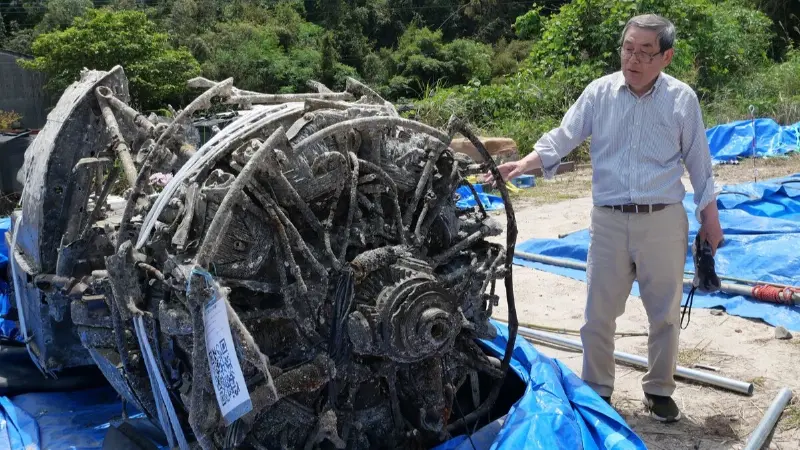


A Kagoshima non-profit organisation plans a permanent display after salvaging the Imperial Japanese Navy aircraft linked to pilot Yoshishige Hayashi.
- A rare Imperial Japanese Navy Shiden Kai fighter has been recovered from the seabed off the coast of Kagoshima, 81 years after it was shot down in the final stages of World War II.
- The complex recovery operation was organized by a local non-profit group, which raised about 8 million yen in public donations to fund the lift.
- The aircraft, one of only two of its kind known to remain in Japan, will be put on permanent display in a new museum to encourage reflection on peace and the war.
A Shiden Kai fighter once operated by the former Imperial Japanese Navy has been brought up from the sea off Akune, Kagoshima Prefecture, 81 years after it sank during World War II.
The Kagoshima non-profit organisation leading the recovery is now preparing a site where the aircraft, shot down in the final stages of the war, can be kept on permanent display.
An official from the organisation said the group wants the aircraft to help both wartime generations and those born later reflect on peace through their own values.
The Shiden Kai was developed late in the war as an advanced successor to the A6M Zero. Armed with four 20mm machine guns, it was known for strong combat capability and manoeuvrability.
The National Museum of the US Air Force describes the model as Japan’s strongest fighter deployed in significant numbers during the war and says it became a serious opponent in the conflict’s closing months.
In Japan, however, the aircraft has also been remembered as “unfortunate” because it entered battle too late to alter the country’s course. Around 400 were built, but most were destroyed by Allied forces after the war.
Apart from the newly salvaged wreck, only one Shiden Kai is known to remain in Japan. That aircraft is displayed in Ainan, a town in Ehime Prefecture.
According to the NPO and others, the recovered fighter was flown by Yoshishige Hayashi, a member of a squadron based at an Imperial Navy air base in Matsuyama, the capital of Ehime.
On April 21, 1945, Hayashi’s aircraft was hit during combat with a US plane over northern Kagoshima. He died in the battle.
Eisuke Himoto, head of the NPO, first heard several years ago from a local antique dealer that an aircraft might be lying somewhere off the Wakimoto coast in Akune.
Although Himoto had doubts at first, the group carried out four underwater surveys. It was later identified as having two machine guns on one wing, a feature that helped confirm the wreck as a Shiden Kai.
After appealing to the public, the organisation raised about 8 million yen in donations between 2024 and 2025 to recover the fighter. It also received messages from bereaved families of squadron members, which Himoto said encouraged him despite uncertainty over whether the aircraft could be salvaged.
One major challenge was the weight. The sunken fighter had become about 9 tonnes, partly because roughly 5 tonnes of sand had flowed into the aircraft while it was underwater.
On April 8, the team spent around six hours lifting the Shiden Kai from the sea. Divers guided the operation to keep the aircraft balanced as it was raised.
Himoto said he was speechless with emotion and felt as though the aircraft was “flying through air” during the recovery.
The NPO is working to create a museum at the former site of an Imperial Navy air base in Izumi, Kagoshima. Around 200 people departed from that base on suicide attack missions during the war.
The salvaged aircraft is expected to go on display at the facility by the end of the year. Himoto said he hopes visitors will look at it and think about war, human beings, sacrifice and love for family.

[Copyright The Jiji Press, Ltd.]
