
Quad ministers deepen energy, minerals and maritime cooperation
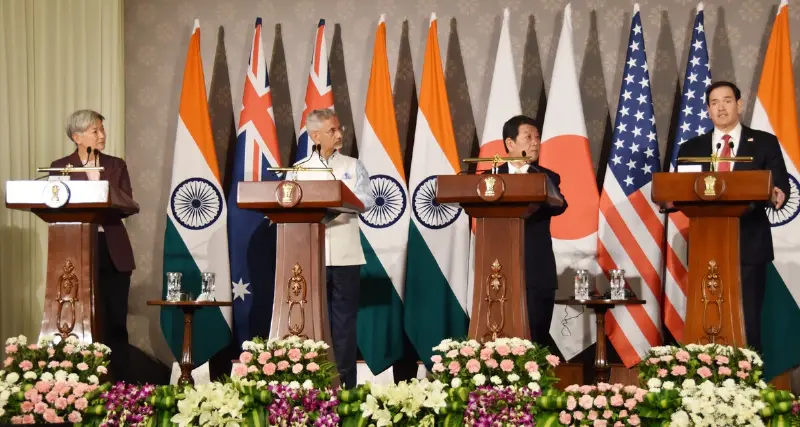


Japan, the US, Australia and India agreed in New Delhi to build a new framework on secure energy and critical-mineral supply chains.
- The Quad ministers established a new framework for cooperation on energy security and critical minerals, aiming to reduce supply-chain risks and curb reliance on China.
- The four nations agreed to advance maritime security cooperation, which includes assisting Fiji with port development to counter China's influence in the South Pacific.
- This expanded cooperation is part of a broader push to realize a "free and open Indo-Pacific" and address concerns over coercive military and economic actions in the region.
The Quad’s foreign ministers left their New Delhi meeting on Tuesday (May 26) with a pledge to expand practical cooperation, but without fixing a date for a leaders’ summit among Japan, the United States, Australia and India.
At the centre of the talks was an agreement to create a new framework on energy security and critical minerals. The plan is designed to deal with supply-chain risks linked to tensions in the Middle East and to curb reliance on China, which holds a dominant position in the critical minerals market.
The meeting was attended by Japanese Foreign Minister Toshimitsu Motegi, US Secretary of State Marco Rubio, Australian Foreign Minister Penny Wong and Indian External Affairs Minister Subrahmanyam Jaishankar.
Motegi told a joint press conference after the talks that he had outlined to the other ministers a new free and open Indo-Pacific initiative drawn up by Japanese Prime Minister Sanae Takaichi.
“Today’s Quad meeting sent an unwavering message that we will strongly advance our practical cooperation to realise a free and open Indo-Pacific region,” Motegi said at the meeting.
The four countries also agreed to maintain their push for maritime security cooperation. Wong said Japan, the US, Australia and India would help Fiji develop ports, an effort apparently aimed at checking China’s growing influence in the South Pacific.
The New Delhi meeting built on the previous Quad foreign ministers’ talks held in Washington in July 2025, when the four countries selected four priority areas for cooperation, including economic security and emerging technologies. This latest round focused on putting those initiatives into motion.
In a joint statement adopted at the meeting, the ministers signalled concern about China’s military and economic pressure without naming Beijing directly. They expressed “serious concerns regarding dangerous and coercive actions” by military aircraft, coast guard vessels and maritime militia vessels.
The timing of a Quad leaders’ meeting remains the main unresolved issue for the grouping. Motegi said, “The four foreign ministers expressed their hope for holding a Quad summit.” No schedule, however, was agreed upon.
A leaders’ meeting had been expected to take place in India last year, but arrangements became difficult after US-India relations worsened under the high-tariff policy of US President Donald Trump’s administration.
Tokyo had hoped Tuesday’s ministerial talks would help create momentum for a summit and keep Trump engaged in Asia, at a time when he appears to be losing interest in the region.
The joint statement stopped short of offering a timeline, saying only: “We look forward to the convening of the Quad leaders’ summit and the next Quad foreign Ministers’ meeting, and continuing our engagements that advance peace, stability and prosperity in the Indo-Pacific and beyond.”
“It would be difficult for a Quad summit to take place within this year,” a Japanese government official said.
Rubio, meanwhile, has continued to attach importance to Asia. He met Indian Prime Minister Narendra Modi in New Delhi on Saturday and invited him to visit the White House in the near future.
India is also pursuing all-around diplomacy, seeking to align not only with Western nations but also with China and Russia. New Delhi hosted a foreign ministers’ meeting of the BRICS group of five emerging countries, including China and Russia, on May 14-15.

[Copyright The Jiji Press, Ltd.]
